


KCET · Maths · Vector Algebra
The diagonals of a parallelogram are the vectors \(3 \hat{\mathbf{i}}+6 \hat{\mathbf{j}}-2 \hat{\mathbf{k}}\). and \(-\hat{\mathbf{i}}-2 \hat{\mathbf{j}}-8 \hat{\mathbf{k}}\). Then the length of the shorter side of parallelogram is
- A \(\sqrt{29}\)
- B \(\sqrt{14}\)
- C \(3 \sqrt{5}\)
- D \(4 \sqrt{3}\)
Answer & Solution
Correct Answer
(A) \(\sqrt{29}\)
Step-by-step Solution
Detailed explanation
Let \(\mathbf{a}\) and \(\mathbf{b}\) be the length of the sides of the parallelogram and \(\mathbf{d}_{1}, \mathbf{d}_{2}\) be the length of diagonals.
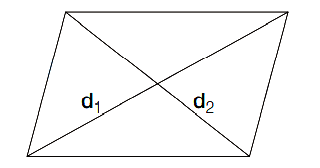
Given, \(\begin{aligned} \mathbf{d}_{1} &=3 \hat{\mathbf{i}}+6 \hat{\mathbf{j}}-2 \hat{\mathbf{k}} \\ \mathbf{d}_{2} &=-\hat{\mathbf{i}}-2 \hat{\mathbf{j}}-8 \hat{\mathbf{k}} \end{aligned}\)
\(\therefore \quad \mathbf{a}=\frac{\mathbf{d}_{1}+\mathbf{d}_{2}}{2}=\frac{2 \hat{\mathbf{i}}+4 \hat{\mathbf{j}}-10 \hat{\mathbf{k}}}{2}=\hat{\mathbf{i}}+2 \hat{\mathbf{j}}-5 \hat{\mathbf{k}}\)
\(\Rightarrow \quad|\mathbf{a}|=\sqrt{1+4+25}=\sqrt{30}\)
and \(\quad \mathbf{b}=\frac{\mathbf{d}_{1}-\mathbf{d}_{2}}{2}=\frac{4 \hat{\mathbf{i}}+8 \hat{\mathbf{j}}+6 \hat{\mathbf{k}}}{2}\)
\(=2 \hat{\mathbf{i}}+4 \hat{\mathbf{j}}+3 \hat{\mathbf{k}}\)
\(\Rightarrow \quad|\mathbf{b}|=\sqrt{4+16+9}=\sqrt{29}\)
Given, \(\begin{aligned} \mathbf{d}_{1} &=3 \hat{\mathbf{i}}+6 \hat{\mathbf{j}}-2 \hat{\mathbf{k}} \\ \mathbf{d}_{2} &=-\hat{\mathbf{i}}-2 \hat{\mathbf{j}}-8 \hat{\mathbf{k}} \end{aligned}\)
\(\therefore \quad \mathbf{a}=\frac{\mathbf{d}_{1}+\mathbf{d}_{2}}{2}=\frac{2 \hat{\mathbf{i}}+4 \hat{\mathbf{j}}-10 \hat{\mathbf{k}}}{2}=\hat{\mathbf{i}}+2 \hat{\mathbf{j}}-5 \hat{\mathbf{k}}\)
\(\Rightarrow \quad|\mathbf{a}|=\sqrt{1+4+25}=\sqrt{30}\)
and \(\quad \mathbf{b}=\frac{\mathbf{d}_{1}-\mathbf{d}_{2}}{2}=\frac{4 \hat{\mathbf{i}}+8 \hat{\mathbf{j}}+6 \hat{\mathbf{k}}}{2}\)
\(=2 \hat{\mathbf{i}}+4 \hat{\mathbf{j}}+3 \hat{\mathbf{k}}\)
\(\Rightarrow \quad|\mathbf{b}|=\sqrt{4+16+9}=\sqrt{29}\)
See the Complete Solution
Get step-by-step explanations for this and 2.5 Lakh+ more JEE, NEET & CET questions.
- Unlock all solutions
- Practice the full chapter
- Track accuracy across PYQs
4.8 rated on Google Play · 14,000+ reviews
More questions from Maths
- \( \sum_{r=1}^{n}(2 r-1)=x \) then
\( \lim _{n \rightarrow \infty}\left[\frac{1^{3}}{x^{2}}+\frac{2^{3}}{x^{2}}+\frac{3^{3}}{\chi^{2}}+\ldots+\frac{n^{3}}{\chi^{2}}\right]= \)KCET 2019 Hard - If \( A=\{x \mid x \in N, x \leq 5\}, B=\left\{x \mid x \in Z, x^{2}-5 x+6=0\right\} \), then the number of onto functions
from \( A \) to \( B \) isKCET 2019 Medium - If \(A=\{1,2,3, \ldots, 10\}\), then number of subsets of \(A\) containing only odd numbers isKCET 2022 Easy
- If \( x^{m} y^{n}=(x+y)^{m+n} \) then \( \frac{d y}{d x} \) is equal toKCET 2016 Hard
- The general solution of \(1+\sin ^{2} x=3 \sin x \cdot \cos x, \tan x \neq \frac{1}{2}\), isKCET 2010 Medium
- The value of \(\int_{0}^{4}|x-1| d x\) isKCET 2011 Easy
More PYQs from KCET
- Which of the following based upon the principle of antigen-antibody interaction?KCET 2024 Hard
- If \(\frac{d y}{d x}+\frac{y}{x}=x^2\), then \(2 y(2)-y(1)=\)KCET 2022 Medium
- Column I lists the parts of the human brain and column II lists the functions. Match the two columns and identify the correct choice from those given.
Column-I Column-II A. Cerebrum p. controls the pituitary B. Cerebellum q. controls vision and hearing C. Hypothalamus r. controls the rate of heart D. Midbrain s. seat of intelligence t. maintains body posture KCET 2005 Easy - Two solid pieces, one of steel and the other of aluminium when immersed completely in water have equal weights. When the solid pieces are weighed in airKCET 2009 Medium
- Two protons are kept at a separation of \(40 Å . F_{n}\) is the nuclear force and \(\mathrm{F}_{\mathrm{e}}\) is the electrostatic force between them. ThenKCET 2008 Easy
- The mass of \(112 \mathrm{~cm}^{3}\) of \(\mathrm{NH}_{3}\) gas at \(\mathrm{STP}\) isKCET 2013 Medium