


KCET · Maths · Sets and Relations
The area of the region bounded by the lines \( y=m x, x=1, x=2 \), and \( x \) axis is \( 6 \) sq. units, then
' \( \mathrm{m} \) ' is
- A \( 11 \)
- B \( 04 \)
- C \( 13 \)
- D \( 12 \)
Answer & Solution
Correct Answer
(B) \( 04 \)
Step-by-step Solution
Detailed explanation
Given that, equation of line \( y=m x, x=1 \) and \( x=2 \)
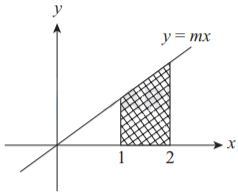
So, required area is given by
\(\text {Area}=\int_{1}^{2} m x d x=6 \)
\( \Rightarrow\left[m \frac{x^{2}}{2}\right]_{1}^{2}=6 \)
\( \Rightarrow m\left(2^{2}-1^{2}\right)=12 \)
\( \Rightarrow 3 m=12 \Rightarrow m=4\)
So, required area is given by
\(\text {Area}=\int_{1}^{2} m x d x=6 \)
\( \Rightarrow\left[m \frac{x^{2}}{2}\right]_{1}^{2}=6 \)
\( \Rightarrow m\left(2^{2}-1^{2}\right)=12 \)
\( \Rightarrow 3 m=12 \Rightarrow m=4\)
See the Complete Solution
Get step-by-step explanations for this and 2.5 Lakh+ more JEE, NEET & CET questions.
- Unlock all solutions
- Practice the full chapter
- Track accuracy across PYQs
4.8 rated on Google Play · 14,000+ reviews
More questions from Maths
- The real part of \( (1-\cos \theta+i \sin \theta)^{-1} \) isKCET 2016 Medium
- The value of \( \lim _{\theta \rightarrow 0} \frac{1-\cos 4 \theta}{1-\cos 6 \theta} \) isKCET 2017 Easy
- The order and degree of the differential equation \(y=\frac{d p}{d x} x=\sqrt{a^{2} p^{2}+b^{2}}, \quad\) where \(\mathrm{p}=\frac{\mathrm{dy}}{\mathrm{dx}}\) (here \(\mathrm{a}\) and \(\mathrm{b}\) are arbitrary constants) respectively areKCET 2010 Easy
- Events \(E_{1}\) and \(E_{2}\) from a partition of the sample space \(S . A\) is any event such that \(P\left(E_{1}\right)=P\left(E_{2}\right)=\frac{1}{2}, P\left(E_{2} / A\right)=\frac{1}{2}\) and \(P\left(A / E_{2}\right)=\frac{2}{3}\), then \(P\left(E_{1} / A\right)\) isKCET 2020 Easy
- If \( f(x)=\left\{\begin{array}{cc}\frac{\sin 3 x}{e^{2 x}-1} & x \neq 0 \\ k-2 & x=0\end{array}\right. \) is continuous at \( x=0 \), then \( k= \)KCET 2019 Medium
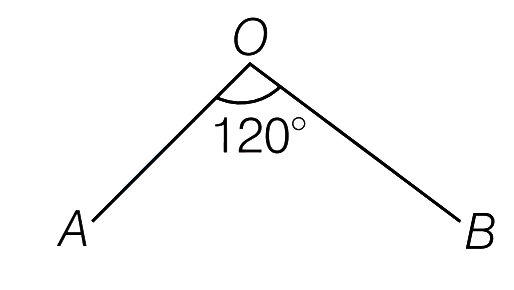
- \(O A\) and \(O B\) are two roads enclosing an angle of \(120^{\circ} . X\) and \(Y\) start from ' \(O\) ' at the same time. \(X\) travels along \(O A\) with a speed of \(4 \mathrm{~km} / \mathrm{h}\) and \(Y\) travels along \(O B\) with a speed of \(3 \mathrm{~km} / \mathrm{h}\). The rate at which the shortest distance between \(X\) and \(Y\) is increasing after \(1 \mathrm{~h}\) is
 KCET 2007 Hard
More PYQs from KCET
- The maximum value of \(\frac{\log _{e} x}{x}\), if \(x>0\) isKCET 2020 Easy
- Pick out the correct statements from the following
I. Electron emission during \(\beta\)-decay is always accompanied by neutrino.
II. Nuclear force is charge independent.
III. Fusion is the chief source of stellar energy.KCET 2013 Easy - If \(\frac{d y}{d x}+\frac{y}{x}=x^2\), then \(2 y(2)-y(1)=\)KCET 2022 Medium
- The conjugate base of \(\mathrm{NH}_{3}\) isKCET 2020 Easy
- In which of the following regions of a nephron does maximum reabsorption of useful substances, takes place?KCET 2005 Easy
- Continuous emission spectrum is produced byKCET 2009 Easy