


KCET · Maths · Area Under Curves
The area bounded between the parabola \(y^{2}=4 x\) and the line \(\mathrm{y}=2 \mathrm{x}-4\) is equal to
- A \(\frac{17}{3}\) sq unit
- B \(\frac{19}{3}\) sq unit
- C 9 sq unit
- D 15 sq unit
Answer & Solution
Correct Answer
(C) 9 sq unit
Step-by-step Solution
Detailed explanation
The point of intersection of \(\mathrm{y}^{2}=4 \mathrm{x}\) and \(y=2 x-4\) is
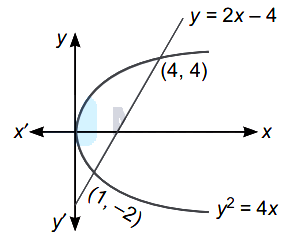
\(\begin{array}{cc} & (2 x-4)^{2}=4 x \\ \Rightarrow & x^{2}-5 x+4=0 \\ \Rightarrow & \quad(x-1)(x-4)=0 \\ \Rightarrow & x=1,4 \\ \Rightarrow & y=-2,4 \\ \therefore \text { Required area } & \\ = & \int_{-2}^{4}\left(\frac{\mathrm{y}+4}{2}\right) \mathrm{dy}-\int_{-2}^{4} \frac{\mathrm{y}^{2}}{4} \mathrm{dy} \\ = & \frac{1}{2}\left[\frac{\mathrm{y}^{2}}{2}+4 \mathrm{y}\right]_{-2}^{4}-\frac{1}{4}\left[\frac{\mathrm{y}^{3}}{3}\right]_{-2}^{4} \\ = & \frac{1}{2}[8+16-(2-8)]-\frac{1}{12}[64+8] \\ = & \frac{1}{2}[30]-\frac{1}{12}(72) \\ = & 15-6=9 \mathrm{sq} \text { unit }\end{array}\)
\(\begin{array}{cc} & (2 x-4)^{2}=4 x \\ \Rightarrow & x^{2}-5 x+4=0 \\ \Rightarrow & \quad(x-1)(x-4)=0 \\ \Rightarrow & x=1,4 \\ \Rightarrow & y=-2,4 \\ \therefore \text { Required area } & \\ = & \int_{-2}^{4}\left(\frac{\mathrm{y}+4}{2}\right) \mathrm{dy}-\int_{-2}^{4} \frac{\mathrm{y}^{2}}{4} \mathrm{dy} \\ = & \frac{1}{2}\left[\frac{\mathrm{y}^{2}}{2}+4 \mathrm{y}\right]_{-2}^{4}-\frac{1}{4}\left[\frac{\mathrm{y}^{3}}{3}\right]_{-2}^{4} \\ = & \frac{1}{2}[8+16-(2-8)]-\frac{1}{12}[64+8] \\ = & \frac{1}{2}[30]-\frac{1}{12}(72) \\ = & 15-6=9 \mathrm{sq} \text { unit }\end{array}\)
See the Complete Solution
Get step-by-step explanations for this and 2.5 Lakh+ more JEE, NEET & CET questions.
- Unlock all solutions
- Practice the full chapter
- Track accuracy across PYQs
4.8 rated on Google Play · 14,000+ reviews
More questions from Maths
- If \( x=c t \) and \( y=\frac{c}{t} \), find \( \frac{d y}{d t} \) at \( t=2 \)KCET 2015 Hard
- If \(A=\left[\begin{array}{ll}\mathrm{k} & 2 \\ 2 & \mathrm{k}\end{array}\right]\) and \(\left|\mathrm{A}^3\right|=125\), then the value of k isKCET 2025 Easy
- If \(\mathrm{f}: \mathrm{R} \rightarrow \mathrm{R}\) is defined by \(\mathrm{f}(\mathrm{x})=\mathrm{x}^{3}\), then \(\mathrm{f}^{-1}(8)\) is equal toKCET 2008 Easy
- If \(\int \frac{d x}{(x+2)\left(x^2+1\right)}=a \log \left|1+x^2\right|+b \tan ^{-1} x\) \(+\frac{1}{5} \log |x+2|+c\), thenKCET 2022 Hard
- If \(\mathbf{a}, \mathbf{b}\) and \(\mathbf{c}\) are non-coplanar, then the value of \(\mathbf{a} \cdot\left\{\frac{\mathbf{b} \times \mathbf{c}}{3 \mathbf{b} \cdot(\mathbf{c} \times \mathbf{a})}\right\}-\mathbf{b} \cdot\left\{\frac{\mathbf{c} \times \mathbf{a}}{2 \mathbf{c} \cdot(\mathbf{a} \times \mathbf{b})}\right\}\) isKCET 2011 Medium
- In \(P(X)\), the power set of a non-empty set \(X\), an binary operation * is defined by \(\mathrm{A}{ }^{*} \mathrm{~B}=\mathrm{A} \cup \mathrm{B}, \forall \mathrm{A}, \mathrm{B} \in \mathrm{P}(\mathrm{x})\) under \(*\), a true statement isKCET 2010 Easy
More PYQs from KCET
- The working of magnetic braking of trains is based onKCET 2017 Medium
- From the graph of angle of deviation versus angle of incidence for an equilateral prism, the refractive index of material of prism is
 KCET 2026 Medium
 - Which of the following electrolytes will have maximum coagulating value for \( \mathrm{Agl} / \mathrm{Ag}^{+} \mathrm{sol} \) ?KCET 2018 Easy
- If \(\overrightarrow{\mathbf{a}}\) and \(\overrightarrow{\mathbf{b}}\) are unit vectors and \(|\overrightarrow{\mathbf{a}}+\overrightarrow{\mathbf{b}}|=1\), then \(|\overrightarrow{\mathbf{a}}-\overrightarrow{\mathbf{b}}|\) is equal toKCET 2008 Medium
- In Prokaryotes the glycocalyx when it is thick is calledKCET 2015 Hard
- If \(\int \frac{\sqrt{x}}{x(x+1)} d x=k \tan ^{-1} m\), then \((k, m)\) isKCET 2010 Easy