


KCET · Maths · Indefinite Integration
If \(\int \frac{d x}{(x+2)\left(x^2+1\right)}=a \log \left|1+x^2\right|+b \tan ^{-1} x\) \(+\frac{1}{5} \log |x+2|+c\), then
- A \(a=\frac{-1}{10}, b=\frac{2}{5}\)
- B \(a=\frac{1}{10}, b=\frac{2}{5}\)
- C \(a=\frac{-1}{10}, b=\frac{-2}{5}\)
- D \(a=\frac{1}{10}, b=\frac{-2}{5}\)
Answer & Solution
Correct Answer
(A) \(a=\frac{-1}{10}, b=\frac{2}{5}\)
Step-by-step Solution
Detailed explanation
Given,
\[
\begin{aligned}
& \int \frac{d x}{(x+2)\left(x^2+1\right)}=a \log \left|1+x^2\right|+b \tan ^{-1} x \\
& +\frac{1}{5} \log |x+2|+c \\
& \text { Let } \frac{1}{(x+2)\left(x^2+1\right)}=\frac{A}{(x+2)}+\frac{B x+C}{\left(x^2+1\right)} \\
& \therefore \quad 1=A\left(x^2+1\right)+(x+2)(B x+C) \\
& 1=A x^2+A+B x^2+C x+2 B x+2 C \\
& 1=(A+B) x^2+x(2 B+C)+A+2 C \\
&
\end{aligned}
\]
Here, \(A+B=0\), ;
\[
2 B+C=0 \text { and } A+2 C=1
\]
On solving them, we get
\[
A=\frac{1}{5}, B=\frac{-1}{5} \text { and } C=\frac{2}{5}
\]
\[
\begin{aligned}
& \text { Therefore, } \int \frac{d x}{(x+2)\left(x^2+1\right)} \\
& =\int\left(\frac{1}{5(x+2)}+\frac{-\frac{5}{5} x+\frac{2}{5}}{x^2+1}\right) d x \\
& =\frac{1}{5} \int \frac{1}{(x+2)} d x-\frac{1}{5} \int \frac{x}{x^2+1} d x+\frac{2}{5} \int \frac{d x}{1+x^2} \\
& =\frac{1}{5} \log |x+2|-\frac{1}{10} \log \left|1+x^2\right|+\frac{2}{5} \tan ^{-1} x+c \\
& =-\frac{1}{10} \log \left(1+x^2\right)+\frac{2}{5} \tan ^{-1} x+\frac{1}{5} \log |x+2|+c \ldots
\end{aligned}
\]
On comparing Eqs. (i) and (ii), we get
\[
a=\frac{-1}{10} \text { and } b=\frac{2}{5}
\]
\[
\begin{aligned}
& \int \frac{d x}{(x+2)\left(x^2+1\right)}=a \log \left|1+x^2\right|+b \tan ^{-1} x \\
& +\frac{1}{5} \log |x+2|+c \\
& \text { Let } \frac{1}{(x+2)\left(x^2+1\right)}=\frac{A}{(x+2)}+\frac{B x+C}{\left(x^2+1\right)} \\
& \therefore \quad 1=A\left(x^2+1\right)+(x+2)(B x+C) \\
& 1=A x^2+A+B x^2+C x+2 B x+2 C \\
& 1=(A+B) x^2+x(2 B+C)+A+2 C \\
&
\end{aligned}
\]
Here, \(A+B=0\), ;
\[
2 B+C=0 \text { and } A+2 C=1
\]
On solving them, we get
\[
A=\frac{1}{5}, B=\frac{-1}{5} \text { and } C=\frac{2}{5}
\]
\[
\begin{aligned}
& \text { Therefore, } \int \frac{d x}{(x+2)\left(x^2+1\right)} \\
& =\int\left(\frac{1}{5(x+2)}+\frac{-\frac{5}{5} x+\frac{2}{5}}{x^2+1}\right) d x \\
& =\frac{1}{5} \int \frac{1}{(x+2)} d x-\frac{1}{5} \int \frac{x}{x^2+1} d x+\frac{2}{5} \int \frac{d x}{1+x^2} \\
& =\frac{1}{5} \log |x+2|-\frac{1}{10} \log \left|1+x^2\right|+\frac{2}{5} \tan ^{-1} x+c \\
& =-\frac{1}{10} \log \left(1+x^2\right)+\frac{2}{5} \tan ^{-1} x+\frac{1}{5} \log |x+2|+c \ldots
\end{aligned}
\]
On comparing Eqs. (i) and (ii), we get
\[
a=\frac{-1}{10} \text { and } b=\frac{2}{5}
\]
See the Complete Solution
Get step-by-step explanations for this and 2.5 Lakh+ more JEE, NEET & CET questions.
- Unlock all solutions
- Practice the full chapter
- Track accuracy across PYQs
4.8 rated on Google Play · 14,000+ reviews
More questions from Maths
- Foot of perpendicular drawn from the origin to the plane \( 2 x-3 y+4 z=29 \) isKCET 2015 Easy
- The vertices of a triangle are \((6,0),(0,6)\) and \((6,6)\). The distance between its circumcentre and centroid isKCET 2009 Medium
- The equation of the normal to the hyperbola \(\frac{x^{2}}{16}-
\frac{y^{2}}{9}=1\) at \((-4,0)\) isKCET 2008 Medium - The function \(f(x)=x^{2}-2 x\) is strictly decreasing in the intervalKCET 2021 Easy
- If a plane meets the coordinate axes at \(A, B\) and \(C\) in such a way that the centroid of \(\triangle A B C\) is at the point \((1,2,3)\), then the equation of the plane isKCET 2021 Easy
- If \(y=\sin x \cdot \sin 2 x \cdot \sin 3 x \ldots \sin n x\), then \(y^{\prime}\) isKCET 2011 Medium
More PYQs from KCET
- The diagram given below represents the history of a striped muscle. Label the parts A, B, C, D, E and F.
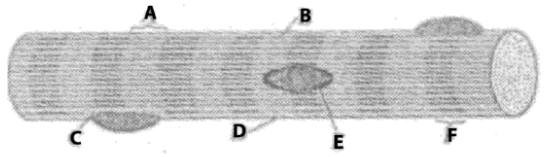 KCET 2011 Easy
 - If \( x y z \) are not equal and \( \neq 0, \neq 1 \) the value of \( \left|\begin{array}{ccc}\log x & \log y & \log z \\ \log 2 x & \log 2 y & \log 2 z \\ \log 3 x & \log 3 y & \log 3 z\end{array}\right| \) is equal toKCET 2016 Medium
- The total energy stored in the condenser system shown in the figure will be
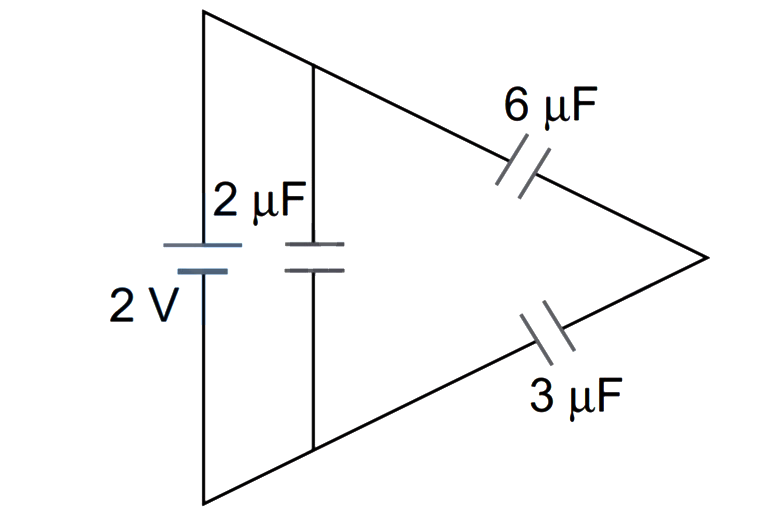 KCET 2008 Hard
 - The IUPAC name of
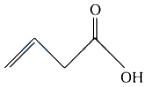
isKCET 2011 Easy - You are given a dipole of charge \(+q\) and \(-q\) separated by a distance 2R. A sphere 'A' of radius ' \(R\) ' passes through the centre of the dipole as shown below and another sphere ' \(B\) ' of radius ' \(2 R\) ' passes through the charge +q . Then the electric flux through the sphere \(A\) is
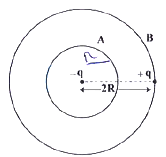 KCET 2025 Easy
 - A box contains \( 6 \) red marbles numbers from \( 1 \) through \( 6 \) and \( 4 \) white marbles \( 12 \) through \( 15 . \)
Find the probability that a marble drawn 'at random' is white and odd numbered.KCET 2015 Easy