


KCET · Maths · Continuity and Differentiability
\(f(x)= \begin{cases}2 a-x & \text { in }-a < x < a \\ 3 x-2 a & \text { in } a \leq x\end{cases}\)
Then, which of the following is true ?
- A \(f(x)\) is discontinuous at \(x=a\)
- B \(f(x)\) is not differentiable at \(x=a\)
- C \(f(x)\) is differentiable at \(x \geq a\)
- D \(f(x)\) is continuous at all \(x < a\)
Answer & Solution
Correct Answer
(B) \(f(x)\) is not differentiable at \(x=a\)
Step-by-step Solution
Detailed explanation
Given, \(\quad \mathrm{f}(\mathrm{x})=\left\{\begin{array}{llc}2 \mathrm{a}-\mathrm{x} & \text { in } & -a < x < a \\ 3 \mathrm{x}-2 \mathrm{a} & \text { in } & \mathrm{a} \leq \mathrm{x}\end{array}\right.\) At \(x=a\) \(\mathrm{LHL}=\lim _{\mathrm{x} \rightarrow \mathrm{a}^{-}} \mathrm{f}(\mathrm{x})\) \( =\lim _{x \rightarrow a} 2 a-x=a \) \( \begin{aligned} \mathrm{RHL} &=\lim _{\mathrm{x} \rightarrow \mathrm{a}^{+}} \mathrm{f}(\mathrm{x}) \\ &=\lim _{\mathrm{x} \rightarrow \mathrm{a}} 3 \mathrm{x}-2 \mathrm{a}=\mathrm{a} \end{aligned} \) and \(\quad \mathrm{f}(\mathrm{a})=3(\mathrm{a})-2 \mathrm{a}=\mathrm{a}\) \(\therefore \quad \mathrm{LHL}=\mathrm{RHL}=\mathrm{f}(\mathrm{a})\) Hence, it is continuous at \(\mathrm{x}=\mathrm{a}\) Again, at \(x=a\) \( \begin{aligned} \mathrm{LHD} &=\lim _{\mathrm{h} \rightarrow 0} \frac{\mathrm{f}(\mathrm{a}-\mathrm{h})-\mathrm{f}(\mathrm{a})}{-\mathrm{h}} \\ &=\lim _{\mathrm{h} \rightarrow 0} \frac{2 \mathrm{a}-(\mathrm{a}-\mathrm{h})-\mathrm{a}}{-\mathrm{h}}=\frac{\mathrm{h}}{-\mathrm{h}}=-1 \end{aligned} \) \( \text { and } \begin{aligned} \mathrm{RHD}=& \lim _{\mathrm{h} \rightarrow 0} \frac{\mathrm{f}(\mathrm{a}+\mathrm{h})-\mathrm{f}(\mathrm{a})}{h} \\ =& \lim _{\mathrm{h} \rightarrow 0} \frac{3(\mathrm{a}+\mathrm{h})-2 \mathrm{a}-\mathrm{a}}{\mathrm{h}}=3 \\ & \mathrm{LHD} \neq \mathrm{RHD} \end{aligned} \) Hence, it is not differentiable at \(\mathrm{x}=\mathrm{a}\). Alternate Solution Let \(y=f(x)= \begin{cases}2 a-x & \text { in }-a < x < a \\ 3 x-2 a & \text { in } \quad a \leq x\end{cases}\)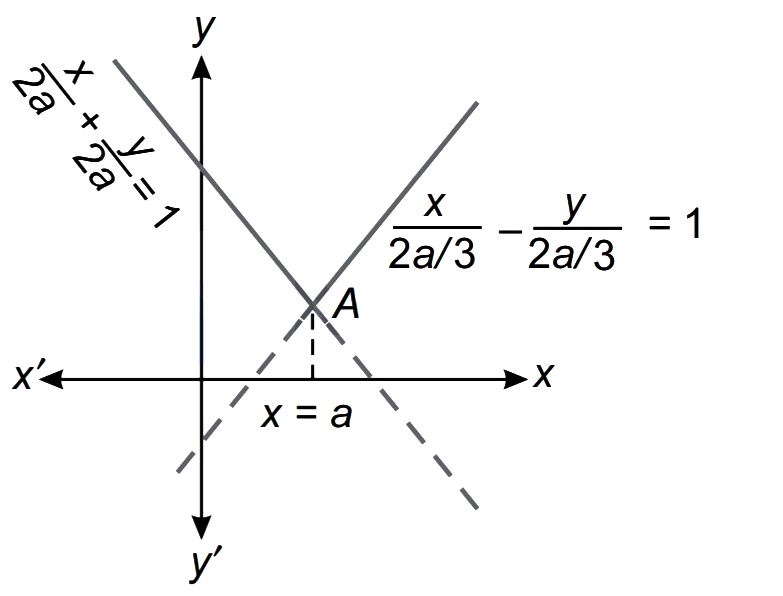 It is clear from the graph that \(\mathrm{f}(\mathrm{x})\) is continuous everywhere it is also differentiable everywhere except a point \(\mathrm{A}\) at \(\mathrm{x}=\mathrm{a}\).
It is clear from the graph that \(\mathrm{f}(\mathrm{x})\) is continuous everywhere it is also differentiable everywhere except a point \(\mathrm{A}\) at \(\mathrm{x}=\mathrm{a}\).See the Complete Solution
Get step-by-step explanations for this and 2.5 Lakh+ more JEE, NEET & CET questions.
- Unlock all solutions
- Practice the full chapter
- Track accuracy across PYQs
4.8 rated on Google Play · 14,000+ reviews
More questions from Maths
- A simple graph contains 24 edges. Degree of each vertex is 3 . The number of vertices isKCET 2010 Easy
- The angle between the lines whose direction cosines are \(\left(\frac{\sqrt{3}}{4}, \frac{1}{4}, \frac{\sqrt{3}}{2}\right)\) and \(\left(\frac{\sqrt{3}}{4}, \frac{1}{4}, \frac{-\sqrt{3}}{2}\right)\) isKCET 2021 Easy
- If \(\mathbf{a} \perp \mathbf{b}\) and \((\mathbf{a}+\mathbf{b}) \perp(\mathbf{a}+m \mathbf{b})\), then \(m\) is equal toKCET 2013 Easy
- For the function \(f(x)=x^3-6 x^2+12 x-3\) \(x=2\) isKCET 2024 Easy
- If \( y=\left(\tan ^{-1} x\right)^{2} \), then \( \left(x^{2}+1\right)^{2} y_{2}+2 x\left(x^{2}+1\right) y_{1} \) is equal toKCET 2014 Easy
- The value of \( \sqrt{24.99} \) isKCET 2019 Medium
More PYQs from KCET
- Choose the correct combination of labelling the molecules involved in the pathway of anerobic respiration in Yeast.
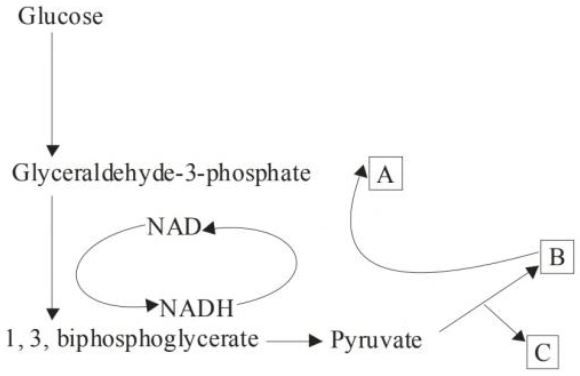 KCET 2015 Hard
 - At \(27^{\circ} \mathrm{C}\) temperature, the mean kinetic energy of the atoms of an ideal gas is \(\mathrm{E}_1\). If the temperature is increased to \(327^{\circ} \mathrm{C}\), then the mean kinetic energy of the atoms will beKCET 2025 Easy
- Light of wavelength \( 600 \mathrm{~nm} \) is incident normally on a slit of width \( 0.2 \mathrm{~mm} \). The angular width of
central maxima in the diffraction pattern is (measured from minimum to minimum)KCET 2016 Medium - The magnetic dipole moment of a current loop is independent ofKCET 2009 Easy
- If \(\alpha, \beta\) and \(\gamma\) are roots of \(x^{3}-2 x+1=0\), then the value of \(\sum\left(\frac{1}{\alpha+\beta-\gamma}\right)\) isKCET 2011 Medium
- \( \cos \left[2 \sin ^{-1} \frac{3}{4}+\cos ^{-1} \frac{3}{4}\right] \)KCET 2019 Easy