


KCET · Maths · Vector Algebra
If \(\overrightarrow{\mathbf{a}}+2 \overrightarrow{\mathbf{b}}+3 \overrightarrow{\mathbf{c}}=\overrightarrow{\mathbf{0}}\), then \(\overrightarrow{\mathbf{a}} \times \overrightarrow{\mathbf{b}}+\overrightarrow{\mathbf{b}} \times \overrightarrow{\mathbf{c}}+\overrightarrow{\mathbf{c}} \times \overrightarrow{\mathbf{a}}\) is equal to
- A \(2(\vec{b} \times \overrightarrow{\mathbf{c}})\)
- B \(3(\overrightarrow{\mathbf{c}} \times \overrightarrow{\mathbf{a}})\)
- C \(\overrightarrow{\mathbf{0}}\)
- D \(6(\overrightarrow{\mathbf{b}} \times \overrightarrow{\mathbf{c}})\)
Answer & Solution
Correct Answer
(D) \(6(\overrightarrow{\mathbf{b}} \times \overrightarrow{\mathbf{c}})\)
Step-by-step Solution
Detailed explanation
Given, \(\quad \overrightarrow{\mathbf{a}}+2 \overrightarrow{\mathbf{b}}+3 \overrightarrow{\mathbf{c}}=\overrightarrow{\mathbf{0}}
\quad \text{...(i)}\)
Taking cross product with \(\overrightarrow{\mathbf{b}}\), we get
\(\overrightarrow{\mathbf{a}} \times \overrightarrow{\mathbf{b}}+2 \overrightarrow{\mathbf{b}} \times \overrightarrow{\mathbf{b}}+3 \overrightarrow{\mathbf{c}} \times \overrightarrow{\mathbf{b}}=\overrightarrow{\mathbf{0}} \times \overrightarrow{\mathbf{b}}\)
\(\Rightarrow \quad \overrightarrow{\mathbf{a}} \times \overrightarrow{\mathbf{b}}=3 \overrightarrow{\mathbf{b}} \times \overrightarrow{\mathbf{c}}\)
Again taking cross product with \(\overrightarrow{\mathbf{c}}\) of Eq. (i), we get
\[
\overrightarrow{\mathbf{a}} \times \overrightarrow{\mathbf{c}}+2 \overrightarrow{\mathbf{b}} \times \overrightarrow{\mathbf{c}}+3 \overrightarrow{\mathbf{c}} \times \overrightarrow{\mathbf{c}}=\overrightarrow{\mathbf{0}} \times \overrightarrow{\mathbf{c}}
\]
\(\Rightarrow \quad \overrightarrow{\mathbf{c}} \times \overrightarrow{\mathbf{a}}=2 \overrightarrow{\mathbf{b}} \times \overrightarrow{\mathbf{c}}\)
\(\therefore \quad \overrightarrow{\mathbf{a}} \times \overrightarrow{\mathbf{b}}+\overrightarrow{\mathbf{b}} \times \overrightarrow{\mathbf{c}}+\overrightarrow{\mathbf{c}} \times \overrightarrow{\mathbf{a}}\)
\(=3 \overrightarrow{\mathbf{b}} \times \overrightarrow{\mathbf{c}}+\overrightarrow{\mathbf{b}} \times \overrightarrow{\mathbf{c}}+2 \overrightarrow{\mathbf{b}} \times \overrightarrow{\mathbf{c}}\)
\(=6(\overrightarrow{\mathbf{b}} \times \overrightarrow{\mathbf{c}})\)
\quad \text{...(i)}\)
Taking cross product with \(\overrightarrow{\mathbf{b}}\), we get
\(\overrightarrow{\mathbf{a}} \times \overrightarrow{\mathbf{b}}+2 \overrightarrow{\mathbf{b}} \times \overrightarrow{\mathbf{b}}+3 \overrightarrow{\mathbf{c}} \times \overrightarrow{\mathbf{b}}=\overrightarrow{\mathbf{0}} \times \overrightarrow{\mathbf{b}}\)
\(\Rightarrow \quad \overrightarrow{\mathbf{a}} \times \overrightarrow{\mathbf{b}}=3 \overrightarrow{\mathbf{b}} \times \overrightarrow{\mathbf{c}}\)
Again taking cross product with \(\overrightarrow{\mathbf{c}}\) of Eq. (i), we get
\[
\overrightarrow{\mathbf{a}} \times \overrightarrow{\mathbf{c}}+2 \overrightarrow{\mathbf{b}} \times \overrightarrow{\mathbf{c}}+3 \overrightarrow{\mathbf{c}} \times \overrightarrow{\mathbf{c}}=\overrightarrow{\mathbf{0}} \times \overrightarrow{\mathbf{c}}
\]
\(\Rightarrow \quad \overrightarrow{\mathbf{c}} \times \overrightarrow{\mathbf{a}}=2 \overrightarrow{\mathbf{b}} \times \overrightarrow{\mathbf{c}}\)
\(\therefore \quad \overrightarrow{\mathbf{a}} \times \overrightarrow{\mathbf{b}}+\overrightarrow{\mathbf{b}} \times \overrightarrow{\mathbf{c}}+\overrightarrow{\mathbf{c}} \times \overrightarrow{\mathbf{a}}\)
\(=3 \overrightarrow{\mathbf{b}} \times \overrightarrow{\mathbf{c}}+\overrightarrow{\mathbf{b}} \times \overrightarrow{\mathbf{c}}+2 \overrightarrow{\mathbf{b}} \times \overrightarrow{\mathbf{c}}\)
\(=6(\overrightarrow{\mathbf{b}} \times \overrightarrow{\mathbf{c}})\)
See the Complete Solution
Get step-by-step explanations for this and 2.5 Lakh+ more JEE, NEET & CET questions.
- Unlock all solutions
- Practice the full chapter
- Track accuracy across PYQs
4.8 rated on Google Play · 14,000+ reviews
More questions from Maths
- If the vector \( a \hat{i}+\hat{j}+\hat{k}, \hat{i}+b \hat{j}+\hat{k} \) and \( \hat{i}+\hat{j}+c \hat{k} \) are colpanar \( (a \neq b \neq c \neq 1) \), then
the value of \( a b c-(a+b+c)= \)KCET 2018 Easy - Let \(f:[2, \infty) \rightarrow R\) be the function defined \(f(x)=x^{2}-4 x+5\), then the ranges of \(f\) isKCET 2020 Medium
- \( \lim _{x \rightarrow 0} \frac{x e^{x}-\sin x}{x} \) is equal toKCET 2016 Easy
- \( \int_{0}^{\frac{\pi}{2}} \frac{\sin ^{1000} x d x}{\sin ^{1000} x+\cos ^{1000} x} \) is equal toKCET 2016 Easy
- If \(\mathrm{x} \neq \mathrm{n} \pi, \mathrm{x} \neq(2 \mathrm{n}+1) \frac{\pi}{2}, \mathrm{n} \in \mathrm{Z}, \quad\) then \(\frac{\sin ^{-1}(\cos x)+\cos ^{-1}(\sin x)}{\tan ^{-1}(\cot x)+\cot ^{-1}(\tan x)}\) isKCET 2010 Hard
- The perpendicular distance of the point \( P(6,7,8) \) from \( X Y \) - plane isKCET 2017 Medium
More PYQs from KCET
- The gene for haemophilia is located on 'X' chromosome. Hence it is normally impossible for aKCET 2016 Easy
- Current in a coil changes from \(4 \mathrm{~A}\) to zero in \(0.1 \mathrm{~s}\) and the emf induced is \(100 \mathrm{~V}\). The self inductance of the coil isKCET 2007 Easy
- The magnetic flux linked with a coil varies as \( \phi=3 t^{2}+4 t+9 . \) The magnitude of the emf
induced at \( t=2 \) seconds isKCET 2018 Easy - The rate constant of a reaction is given by \(k=P Z e^{-E_{a} / R T}\) under standard notation. In order to speed up the reaction, which of the following factors has to be decreased?KCET 2020 Hard
- A uniform electric field vector \(\mathbf{E}\) exists along horizontal direction as shown. The electric potential at \(A\) is \(V_A\). A small point charge \(q\) is slowly taken from \(A\) to \(B\) along the curved path as shown. The potential energy of the charge when it is at point \(B\) is
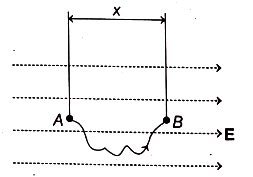 KCET 2023 Medium
 - The shape of \( X e F_{6} \) is,KCET 2016 Easy