


KCET · Maths · Sets and Relations
Let the relation \(R\) is defined in \(N\) by \(a R b\), if \(3 a+2 b=27\) then \(R\) is
- A \(\{(1,12)(3,9)(5,6)(7,3)\}\)
- B \(\left\{\left(0, \frac{27}{2}\right)(1,12)(3,9)(5,6)(7,3)\right\}\)
- C \(\{(1,12)(3,9)(5,6)(7,3)(9,0)\}\)
- D \(\{(2,1)(9,3)(6,5)(3,7)\}\)
Answer & Solution
Correct Answer
(A) \(\{(1,12)(3,9)(5,6)(7,3)\}\)
Step-by-step Solution
Detailed explanation
Given relation is \(3 a+2 b=27\), where \(a, b \in N\)
\[
\begin{aligned}
& 3 a+2 b=27 \\
& \Rightarrow \quad b=\frac{27-3 a}{2} \\
& a=1 \Rightarrow b=\frac{27-3}{2}=\frac{24}{2}=12 \\
& a=3 \Rightarrow b=\frac{27-9}{2}=\frac{18}{2}=9 \\
& a=5 \Rightarrow b=\frac{27-15}{2}=\frac{12}{2}=6 \\
& a=7 \Rightarrow b=\frac{27-21}{2}=\frac{6}{2}=3
\end{aligned}
\]
Hence, we can see that all the elements of option (a) satisfies the given relation. Hence, option (a) is correct.
\[
\begin{aligned}
& 3 a+2 b=27 \\
& \Rightarrow \quad b=\frac{27-3 a}{2} \\
& a=1 \Rightarrow b=\frac{27-3}{2}=\frac{24}{2}=12 \\
& a=3 \Rightarrow b=\frac{27-9}{2}=\frac{18}{2}=9 \\
& a=5 \Rightarrow b=\frac{27-15}{2}=\frac{12}{2}=6 \\
& a=7 \Rightarrow b=\frac{27-21}{2}=\frac{6}{2}=3
\end{aligned}
\]
Hence, we can see that all the elements of option (a) satisfies the given relation. Hence, option (a) is correct.
See the Complete Solution
Get step-by-step explanations for this and 2.5 Lakh+ more JEE, NEET & CET questions.
- Unlock all solutions
- Practice the full chapter
- Track accuracy across PYQs
4.8 rated on Google Play · 14,000+ reviews
More questions from Maths
- \( f(x)=\left\{\begin{array}{cl}3 x-8 & \text { if } x \leq 5 \\ 2 k & \text { if } x>5\end{array}\right. \) is continuous, find \( k . \)KCET 2015 Hard
- The point \((1,-3,4)\) lies in the octantKCET 2020 Medium
- The second order derivative of \(\cos^{-1}(4x^3 - 3x)\) with respect to \(\cos^{-1}(2x^2 - 1)\), where \(\dfrac{1}{2} < x < 1\) isKCET 2026 Medium
- Find the co-ordinates of the foot of the perpendicular drawn from the origin to the plane \( 5 y+8 \)
\( =0 \) :KCET 2016 Hard - If \( y=\left(\tan ^{-1} x\right)^{2} \), then \( \left(x^{2}+1\right)^{2} y_{2}+2 x\left(x^{2}+1\right) y_{1} \) is equal toKCET 2014 Easy
- \(\frac{1}{2 \cdot 5}+\frac{1}{5 \cdot 8}+\frac{1}{8 \cdot 11}+\ldots \frac{1}{(3 n-1)(3 n+2)}\) is equal toKCET 2007 Hard
More PYQs from KCET
- A particle starts from rest. Its acceleration \(a\) versus time \(t\) is shown in the figure. The maximum speed of the particle will be
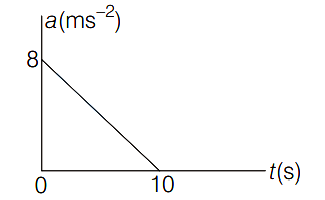 KCET 2021 Hard
 - An object approaches a convergent lens from the left of the lens with a uniform speed \(5 \mathrm{~m} / \mathrm{s}\) and stops at the focus, the imageKCET 2020 Hard
- \(\int \frac{\sin \frac{5 x}{2}}{\sin \frac{x}{2}} d x\) isKCET 2024 Hard
- Let \( f: R \rightarrow R \) be defined by \( f(x)=x^{4} \), thenKCET 2017 Hard
- Mercury is a liquid metal becauseKCET 2008 Easy
- Match the following Column I with Column II.
Select the code for the correct answer from the options given below.Column I Column II (A) Surgical methods (p) Condom (B) Barrier methods (q) Pills (C) Natural methods (r) Tubectomy (D) Chemical methods (s) Lactational amenorrhea KCET 2018 Medium