


KCET · Maths · Differential Equations
Let \( f: N \rightarrow N \) defined by \( f(n)=\left\{\begin{array}{cl}\frac{n+1}{2} ; & \text { if } n \text { is odd } \\ \frac{n}{2} ; & \text { if } n \text { is even }\end{array}\right. \)
then \( \mathrm{f} \) is
- A one-one and onto
- B one-one but not onto
- C onto but not one-one
- D neither one-one nor onto
Answer & Solution
Correct Answer
(C) onto but not one-one
Step-by-step Solution
Detailed explanation
Given that, \( f: N \rightarrow N \) defined by
\( f(n)=\left\{\begin{array}{cc}\frac{n+1}{2} & n \text { is odd } \\ \frac{n}{2} & n \text { is even }\end{array}\right. \)
For \( n=1 \), we have \( f(1)=\frac{1+1}{2}=1 \)
and, if \( n=2 \), we have \( f(2)=\frac{2}{2}=1 \)
So, \( f(1)=f(2) \) but \( 1 \neq 2 \). Therefore, \( f(x) \) is not one-one.
Now, \( f(x)=\frac{n+1}{2} \) if \( \mathrm{n} \) is odd
if \( y=\frac{n+1}{2} \), then \( n=2 y-1, \forall y \)
Also, \( f(x)=\frac{n}{2} \) if \( n \) is even. That is,
\( y=\frac{n}{2} \) or \( n=2 y, \forall y \)
Therefore, \( f(x) \) is onto.
\( f(n)=\left\{\begin{array}{cc}\frac{n+1}{2} & n \text { is odd } \\ \frac{n}{2} & n \text { is even }\end{array}\right. \)
For \( n=1 \), we have \( f(1)=\frac{1+1}{2}=1 \)
and, if \( n=2 \), we have \( f(2)=\frac{2}{2}=1 \)
So, \( f(1)=f(2) \) but \( 1 \neq 2 \). Therefore, \( f(x) \) is not one-one.
Now, \( f(x)=\frac{n+1}{2} \) if \( \mathrm{n} \) is odd
if \( y=\frac{n+1}{2} \), then \( n=2 y-1, \forall y \)
Also, \( f(x)=\frac{n}{2} \) if \( n \) is even. That is,
\( y=\frac{n}{2} \) or \( n=2 y, \forall y \)
Therefore, \( f(x) \) is onto.
See the Complete Solution
Get step-by-step explanations for this and 2.5 Lakh+ more JEE, NEET & CET questions.
- Unlock all solutions
- Practice the full chapter
- Track accuracy across PYQs
4.8 rated on Google Play · 14,000+ reviews
More questions from Maths
- If \(A=\left\{x: x\right.\) is an integer and \(\left.x^2-9=0\right\}\)
\(B=\{x: x\) is a natural number and \(2 \leq x \lt 5\}\)
\(\mathrm{C}=\{\mathrm{x}: \mathrm{x}\) is a prime number \(\leq 4\}\)
Then \((B-C) \cup A\) is,KCET 2025 Easy - Two dice are thrown simultaneously. The probability of obtaining a total score of \( 5 \) isKCET 2014 Easy
- The converse of the contrapositive of the conditional \(\mathrm{p} \rightarrow \sim \mathrm{q}\) isKCET 2008 Easy
- The distance of the focus of \(x^{2}-y^{2}=4\), form the directrix which is nearer to it, isKCET 2010 Easy
- \( \int e^{x}\left(\frac{1+\sin x}{1+\cos x}\right) d x \) isKCET 2015 Easy
- The shaded region in the figure given is the solution of which of the inequations?
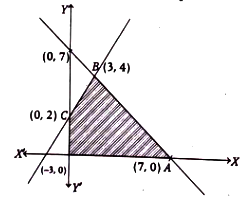 KCET 2023 Easy
More PYQs from KCET
- The kinetic energy of the photoelectrons increases by \(0.52 \mathrm{eV}\) when the wavelength of incident light is changed from \(500 \mathrm{~nm}\) to another wavelength which is approximatelyKCET 2022 Medium
- Identify the incorrect statement with respect to the rules of Binomial Nomenclature.KCET 2025 Easy
- The susceptibility of a ferromagnetic substance isKCET 2017 Medium
- A childless couple visit Assisted Reproductive Technologies (ARTs) centre to get assistance to have a child. On diagnosis, it was noticed that there was low sperm count in the male partner. Which of the following strategy of ART is most suitable in this case?KCET 2019 Medium
- Identify the logic operation carried out by the following circuit.
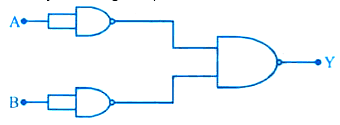 KCET 2016 Easy
 - A stone is thrown vertically at a speed of \( 30 \mathrm{~ms}^{-1} \) making an angle of \( 45^{\circ} \) with the horizontal.
What is the maximum height reached by the stone? Take \( g=10 \mathrm{~ms}^{-2} \).KCET 2014 Easy