


KCET · Maths · Functions
Let \(A=\{x: x \in R, x\) is not a positive integer \()\) Define \(f: A \rightarrow R\) as \(f(x)=\frac{2 x}{x-1}\), then \(f\) is
- A injective but not surjective.
- B surjective but not injective.
- C bijective.
- D neither injective nor surjective.
Answer & Solution
Correct Answer
(A) injective but not surjective.
Step-by-step Solution
Detailed explanation
Given function,
\(f(x)=\frac{2 x}{x-1}\)
On differentiating w.r.t. \(x\), we get
\(\begin{aligned}
f^{\prime}(x) &=\frac{(x-1)(2)-2 x(1-0)}{(x-1)^{2}} \\
&=\frac{2 x-2-2 x}{(x-1)^{2}}=\frac{-2}{(x-1)^{2}} < 0
\end{aligned}\)
Function is strictly decreasing.
Function is injective
\(\frac{2 x}{x-1}=y \Rightarrow 2 x=y x-y\)
\(\Rightarrow \quad y=x(y-2)\)
Let \(\quad x=\frac{y}{y-2} \notin \pi\) for \(y=2\)
\(f\) is not surjective.
\(f(x)=\frac{2 x}{x-1}\)
On differentiating w.r.t. \(x\), we get
\(\begin{aligned}
f^{\prime}(x) &=\frac{(x-1)(2)-2 x(1-0)}{(x-1)^{2}} \\
&=\frac{2 x-2-2 x}{(x-1)^{2}}=\frac{-2}{(x-1)^{2}} < 0
\end{aligned}\)
Function is strictly decreasing.
Function is injective
\(\frac{2 x}{x-1}=y \Rightarrow 2 x=y x-y\)
\(\Rightarrow \quad y=x(y-2)\)
Let \(\quad x=\frac{y}{y-2} \notin \pi\) for \(y=2\)
\(f\) is not surjective.
See the Complete Solution
Get step-by-step explanations for this and 2.5 Lakh+ more JEE, NEET & CET questions.
- Unlock all solutions
- Practice the full chapter
- Track accuracy across PYQs
4.8 rated on Google Play · 14,000+ reviews
More questions from Maths
- If \( \vec{a} \) and \( \vec{b} \) are unit vectors then what is the angle between \( \vec{a} \) and \( \vec{b} \) for \( \sqrt{3} \vec{a}-\vec{b} \) to be unit
vector?KCET 2016 Medium - If lines represented by \(x+3 y-6=0\), \(2 x+y-4=0\) and \(k x-3 y+1=0\) are concurrent, then the value of \(k\) isKCET 2011 Easy
- Mean and standard deviation of \( 100 \) items are \( 50 \) and \( 4 \) respectively. The sum of all squares of
the items isKCET 2019 Medium - A graph \(G\) has ' \(m\) ' vertices of odd degree and ' \(n\) ' vertices of even degree. Then which of the following statements is necessarily true?KCET 2007 Medium
- If the circles \(x^{2}+y^{2}=9\) and \(x^{2}+y^{2}+2 \alpha x+2 y+1=0\) touch each other internally, then \(\alpha\) is equal toKCET 2008 Hard
- If
\(f(x)=\left\{\begin{array}{cl}\frac{\left.x^{2}-(a+2) x+a\right)}{x-2} & x \neq 2 \\ 2 & , x=2\end{array} \quad\right.\) is continuous at \(x=2\), then the value of \(a\) isKCET 2012 Easy
More PYQs from KCET
- The variation of terminal potential difference \( (V) \) with current flowing through as cell is as
shown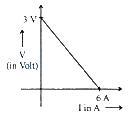
The emf and internal resistance of the cell areKCET 2019 Easy - Match the hormones of Column I with its function in Column II.
Column-I Column-II A. Catecholamines (i) Diurnal rhythm B. MSH (ii) Immune response C. Thymosins (iii) Pigmentation D. Melatonin (iv) Stress hormone KCET 2021 Easy - Match the organic compounds listed under Column-I with the explanation given under Column-II. Choose the appropriate option from the given choices.
Column-I Column-II A. Phosphoenol pyruvate (PEP) p. 6-carbon compound B. Ribulose biphosphate (RuBP) q. 2-carbon compound C. Oxaloacetic acid (OAA) r. 4-carbon compound D. Acetyl coenzymeA s. 5-carbon compound t. 3-carbon compound KCET 2014 Medium - A strong magnetic field is applied on a stationary electron. Then, the electronKCET 2021 Easy
- Binary operation * on \( R-\{-1\} \) defined by
\( a^{*} b=\frac{a}{b+1} \) isKCET 2017 Easy - In the following pairs, the one in which both transition metal ions are colourless isKCET 2025 Medium