


KCET · Maths · Mathematical Reasoning
In \(\quad\) Ine \(\quad(Z, *), \quad\) if \(a^{*} b=a+b-n, \forall a, b \in Z, \quad\) where \(n\) is a fixed integer, then the inverse of \((-n)\) is
- A \(n\)
- B \(-n\)
- C \(-3 n\)
- D \(3 n\)
Answer & Solution
Correct Answer
(D) \(3 n\)
Step-by-step Solution
Detailed explanation
Given,
In a group \(\left(Z,{ }^{*}\right)\)
\(a^{*} b=a+b-n, \forall a_{1}, b \in z...(i)\)
where, \(n\) is a fixed number
\(\begin{array}{llr}\therefore & a^{*} e=a & \\ \Rightarrow & a+e-n=a \quad \text { [from Eq. (i)] } \\ \Rightarrow & e=n & \text { (identity) }\end{array}\)
For finding inverse,
\(\alpha^{*}(-n)=n\)
\(\Rightarrow \quad \alpha-n-(-n)=n \quad\) [from Eq. (i)]
\(\Rightarrow \quad \alpha-n-n=n\)
\(\Rightarrow \quad \alpha=3 n\)
So, inverse of \((-n)\) is \(3 n\).
In a group \(\left(Z,{ }^{*}\right)\)
\(a^{*} b=a+b-n, \forall a_{1}, b \in z...(i)\)
where, \(n\) is a fixed number
\(\begin{array}{llr}\therefore & a^{*} e=a & \\ \Rightarrow & a+e-n=a \quad \text { [from Eq. (i)] } \\ \Rightarrow & e=n & \text { (identity) }\end{array}\)
For finding inverse,
\(\alpha^{*}(-n)=n\)
\(\Rightarrow \quad \alpha-n-(-n)=n \quad\) [from Eq. (i)]
\(\Rightarrow \quad \alpha-n-n=n\)
\(\Rightarrow \quad \alpha=3 n\)
So, inverse of \((-n)\) is \(3 n\).
See the Complete Solution
Get step-by-step explanations for this and 2.5 Lakh+ more JEE, NEET & CET questions.
- Unlock all solutions
- Practice the full chapter
- Track accuracy across PYQs
4.8 rated on Google Play · 14,000+ reviews
More questions from Maths
- A car manufacturing factory has two plants \(X\) and \(Y\). Plant \(X\) manufactures \(70 \%\) of cars and plant \(Y\) manufactures \(30 \%\) of cars. \(80 \%\) of cars at plant \(X\) and \(90 \%\) of cars at plant \(Y\) are rated as standard quality. A car is chosen at random and is found to be standard quality. The probability that it has come from plant \(X\) isKCET 2021 Medium
- If \(A=\left[\begin{array}{ll}\mathrm{k} & 2 \\ 2 & \mathrm{k}\end{array}\right]\) and \(\left|\mathrm{A}^3\right|=125\), then the value of k isKCET 2025 Easy
- A stone is dropped into a quiet lake and waves move in circles at the speed of \( 5 \mathrm{cms}^{-1} \). At that
instant, when the radius of circular wave is \( 8 \mathrm{~cm} \), how fast is the enclosed area increasing?KCET 2014 Easy - If \( x^{m} y^{n}=(x+y)^{m+n} \) then \( \frac{d y}{d x} \) is equal toKCET 2016 Hard
- If \( \left|\begin{array}{ll}3 & x \\ x & 1\end{array}\right|=\left|\begin{array}{ll}3 & 2 \\ 4 & 1\end{array}\right| \) then \( x \) is equal toKCET 2017 Easy
- The mean of 100 observations is 50 and their standard deviation is 5 . Then, the sum of squares of all observations isKCET 2023 Easy
More PYQs from KCET
- The function \(f(x)=\frac{\log (1+a x)-\log (1-b x)}{x}\) is not defined at \(\mathrm{x}=0\). The value which should be assigned to \(\mathrm{f}\) at \(\mathrm{x}=0\) so that it is continuous at \(\mathrm{x}=0\) isKCET 2009 Easy
- Arrange the following in the increasing order of their bond order
\(\mathrm{O}_{2}, \mathrm{O}_{2}^{+}, \mathrm{O}_{2}^{-}\)and \(\mathrm{O}_{2}^{2-}\)KCET 2009 Easy - Identify the incorrect statement from the following.KCET 2024 Medium
- An electron falls through a distance \(1.5\) cm in \(2.0 \times 10^4\) N/C from rest. The time taken to cover this distance in second is ____
\((e = 1.6 \times 10^{-19}\text{ C}, m_e = 9.11 \times 10^{-31}\text{ kg})\)KCET 2026 Medium - Horizontal tube of non-uniform corss-section has radii of \(0.1 \mathrm{~m}\) and \(0.05 \mathrm{~m}\) respectively at \(\mathrm{M}\) and N. For a streamline flow of liquid the rate of liquid flow is
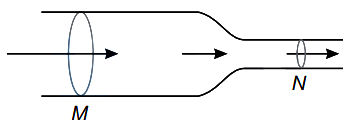 KCET 2009 Easy
 - Diameter of the objective of a telescope is \( 200 \mathrm{~cm} \). What is the resolving power of a telescope
\( ? \) Take wavelength of light \( =5000 \mathrm{~A} \).KCET 2014 Easy