


KCET · Maths · Differentiation
If \( x^{y}=e^{x-y} \) then \( \frac{d y}{d x} \) is equal to
- A \( \frac{\log x}{\log (x-y)} \)
- B \( \frac{e^{x}}{x^{x-y}} \)
- C \( \frac{\log x}{(1+\log x)^{2}} \)
- D \( \frac{1}{y}-\frac{1}{x-y} \)
Answer & Solution
Correct Answer
(C) \( \frac{\log x}{(1+\log x)^{2}} \)
Step-by-step Solution
Detailed explanation
Given that, \( x^{y}=e^{x-y} \)
Taking log both sides, we get
\[
\begin{array}{l}
y \log x=x-y \\
y(1+\log x)=x \\
\Rightarrow y=\frac{x}{(1+\log x)}
\end{array}
\]
\[
\begin{array}{l}
\text { So, } \frac{d y}{d x}=\frac{(1+\log x)-x\left(\frac{1}{x}\right)}{(1+\log x)^{2}} \\
=\frac{\log x}{(1+\log x)^{2}}
\end{array}
\]
Taking log both sides, we get
\[
\begin{array}{l}
y \log x=x-y \\
y(1+\log x)=x \\
\Rightarrow y=\frac{x}{(1+\log x)}
\end{array}
\]
\[
\begin{array}{l}
\text { So, } \frac{d y}{d x}=\frac{(1+\log x)-x\left(\frac{1}{x}\right)}{(1+\log x)^{2}} \\
=\frac{\log x}{(1+\log x)^{2}}
\end{array}
\]
See the Complete Solution
Get step-by-step explanations for this and 2.5 Lakh+ more JEE, NEET & CET questions.
- Unlock all solutions
- Practice the full chapter
- Track accuracy across PYQs
4.8 rated on Google Play · 14,000+ reviews
More questions from Maths
- \(\lim _{x \rightarrow 1} \frac{x^4-\sqrt{x}}{\sqrt{x}-1}\) isKCET 2025 Medium
- How many \( 5 \) digit telephone numbers can be constructed using the digits \( 0 \) to \( 9 \), if each
number starts with \( 67 \) and no digit appears more than once ?KCET 2014 Easy - The inverse of 2010 in the group \(\mathrm{Q}^{+}\)of all positive rational under the binary operation * defined by \(\mathrm{a}\) * \(\mathrm{b}=\frac{\mathrm{ab}}{2010}, \forall \mathrm{a}, \mathrm{b} \in \mathrm{Q}^{+}\), isKCET 2010 Easy
- Probability of occurrence of an event A is \(\dfrac{1}{2}\) and that of B is \(\dfrac{3}{10}\). If A and B are mutually exclusive, then the probability of occurrence of neither A nor B isKCET 2026 Easy
- The modulus and amplitude of \(\frac{1+2 i}{1-(1-i)^{2}}\) areKCET 2013 Easy
- If \(\omega\) is an imaginary cube root of unity, then the value of \(\left[\begin{array}{ccc}1 & \omega^{2} & 1-\omega^{4} \\ \omega & 1 & 1+\omega^{5} \\ 1 & \omega & \omega^{2}\end{array}\right]\) isKCET 2011 Easy
More PYQs from KCET
- A miscible mixture of \( \mathrm{C}_{6} \mathrm{H}_{6}+\mathrm{CH} \mathrm{Cl}_{3} \) can be separated byKCET 2016 Easy
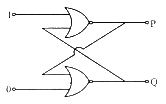
- In the following circuit, what are \( P \) and \( Q \) ?
 KCET 2019 Easy
 - A person wants a real image of his own, \( 3 \) times enlarged. Where should he stand infront of a concave mirror of radius of curvature \( 30 \mathrm{~cm} \) ?KCET 2015 Easy
- A current of 3 A is passed through a molten calcium salt for 1 hr 47 min 13 s . The mass of calcium deposited is
(Molar mass of \(\mathrm{Ca}=40 \mathrm{~g} \mathrm{~mol}^{-1}\) )KCET 2024 Medium - Formation of coloured solution is possible when metal ion in the compound containsKCET 2007 Medium
- During chemiosmotic synthesis at ATP in photosynthesisKCET 2019 Medium