


KCET · Maths · Application of Derivatives
If \((x e)^{y}=e^{y}\), then \(\frac{d y}{d x}\) is
- A \(\frac{\log x}{(1+\log x)^{2}}\)
- B \(\frac{1}{(1+\log x)^{2}}\)
- C \(\frac{\log x}{(1+\log x)}\)
- D \(\frac{e^{x}}{x(y-1)}\)
Answer & Solution
Correct Answer
(A) \(\frac{\log x}{(1+\log x)^{2}}\)
Step-by-step Solution
Detailed explanation
We have, \((x e)^{y}=e^{x}\)
Taking log on both sides at base \(e\), we get
\(\begin{aligned}
y \log (x e) &=x \log e \\
\Rightarrow \quad & y(\log x+\log e) &=x\left(\because \log _{e} e=1\right) \\
\Rightarrow \quad y &=\frac{x}{\log x+1}
\end{aligned}\)
On differentiating both sides w.r.t. \(x\), we get
\(\begin{aligned}
\frac{d y}{d x} &=\frac{(\log x+1)-x\left(\frac{1}{x}+0\right)}{(\log x+1)^{2}} \\
\Rightarrow \quad \frac{d y}{d x} &=\frac{\log x}{(\log x+1)^{2}}
\end{aligned}\)
Taking log on both sides at base \(e\), we get
\(\begin{aligned}
y \log (x e) &=x \log e \\
\Rightarrow \quad & y(\log x+\log e) &=x\left(\because \log _{e} e=1\right) \\
\Rightarrow \quad y &=\frac{x}{\log x+1}
\end{aligned}\)
On differentiating both sides w.r.t. \(x\), we get
\(\begin{aligned}
\frac{d y}{d x} &=\frac{(\log x+1)-x\left(\frac{1}{x}+0\right)}{(\log x+1)^{2}} \\
\Rightarrow \quad \frac{d y}{d x} &=\frac{\log x}{(\log x+1)^{2}}
\end{aligned}\)
See the Complete Solution
Get step-by-step explanations for this and 2.5 Lakh+ more JEE, NEET & CET questions.
- Unlock all solutions
- Practice the full chapter
- Track accuracy across PYQs
4.8 rated on Google Play · 14,000+ reviews
More questions from Maths
- Let \(f(x)=\sin 2 x+\cos 2 x\) and \(g(x)=x^2-1\) then \(g(f(x))\) is invertible in the domainKCET 2023 Medium
- The value of \(\sum_{k=1}^{6}\left(\sin \frac{2 k \pi}{7}-i \cos \frac{2 k \pi}{7}\right)\) isKCET 2008 Hard
- The sides of an equilateral triangle are increasing at the rate of \( 4 \mathrm{~cm} / \mathrm{sec} \). The rate at which its
area is increasing, when the side is \( 14 \mathrm{~cm} \)KCET 2019 Medium - If the eccentricity of the hyperbola \( \frac{x^{2}}{a^{2}}-\frac{y^{2}}{b^{2}}=1 \) is \( \frac{5}{4} \) and \( 2 x+3 y-6=0 \) is a focal chord of
the hyperbola, then the length of transverse axis is equal toKCET 2015 Medium - Let \(A=\{x, y, z, u\}\) and \(B=\{a, b\}\). A function \(f: A \rightarrow B\) is selected randomly. The probability that the function is an onto function isKCET 2023 Easy
- The middle term of expansion of \( \left(\frac{10}{x}+\frac{x}{10}\right)^{10} \)KCET 2015 Easy
More PYQs from KCET
- If \( |\bar{a} \times \bar{b}|^{2}+|\bar{a} \cdot \bar{b}|^{2}=144 \) and \( |\bar{a}|=4 \), then the value of \( |\bar{b}| \) isKCET 2018 Hard
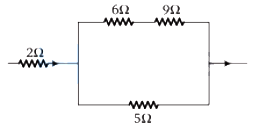
- In this circuit, when certain current flows, the heat produced in \(5 \Omega\) is \(4.05 \mathrm{~J}\) in a time t. The heat produced in \(2 \Omega\) coil in the same time interval is
 KCET 2012 Easy
 - A convex lens of focal length \(f\) is placed somewhere in between an object and a screen. The distance between the object and the screen is \(x\). If the numerical value of the magnification produced by the lens is \(m\), then the focal length of the lens isKCET 2022 Hard
- With regard to photoelectric effect, identify the correct statement among the following.KCET 2020 Medium
- If \(n\) is an odd positive integer and \(\left(1+x+x^{2}+x^{3}\right)^{n}=\sum_{r=0}^{3 n} a_{r} x^{r}\), then \(a_{0}-a_{1}+a_{2}-a_{3}+\ldots-a_{3 n}\) is equal toKCET 2011 Hard
- A ray of light is incident normally on one face of a right angled isosceles prism. It then grazes the hypotenuse. The refractive index of the material of the prism isKCET 2007 Medium