


KCET · Physics · Ray Optics
A convex lens of focal length \(f\) is placed somewhere in between an object and a screen. The distance between the object and the screen is \(x\). If the numerical value of the magnification produced by the lens is \(m\), then the focal length of the lens is
- A \(\frac{m x}{(m-1)^2}\)
- B \(\frac{(m+1)^2 x}{m}\)
- C \(\frac{(m-1)^2 x}{m}\)
- D \(\frac{m x}{(m+1)^2}\)
Answer & Solution
Correct Answer
(D) \(\frac{m x}{(m+1)^2}\)
Step-by-step Solution
Detailed explanation
Given, distance between object and screen for convex lens \(=x\)
i.c \(\quad u+v=x\)
but magnification, \(m=\frac{v}{u}\)
From Eqs. (i) and (ii), we get
\[
\begin{array}{rlrl}
& & u+m u & =x \Rightarrow u(m+1)=x \\
\Rightarrow & u & =\frac{x}{m+1}
\end{array}
\]
Again from Eqs. (i) and (ii), we get
\[
\begin{aligned}
\frac{v}{m}+v & =x \Rightarrow v\left(\frac{1}{m}+1\right)=x \\
\Rightarrow \quad & =\frac{m x}{m+1}
\end{aligned}
\]
Using lens formula ,
\[
\frac{1}{f}=\frac{1}{v}-\frac{1}{u}=\frac{1}{\left(\frac{m x}{m+1}\right)}-\frac{1}{\left(\frac{-x}{m+1}\right)}
\]
[from Eqs. (iii) and (iv)]
\[
\begin{aligned}
& =\frac{m+1}{m x}+\frac{m+1}{x}=\frac{m+1}{x}\left[\frac{1}{m}+1\right] \\
& =\frac{m+1}{x}\left(\frac{1+m}{m}\right)=\frac{(m+1)^2}{m x} \Rightarrow f=\frac{m x}{(m+1)^2}
\end{aligned}
\]
i.c \(\quad u+v=x\)
but magnification, \(m=\frac{v}{u}\)
From Eqs. (i) and (ii), we get
\[
\begin{array}{rlrl}
& & u+m u & =x \Rightarrow u(m+1)=x \\
\Rightarrow & u & =\frac{x}{m+1}
\end{array}
\]
Again from Eqs. (i) and (ii), we get
\[
\begin{aligned}
\frac{v}{m}+v & =x \Rightarrow v\left(\frac{1}{m}+1\right)=x \\
\Rightarrow \quad & =\frac{m x}{m+1}
\end{aligned}
\]
Using lens formula ,
\[
\frac{1}{f}=\frac{1}{v}-\frac{1}{u}=\frac{1}{\left(\frac{m x}{m+1}\right)}-\frac{1}{\left(\frac{-x}{m+1}\right)}
\]
[from Eqs. (iii) and (iv)]
\[
\begin{aligned}
& =\frac{m+1}{m x}+\frac{m+1}{x}=\frac{m+1}{x}\left[\frac{1}{m}+1\right] \\
& =\frac{m+1}{x}\left(\frac{1+m}{m}\right)=\frac{(m+1)^2}{m x} \Rightarrow f=\frac{m x}{(m+1)^2}
\end{aligned}
\]
See the Complete Solution
Get step-by-step explanations for this and 2.5 Lakh+ more JEE, NEET & CET questions.
- Unlock all solutions
- Practice the full chapter
- Track accuracy across PYQs
4.8 rated on Google Play · 14,000+ reviews
More questions from Physics
- A transformer works on the principle ofKCET 2011 Easy
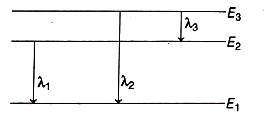
- Three energy levels of hydrogen atom and the corresponding wavelength of the emitted radiation due to different electron transition are as shown. Then,
 KCET 2023 Medium
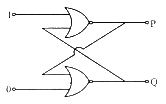
 - In the following circuit, what are \( P \) and \( Q \) ?
 KCET 2019 Easy
 - In domestic electric mains supply, the voltage and the current areKCET 2025 Easy
- A square loop of side 2 m lies in the \(Y-Z\) plane in a region having a magnetic field \(\vec{B}=(5 \hat{\mathrm{i}}+3 \hat{\mathrm{j}}-4 \hat{\mathrm{k}}) \mathrm{T}\). The magnitude of magnetic flux through the square loop isKCET 2025 Easy
- A certain amount of heat energy is supplied to a monoatomic ideal gas which expands at constant pressure. What fraction of the heat energy is converted into work ?KCET 2020 Easy
More PYQs from KCET
- The \(X\) and \(Y\) components of a force \(F\) acting at \(30^{\circ}\) to \(x\)-axis are respectivelyKCET 2012 Easy
- Match the physical quantities given in List-I with dimensions expressed in terms of mass (M), length (L), time (T) and electric current (A) given in List-II.
Codes:List-I List-II (a) Torque (i) \([M^{-1}L^{-2}T^{4}A^{2}]\) (b) Gravitational constant (ii) \([M^{1}L^{2}T^{-1}]\) (c) Capacitance (iii) \([M^{-1}L^{3}T^{-2}]\) (d) Planck's constant (iv) \([M^{1}L^{2}T^{-2}]\) KCET 2026 Medium - \(A\) and \(B\) are two sets having 3 and 6 elements respectively.
Consider the following statements.
Statement (I): Minimum number of elements in AUB is 3
Statement (II): Maximum number of elements in AB is 3
Which of the following is correct?KCET 2025 Easy - If \((x e)^{y}=e^{y}\), then \(\frac{d y}{d x}\) isKCET 2020 Easy
- The germ pores in the pollen grain are the regionsKCET 2014 Medium
- \(\sin ^{2} 17.5^{\circ}+\sin ^{2} 72.5^{\circ}\) is equal toKCET 2007 Easy