


KCET · Maths · Trigonometric Ratios & Identities
If \( \sin x=\frac{2 t}{1+t^{2}}, \tan y=\frac{2 t}{1-t^{2}} \), then \( \frac{d y}{d x} \) is equal to
- A \( 11 \)
- B \( 00 \)
- C \( -1 \)
- D \( 12 \)
Answer & Solution
Correct Answer
(A) \( 11 \)
Step-by-step Solution
Detailed explanation
Given that,
\( \sin x=\frac{2 t}{1+t^{2}} \) and \( \tan y=\frac{2 t}{1-t^{2}} \)
So, \( x=\sin ^{-1}\left(\frac{2 t}{1+t^{2}}\right) \rightarrow(1) \)
and \( y=\tan ^{-1}\left(\frac{2 t}{1-t^{2}}\right) \rightarrow(2) \)
We know that \( \sin ^{-1}\left(\frac{2 t}{1+t^{2}}\right)=2 \tan ^{-1} t \) and \( \tan ^{-1}\left(\frac{2 t}{1-t^{2}}\right)=2 \tan ^{-1} t \)
So, Eqs. (1) and (2) becomes
\( x=2 \tan ^{-1} t \) and \( y=2 \tan ^{-1} t \)
Differentiating Eqs. (1) and (2) with respect to t, we get
\( \frac{d y}{d x}=\frac{d\left(\frac{2 \tan ^{-1} \theta}{d \theta}\right)}{\frac{d\left(2 \tan ^{-1} \theta\right)}{d \theta}}=1 \)
\( \sin x=\frac{2 t}{1+t^{2}} \) and \( \tan y=\frac{2 t}{1-t^{2}} \)
So, \( x=\sin ^{-1}\left(\frac{2 t}{1+t^{2}}\right) \rightarrow(1) \)
and \( y=\tan ^{-1}\left(\frac{2 t}{1-t^{2}}\right) \rightarrow(2) \)
We know that \( \sin ^{-1}\left(\frac{2 t}{1+t^{2}}\right)=2 \tan ^{-1} t \) and \( \tan ^{-1}\left(\frac{2 t}{1-t^{2}}\right)=2 \tan ^{-1} t \)
So, Eqs. (1) and (2) becomes
\( x=2 \tan ^{-1} t \) and \( y=2 \tan ^{-1} t \)
Differentiating Eqs. (1) and (2) with respect to t, we get
\( \frac{d y}{d x}=\frac{d\left(\frac{2 \tan ^{-1} \theta}{d \theta}\right)}{\frac{d\left(2 \tan ^{-1} \theta\right)}{d \theta}}=1 \)
See the Complete Solution
Get step-by-step explanations for this and 2.5 Lakh+ more JEE, NEET & CET questions.
- Unlock all solutions
- Practice the full chapter
- Track accuracy across PYQs
4.8 rated on Google Play · 14,000+ reviews
More questions from Maths
- If \( \vec{a}=\hat{i}+2 \hat{j}+2 \hat{k},|\vec{b}|=5 \) and the angle between \( \vec{a} \) and \( \vec{b} \) is \( \frac{\pi}{6} \), then the area of the
triangle formed by these two vectors as two sides isKCET 2015 Easy - \(\int \frac{\sin x \cos x}{\sqrt{1-\sin ^{4} x}} d x\) is equal toKCET 2008 Medium
- If \( \left(\frac{1+i}{1-i}\right)^{\mathrm{m}} \), then the least positive integralvalue of \( \mathrm{m} \) isKCET 2017 Easy
- If \(x \cos \alpha+y \sin \alpha=4\) is tangent to \(\frac{x^{2}}{25}+\frac{y^{2}}{9}=1\), then the value of \(\alpha\) isKCET 2011 Hard
- A line passes through \((-1,-3)\) and perpendicular to \(x+6 y=5\). Its \(x\) intercept isKCET 2025 Easy
- The locus of the mid point of the line joining the focus and any point on the parabola \(y^{2}=4 a x\) is a parabola with the equation of directrix asKCET 2008 Hard
More PYQs from KCET
- A solid cube of mass \(m\) at a temperature \(\theta_0\) is heated at a constant rate. It becomes liquid at temperature \(\theta_1\) and vapour at temperature \(\theta_2\). Let \(s_1\) and \(s_2\) be specific heats in its solid and liquid states respectively. If \(L_f\) and \(L_v\) are latent heats of fusion and vaporisation respectively, then the minimum heat energy supplied to the cube until it vaporises isKCET 2024 Medium
- Select the correct statements from the following:KCET 2023 Medium
- From the following graph of photo current against collector plate potential, for two different intensities of light \( I_{1} \) and \( I_{2} \), one can conclude
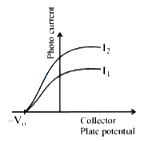 KCET 2017 Hard
 - Which one of the following gases converts haemoglobin into carboxy haemoglobin?KCET 2023 Easy
- Which of the following is the CORRECT statement about \(\Psi^2\)?KCET 2026 Easy
- In anomalous expansion of water, at what temperature, the density of water is maximum ?KCET 2014 Medium