


KCET · Maths · Application of Derivatives
If the length of the subtangent at any point to the curve \(x y^{n}=a\) is proportional to the abscissa, then \(n\) is
- A any non-zero real number
- B 2
- C \(-2\)
- D 1
Answer & Solution
Correct Answer
(A) any non-zero real number
Step-by-step Solution
Detailed explanation
Given, curve is \(x y^{n}=a\)
On differentiating w.r.t. \(x\), we get
\(x \cdot n y^{n-1} \cdot \frac{d y}{d x}+y^{n}=0\)
\(\Rightarrow \quad y^{n-1}\left[x n \frac{d y}{d x}+y\right]=0\)
\(\Rightarrow \quad \frac{d y}{d x}=-\frac{y}{n x} \quad(\because y \neq 0)\)
\(\begin{aligned} \therefore \text { Length of subtangent } &=\frac{y}{(d y / d x)} \\ &=y \times\left(\frac{-n x}{y}\right)=-n x \end{aligned}\)
Since, it is proportional to \(x\).
So, \(n\) can be any non-zero real number.
On differentiating w.r.t. \(x\), we get
\(x \cdot n y^{n-1} \cdot \frac{d y}{d x}+y^{n}=0\)
\(\Rightarrow \quad y^{n-1}\left[x n \frac{d y}{d x}+y\right]=0\)
\(\Rightarrow \quad \frac{d y}{d x}=-\frac{y}{n x} \quad(\because y \neq 0)\)
\(\begin{aligned} \therefore \text { Length of subtangent } &=\frac{y}{(d y / d x)} \\ &=y \times\left(\frac{-n x}{y}\right)=-n x \end{aligned}\)
Since, it is proportional to \(x\).
So, \(n\) can be any non-zero real number.
See the Complete Solution
Get step-by-step explanations for this and 2.5 Lakh+ more JEE, NEET & CET questions.
- Unlock all solutions
- Practice the full chapter
- Track accuracy across PYQs
4.8 rated on Google Play · 14,000+ reviews
More questions from Maths
- If \( 3 \tan ^{-1} x+\cot ^{-1}=\pi \) then \( x \) equal toKCET 2016 Easy
- If \(A\) and \(B\) have \(n\) elements in common, then the number of elements common to \(A \times B\) and \(B \times A\) isKCET 2012 Easy
- \(n\)th term of the series \(1+\frac{3}{7}+\frac{5}{7^2}+\frac{1}{7^2}+\ldots\) isKCET 2023 Easy
- The maximum value of \( \left(\frac{1}{x}\right)^{x} \) isKCET 2016 Hard
- If \( 1+\sin \theta+\sin ^{2} \theta+\ldots . \) upto \( \infty=2 \sqrt{3}+4 \), then \( \theta= \)KCET 2016 Medium
- The right hand and left hand limit of the function are respectively.
\(f(x)=\left\{\begin{array}{cc}\frac{e^{1 / x}-1}{e^{1 / x}+1}, & \text { if } x \neq 0 \\ 0, & \text { if } x=0\end{array}\right.\)KCET 2020 Medium
More PYQs from KCET
- If \(A=\left[\begin{array}{ccc}1 & -2 & 2 \\ 0 & 2 & -3 \\ 3 & -2 & 4\end{array}\right]\), then \(A \cdot \operatorname{adj}(A)\) is equal toKCET 2007 Medium
- The spectrum of an oil flame is an example forKCET 2010 Easy
- In \(P(X)\), the power set of a non-empty set \(X\), an binary operation * is defined by \(\mathrm{A}{ }^{*} \mathrm{~B}=\mathrm{A} \cup \mathrm{B}, \forall \mathrm{A}, \mathrm{B} \in \mathrm{P}(\mathrm{x})\) under \(*\), a true statement isKCET 2010 Easy
- One mole of an ideal monoatomic gas is taken round the cyclic process MNOM. The work done by the gas is
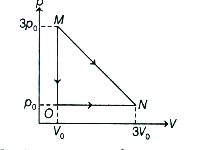 KCET 2024 Easy
 - A bivalent metal has an equivalent mass of 32 . The molecular mass of the metal nitrate isKCET 2009 Medium
- Two monochromatic light waves of amplitudes \(3 \mathrm{~A}\) and \(2 \mathrm{~A}\) interfering at a point have a phase difference of \(60^{\circ}\). The intensity at that point will be proportional toKCET 2011 Medium