


KCET · Maths · Application of Derivatives
If \(f(x)=x e^{x(1-x)}\), then \(f(x)\) is
- A increasing in \(R\)
- B decreasing in \(R\)
- C decreasing in \(\left[-\frac{1}{2}, 1\right]\)
- D increasing in \(\left[-\frac{1}{2}, 1\right]\)
Answer & Solution
Correct Answer
(D) increasing in \(\left[-\frac{1}{2}, 1\right]\)
Step-by-step Solution
Detailed explanation
Given, \(f(x)=x e^{x(1-x)}\)
\(f^{\prime}(x)=e^{x(1-x)}+x e^{x(1-x)}(1-2 x)\)
\(=e^{x(1-x)}(1+x(1-2 x))\)
\(=-e^{x(1-x)}\left(2 x^2-x-1\right)\)
\(=-e^{x(1-x)}\left(2 x^2-2 x+x-1\right)\)
\(=-e^{x(1-x)}(x-1)(2 x+1)\)
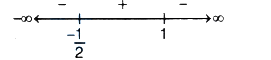
So, \(f(x)\) is increasing when \(f^{\prime}(x) \geq 0\) and decreasing when \(f^{\prime}(x) \leq 0\).
Hence, \(f\) is increasing in \(\left[\frac{-1}{2}, 1\right]\).
\(f^{\prime}(x)=e^{x(1-x)}+x e^{x(1-x)}(1-2 x)\)
\(=e^{x(1-x)}(1+x(1-2 x))\)
\(=-e^{x(1-x)}\left(2 x^2-x-1\right)\)
\(=-e^{x(1-x)}\left(2 x^2-2 x+x-1\right)\)
\(=-e^{x(1-x)}(x-1)(2 x+1)\)
So, \(f(x)\) is increasing when \(f^{\prime}(x) \geq 0\) and decreasing when \(f^{\prime}(x) \leq 0\).
Hence, \(f\) is increasing in \(\left[\frac{-1}{2}, 1\right]\).
See the Complete Solution
Get step-by-step explanations for this and 2.5 Lakh+ more JEE, NEET & CET questions.
- Unlock all solutions
- Practice the full chapter
- Track accuracy across PYQs
4.8 rated on Google Play · 14,000+ reviews
More questions from Maths
- If \(\sin 3 \theta=\sin \theta\), how many solutions exist such that \(-2 \pi < \theta < 2 \pi\) ?KCET 2007 Medium
- If \(\mathbf{a}, \mathbf{b}\) and \(\mathbf{c}\) are unit vectors such that \(\mathbf{a}+\mathbf{b}+\mathbf{c}=\mathbf{0}\), then angle between \(\mathbf{a}\) and \(\mathbf{b}\) isKCET 2011 Medium
- If the function \(f(x)=\left\{\begin{array}{cl}\frac{1-\cos x}{x^{2}}, & \text { for } x \neq 0 \\ k, & \text { for } x=0\end{array}\right.\) continuous at \(x=0\), then the value of \(k\) isKCET 2007 Easy
- If \( \tan ^{-1}\left(x^{2}+y^{2}\right)=\alpha \) then \( \frac{d y}{d x} \) is equal toKCET 2016 Medium
- The maximum value of \(z=3 x+4 y\), subject to the constraints \(x+y \leq 40, x+2 y \leq 60\) and \(x, y \geq 0\) isKCET 2025 Medium
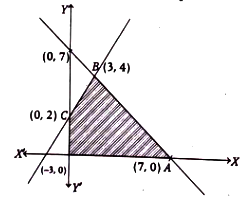
- The shaded region in the figure given is the solution of which of the inequations?
 KCET 2023 Easy
More PYQs from KCET
- If the function \( g(x) \) is defined by
\[
g(x)=\frac{\chi^{200}}{200}+\frac{\chi^{199}}{199}+\frac{\chi^{198}}{198}+\ldots \ldots+\frac{\chi^{2}}{2}+\chi+5, \text { then } g^{\prime}(0)=
\]KCET 2015 Easy - In which of the following regions of a nephron does maximum reabsorption of useful substances, takes place?KCET 2005 Easy
- In refraction, light waves are bent on passing from one medium to second medium because, in the second mediumKCET 2021 Easy
- \(\tan ^{-1}\left[\frac{1}{\sqrt{3}} \sin \frac{5 \pi}{2}\right] +\sin ^{-1}\left[\cos \left(\sin ^{-} \frac{\sqrt{3}}{2}\right)\right]\) is equal toKCET 2021 Easy
- If \( \sin ^{-1} x+\cos ^{-1} y=\frac{2 \pi}{5} \), then \( \cos ^{-1} x+\sin ^{-1} y \) isKCET 2018 Easy
- If \( \left(\frac{1-i}{1+i}\right)^{96}=a+i b \) then \( (a, b) \) isKCET 2018 Medium