


KCET · Maths · Quadratic Equation
If \(f(x)=\left\{\begin{array}{cl}x^2-1, & 0 < x < 2 \\ 2 x+3, & 2 \leq x < 3\end{array}\right.\),the quadratic equation whose roots are \(\lim _{x \rightarrow 2^{-}} f(x)\) and \(\lim _{x \rightarrow 2^{+}} f(x)\) is
- A \(x^2-14 x+49=0\)
- B \(x^2-10 x+21=0\)
- C \(x^2-6 x+9=0\)
- D \(x^2-7 x+8=0\)
Answer & Solution
Correct Answer
(B) \(x^2-10 x+21=0\)
Step-by-step Solution
Detailed explanation
\(f(x)= \begin{cases}x^2-1, & 0 < x < 2 \\ 2 x+3, & 2 \leq x < 3\end{cases}\)
Now, \(\lim _{x \rightarrow 2^{-}} f(x)=\lim _{x \rightarrow 2^{-}} x^2-1=\lim _{h \rightarrow 0}\left[(2-h)^2-1\right]\) \(=\lim _{h \rightarrow 0}\left[4+h^2-4 h-1\right]=4+0-0-1=3\)
and \(\lim _{x \rightarrow 2^{+}} f(x)=\lim _{x \rightarrow 2^{+}}(2 x+3)=\lim _{h \rightarrow 0} 2(2+h)+3\) \(=\lim _{h \rightarrow 0} 4+2 h+3=4+0+3=7\)
Therefore, the quadratic equation whose roots are 3 and 7 is given by \(x^2-(3+7) x+(3 \times 7)=0\) which is \(x^2-10 x+21=0\)
Now, \(\lim _{x \rightarrow 2^{-}} f(x)=\lim _{x \rightarrow 2^{-}} x^2-1=\lim _{h \rightarrow 0}\left[(2-h)^2-1\right]\) \(=\lim _{h \rightarrow 0}\left[4+h^2-4 h-1\right]=4+0-0-1=3\)
and \(\lim _{x \rightarrow 2^{+}} f(x)=\lim _{x \rightarrow 2^{+}}(2 x+3)=\lim _{h \rightarrow 0} 2(2+h)+3\) \(=\lim _{h \rightarrow 0} 4+2 h+3=4+0+3=7\)
Therefore, the quadratic equation whose roots are 3 and 7 is given by \(x^2-(3+7) x+(3 \times 7)=0\) which is \(x^2-10 x+21=0\)
See the Complete Solution
Get step-by-step explanations for this and 2.5 Lakh+ more JEE, NEET & CET questions.
- Unlock all solutions
- Practice the full chapter
- Track accuracy across PYQs
4.8 rated on Google Play · 14,000+ reviews
More questions from Maths
- The distance of the focus of \(x^{2}-y^{2}=4\), form the directrix which is nearer to it, isKCET 2010 Easy
- Meera visits only one of the two temples A and B in her locality. Probability that she visits temple A is \(\frac{2}{5}\). If she visits temple \(A, \frac{1}{3}\) is the probability that she meets her friend, whereas it is \(\frac{2}{7}\) if she visits temple \(B\). Meera met her friend at one of the two temples. The probability that she met her at temple B isKCET 2025 Medium
- The range in which \(y=-x^{2}+6 x-3\) is increasing isKCET 2007 Easy
- If \(1, \omega, \omega^{2}\) are the cube roots of unity, then \((1+\omega)\left(1+\omega^{2}\right)\left(1+\omega^{4}\right)\left(1+\omega^{8}\right)\) is equal toKCET 2007 Easy
- Binary operation * on \( R-\{-1\} \) defined by
\( a^{*} b=\frac{a}{b+1} \) isKCET 2017 Easy - Two events \( A \) and \( B \) will be independent ifKCET 2017 Medium
More PYQs from KCET
- If \(\mu_{0}\) is permeability of free space and \(\varepsilon_{0}\) is permittivity of free space, the speed of light in vacuum is given byKCET 2008 Easy
- A Lewis acid ' \(X\) ' reacts with \(\mathrm{LiAlH}_{4}\) in ether medium to give a highly toxic gas. This gas when heated with \(\mathrm{NH}_{3}\) gives a compound commonly known as inorganic benzene. The gas isKCET 2020 Hard
- Identify the enzyme that catalyses the step labelled as 'M' in the given schematic representation of replication of retrovirus.
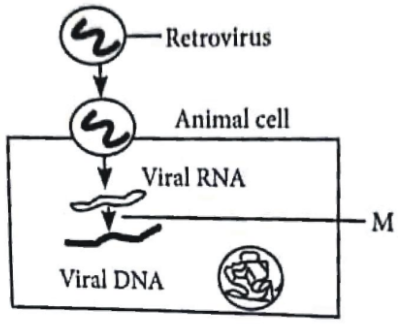 KCET 2019 Hard
 - If the person shows the production of interferons in his body, chances are that he is suffering fromKCET 2009 Hard
- The breakdown of detritus into small particles by detritivores is calledKCET 2015 Hard
- \(\tan ^{-1}\left[\frac{1}{\sqrt{3}} \sin \frac{5 \pi}{2}\right] +\sin ^{-1}\left[\cos \left(\sin ^{-} \frac{\sqrt{3}}{2}\right)\right]\) is equal toKCET 2021 Easy