


KCET · Maths · Complex Number
If \(1, \omega, \omega^{2}\) are the cube roots of unity, then \((1+\omega)\left(1+\omega^{2}\right)\left(1+\omega^{4}\right)\left(1+\omega^{8}\right)\) is equal to
- A 1
- B 0
- C \(\omega^{2}\)
- D \(\omega\)
Answer & Solution
Correct Answer
(A) 1
Step-by-step Solution
Detailed explanation
Given, \((1+\omega)\left(1+\omega^{2}\right)\left(1+\omega^{4}\right)\left(1+\omega^{8}\right)\)
\[
\begin{aligned}
&=(1+\omega)(-\omega)\left(1+\omega^{3} \cdot \omega\right)\left\{1+\left(\omega^{3}\right)^{2} \cdot \omega^{2}\right\} \\
&=(1+\omega)(-\omega)(1+\omega)\left(1+\omega^{2}\right) \quad\left[\because \omega^{2}=1\right] \\
&=(1+\omega)^{2}\left(-\omega-\omega^{3}\right) \quad \\
&=\left(1+\omega^{2}+2 \omega\right)(-\omega-1) \\
&=(-\omega+2 \omega)\left(+\omega^{2}\right)=\omega^{3}=1
\end{aligned}
\]
\[
\begin{aligned}
&=(1+\omega)(-\omega)\left(1+\omega^{3} \cdot \omega\right)\left\{1+\left(\omega^{3}\right)^{2} \cdot \omega^{2}\right\} \\
&=(1+\omega)(-\omega)(1+\omega)\left(1+\omega^{2}\right) \quad\left[\because \omega^{2}=1\right] \\
&=(1+\omega)^{2}\left(-\omega-\omega^{3}\right) \quad \\
&=\left(1+\omega^{2}+2 \omega\right)(-\omega-1) \\
&=(-\omega+2 \omega)\left(+\omega^{2}\right)=\omega^{3}=1
\end{aligned}
\]
See the Complete Solution
Get step-by-step explanations for this and 2.5 Lakh+ more JEE, NEET & CET questions.
- Unlock all solutions
- Practice the full chapter
- Track accuracy across PYQs
4.8 rated on Google Play · 14,000+ reviews
More questions from Maths
- If \(y=\tan ^{-1} \sqrt{\mathrm{x}^{2}-1}\), then the ratio \(\frac{\mathrm{d}^{2} \mathrm{y}}{\mathrm{dx} \mathrm{x}^{2}}: \frac{\mathrm{dy}}{\mathrm{dx}}\) isKCET 2010 Medium
- A random experiment has five outcomes \(\mathrm{w}_1, \mathrm{w}_2, \mathrm{w}_3, \mathrm{w}_4\) and \(\mathrm{w}_5\). The probabilities of the occurrence of the outcomes \(\mathrm{w}_1, \mathrm{w}_2, \mathrm{w}_3, \mathrm{w}_4\) and \(\mathrm{w}_5\) are respectively \(\frac{1}{6}, \mathrm{a}, \mathrm{b}\) and \(\frac{1}{12}\) such that \(12 \mathrm{a}+12 \mathrm{~b}-1=0\). Then the probabilities of occurrence of the outcome \(w_3\) isKCET 2025 Easy
- If \(A\) and \(B\) are symmetric matrices of the same order, then which one of the following is not true?KCET 2011 Hard
- The angle between the lines whose direction ratios are \(a, b, c\) and \(b - c, c - a, a - b\) isKCET 2026 Easy
- In a regular graph of 15 vertices the sum of the degree of the vertices is 60 . Then, the degree of each vertex isKCET 2013 Easy
- The number \(\left(49^{2}-4\right)\left(49^{3}-49\right)\) is divisible byKCET 2010 Medium
More PYQs from KCET
- The correct statement isKCET 2014 Easy
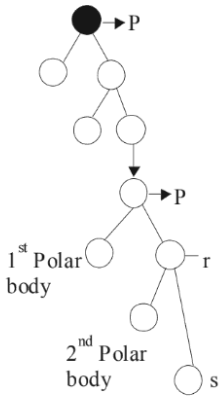
- Identify the cells represented as p, q, r, and s in the schematic represents of Oogenesis shown below and choose the correct option.
 KCET 2020 Hard
 - If \(m\) and \(n\) are order and degree of the differential equation
\(\left(y^{\prime \prime}\right)^{5}+4 \cdot \frac{\left(y^{\prime \prime}\right)^{3}}{y^{\prime \prime \prime}}+y^{\prime \prime \prime}=\sin x\), thenKCET 2013 Medium - \(\int \frac{\sin x}{3+4 \cos ^2 x} d x\)KCET 2024 Medium
- An aqueous solution of alcohol contains \(18 \mathrm{~g}\) of water and \(414 \mathrm{~g}\) of ethyl alcohol. The mole fraction of water isKCET 2022 Easy
- A radioactive sample \(S_{1}\) having the activity \(\mathrm{A}_{1}\) has twice the number of nuclei as another sample \(S_{2}\) of activity \(A_{2}\). If \(A_{2}=2 A_{1}\), then the ratio of half-life of \(S_{1}\) to the half-life of \(S_{2}\) isKCET 2010 Medium