


KCET · Maths · Matrices
If \(A\) is a square matrix satisfying the equation \(A^2-5 A+7 I=0\), where \(I\) is the \(I\) dentity matrix and 0 is null matrix of same order, then \(\mathrm{A}^{-1}=\)
- A \(\frac{1}{7}(5 \mathrm{I}-\mathrm{A})\)
- B \(\frac{1}{7}(\mathrm{~A}-5 \mathrm{I})\)
- C \(7(5 I-A)\)
- D \(\frac{1}{5}(7 \mathrm{I}-\mathrm{A})\)
Answer & Solution
Correct Answer
(A) \(\frac{1}{7}(5 \mathrm{I}-\mathrm{A})\)
Step-by-step Solution
Detailed explanation
Given
\(\begin{aligned}
& \mathrm{A}^2-5 \mathrm{~A}+7 \mathrm{I}=0 \quad\left(\because \text { Multiply by } \mathrm{A}^{-1} \text { both sides }|\mathrm{A}| \neq 0\right) \\
& \mathrm{A}-5 \mathrm{I}+7 \mathrm{~A}^{-1}=0 \\
& \mathrm{~A}^{-1}=\frac{(5 \mathrm{I}-\mathrm{A})}{7}
\end{aligned}\)
\(\begin{aligned}
& \mathrm{A}^2-5 \mathrm{~A}+7 \mathrm{I}=0 \quad\left(\because \text { Multiply by } \mathrm{A}^{-1} \text { both sides }|\mathrm{A}| \neq 0\right) \\
& \mathrm{A}-5 \mathrm{I}+7 \mathrm{~A}^{-1}=0 \\
& \mathrm{~A}^{-1}=\frac{(5 \mathrm{I}-\mathrm{A})}{7}
\end{aligned}\)
See the Complete Solution
Get step-by-step explanations for this and 2.5 Lakh+ more JEE, NEET & CET questions.
- Unlock all solutions
- Practice the full chapter
- Track accuracy across PYQs
4.8 rated on Google Play · 14,000+ reviews
More questions from Maths
- If \(y=a \sin x+b \cos x\), then \(y^2+\left(\frac{d y}{d x}\right)^2\) is aKCET 2023 Easy
- If \(A\) and \(B\) are matrices of order 3 and \(|A|=5,|B|=3\), then \(|3 A B|\) isKCET 2021 Easy
- In a simultaneous throw of a pair of dice, the probability of getting a total more than \( 7 \) isKCET 2018 Easy
- If \(\log _{10} 7=0.8451\), then the position of the first significant figure of \(7^{-20}\) isKCET 2008 Easy
- Acute angle between the line \( \frac{x-5}{2}=\frac{y+1}{-1}=\frac{z+4}{1} \) and the plane \( 3 x-4 y-z+5=0 \) isKCET 2019 Medium
- Two dice are thrown simultaneously, the probability of obtaining a total score of \( 5 \) isKCET 2016 Medium
More PYQs from KCET
- The volume of air inspired or expired by a healthy man per minute isKCET 2017 Easy
- The sum of the series, \(\frac{1}{2.3} \cdot 2+\frac{2}{3.4} \cdot 2^{2}+\frac{3}{4.5} \cdot 2^{3}+\ldots\) upto \(n\) terms isKCET 2013 Hard
- Identify the products \(A\) and \(B\) in the reactions :
\[
\begin{aligned}
& R-X+\mathrm{AgCN} \longrightarrow A+\mathrm{Ag} X \\
& R-X+\mathrm{KCN} \longrightarrow B+\mathrm{KX}
\end{aligned}
\]KCET 2022 Medium - The function of potassium ethyl xanthate in froth floatation process is to make the oreKCET 2012 Easy
- The value of I in the figure shown below is
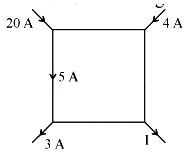 KCET 2017 Easy
 - The acid strength of active methylene group in
(a) \( \mathrm{CH}_{3} \mathrm{COCH}_{2} \mathrm{COOC}_{2} \mathrm{H}_{5} \)
(b) \( \mathrm{CH}_{3} \mathrm{COCH}_{2} \mathrm{COCH}_{3} \)
(c) \( \mathrm{C}_{2} \mathrm{H}_{5} \mathrm{OOCCH}_{2} \mathrm{COOC}_{2} \mathrm{H}_{5} \)
decreases asKCET 2014 Easy