


KCET · Maths · Vector Algebra
If \(\overrightarrow{\mathbf{a}}, \overrightarrow{\mathbf{b}}\) and \(\overrightarrow{\mathbf{c}}\) are unit vectors, such that \(\overrightarrow{\mathbf{a}}+\overrightarrow{\mathbf{b}}+\overrightarrow{\mathbf{c}}=\overrightarrow{\mathbf{0}}\), then \(3 \overrightarrow{\mathbf{a}} \cdot \overrightarrow{\mathbf{b}}+2 \overrightarrow{\mathbf{b}} \cdot \overrightarrow{\mathbf{c}}+\overrightarrow{\mathbf{c}} \cdot \overrightarrow{\mathbf{a}}\) is
- A \(-1\)
- B 1
- C \(-3\)
- D 3
Answer & Solution
Correct Answer
(C) \(-3\)
Step-by-step Solution
Detailed explanation
\(\overrightarrow{\mathbf{a}}, \overrightarrow{\mathbf{b}}, \overrightarrow{\mathbf{c}}\) are unit vectors, then \(|\overrightarrow{\mathbf{a}}|=|\overrightarrow{\mathbf{b}}|=|\overrightarrow{\mathbf{c}}|=1\)
Given,
\[
\begin{aligned}
\overrightarrow{\mathbf{a}}+\overrightarrow{\mathbf{b}}+\overrightarrow{\mathbf{c}} &=0 \\
\overrightarrow{\mathbf{a}} &=-(\overrightarrow{\mathbf{b}}+\overrightarrow{\mathbf{c}})
\end{aligned}
\]
Squaring on both sides
\[
\begin{aligned}
\overrightarrow{\mathbf{a}^{2}} &=(\overrightarrow{\mathbf{b}}+\overrightarrow{\mathbf{c}})^{2} \\
\overrightarrow{\mathbf{a}^{2}} &=\overrightarrow{\mathbf{b}^{2}}+\overrightarrow{\mathbf{c}^{2}}+2 \overrightarrow{\mathbf{b}} \cdot \overrightarrow{\mathbf{c}} \\
|\overrightarrow{\mathbf{a}}|^{2} &=|\overrightarrow{\mathbf{b}}|^{2}+|\overrightarrow{\mathbf{c}}|^{2}+2(\overrightarrow{\mathbf{b}} \cdot \overrightarrow{\mathbf{c}}) \quad\left(\because \overrightarrow{\mathbf{a}^{2}}=|\overrightarrow{\mathbf{a}}|^{2}\right)
\end{aligned}
\]
\[
\begin{aligned}
&1=1+1+2(\overrightarrow{\mathbf{b}} \cdot \overrightarrow{\mathbf{c}})\\
&\Rightarrow \overrightarrow{\mathbf{b}} \cdot \overrightarrow{\mathbf{c}}=-1 / 2\\
&\text { Similarly, } \overrightarrow{\mathbf{a}} \cdot \overrightarrow{\mathbf{b}}=\overrightarrow{\mathbf{c}} \cdot \overrightarrow{\mathbf{a}}=-1 / 2\\
&\text { Hence, } 3 \overrightarrow{\mathbf{a}} \cdot \overrightarrow{\mathbf{b}}+2 \overrightarrow{\mathbf{b}} \cdot \overrightarrow{\mathbf{c}}+\overrightarrow{\mathbf{c}} \cdot \overrightarrow{\mathbf{a}}\\
&=3(-1 / 2)+2(-1 / 2)+(-1 / 2)\\
&=(3+2+1)(-1 / 2)\\
&=6(-1 / 2)=-3
\end{aligned}
\]
Given,
\[
\begin{aligned}
\overrightarrow{\mathbf{a}}+\overrightarrow{\mathbf{b}}+\overrightarrow{\mathbf{c}} &=0 \\
\overrightarrow{\mathbf{a}} &=-(\overrightarrow{\mathbf{b}}+\overrightarrow{\mathbf{c}})
\end{aligned}
\]
Squaring on both sides
\[
\begin{aligned}
\overrightarrow{\mathbf{a}^{2}} &=(\overrightarrow{\mathbf{b}}+\overrightarrow{\mathbf{c}})^{2} \\
\overrightarrow{\mathbf{a}^{2}} &=\overrightarrow{\mathbf{b}^{2}}+\overrightarrow{\mathbf{c}^{2}}+2 \overrightarrow{\mathbf{b}} \cdot \overrightarrow{\mathbf{c}} \\
|\overrightarrow{\mathbf{a}}|^{2} &=|\overrightarrow{\mathbf{b}}|^{2}+|\overrightarrow{\mathbf{c}}|^{2}+2(\overrightarrow{\mathbf{b}} \cdot \overrightarrow{\mathbf{c}}) \quad\left(\because \overrightarrow{\mathbf{a}^{2}}=|\overrightarrow{\mathbf{a}}|^{2}\right)
\end{aligned}
\]
\[
\begin{aligned}
&1=1+1+2(\overrightarrow{\mathbf{b}} \cdot \overrightarrow{\mathbf{c}})\\
&\Rightarrow \overrightarrow{\mathbf{b}} \cdot \overrightarrow{\mathbf{c}}=-1 / 2\\
&\text { Similarly, } \overrightarrow{\mathbf{a}} \cdot \overrightarrow{\mathbf{b}}=\overrightarrow{\mathbf{c}} \cdot \overrightarrow{\mathbf{a}}=-1 / 2\\
&\text { Hence, } 3 \overrightarrow{\mathbf{a}} \cdot \overrightarrow{\mathbf{b}}+2 \overrightarrow{\mathbf{b}} \cdot \overrightarrow{\mathbf{c}}+\overrightarrow{\mathbf{c}} \cdot \overrightarrow{\mathbf{a}}\\
&=3(-1 / 2)+2(-1 / 2)+(-1 / 2)\\
&=(3+2+1)(-1 / 2)\\
&=6(-1 / 2)=-3
\end{aligned}
\]
See the Complete Solution
Get step-by-step explanations for this and 2.5 Lakh+ more JEE, NEET & CET questions.
- Unlock all solutions
- Practice the full chapter
- Track accuracy across PYQs
4.8 rated on Google Play · 14,000+ reviews
More questions from Maths
- The remainder obtained when \( 1 !+2 !+3 !+\ldots+11 ! \) is divided by \( 12 \) isKCET 2015 Easy
- The standard deviation of the numbers 31 , \(32,33 \ldots 46,47\) isKCET 2021 Easy
- On the set of positive rationals, a binary operation * is defined by \( a^{*} b=\frac{2 a b}{5} \). If \( 2^{*} x=3^{-1} \)
then \( x= \)KCET 2019 Easy - \(\int_{-2}^0\left(x^3+3 x^2+3 x+3+(x+1) \cos (x+1)\right) d x\)
is equals toKCET 2023 Medium - If \(\overrightarrow{\mathbf{a}}+2 \overrightarrow{\mathbf{b}}+3 \overrightarrow{\mathbf{c}}=\overrightarrow{\mathbf{0}}\), then \(\overrightarrow{\mathbf{a}} \times \overrightarrow{\mathbf{b}}+\overrightarrow{\mathbf{b}} \times \overrightarrow{\mathbf{c}}+\overrightarrow{\mathbf{c}} \times \overrightarrow{\mathbf{a}}\) is equal toKCET 2009 Hard
- The smallest positive integral value of \(n\) such that \(\left[\frac{1+\sin \frac{\pi}{8}+i \cos \frac{\pi}{8}}{1+\sin \frac{\pi}{8}-i \cos \frac{\pi}{8}}\right]^{\mathrm{n}}\) \(n\) is equal toKCET 2009 Medium
More PYQs from KCET
- The IUPAC name for tertiary butyl iodide isKCET 2008 Easy
- The general solution of the differential equation \(\sqrt{1-x^{2} y^{2}} \cdot d x=y \cdot d x+x \cdot d y\) isKCET 2013 Medium
- In the series \(L-C-R\) circuit shown, the impedance is
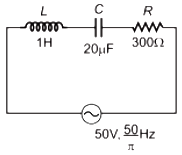 KCET 2011 Easy
 - If \(m\) and \(n\) are order and degree of the differential equation
\(\left(y^{\prime \prime}\right)^{5}+4 \cdot \frac{\left(y^{\prime \prime}\right)^{3}}{y^{\prime \prime \prime}}+y^{\prime \prime \prime}=\sin x\), thenKCET 2013 Medium - The vector equation of the plane which is at a distance of \( \frac{3}{\sqrt{14}} \) from the origin and the normal
from the origin is \( 2 \hat{i}-3 \hat{j}+\hat{k} \) isKCET 2016 Medium - Which of the following sequence is correct regarding field strength of ligands as per
spectrochemical series?KCET 2016 Easy