


KCET · Maths · Matrices
If \(A=\left[\begin{array}{ll}2 & -1 \\ 3 & -2\end{array}\right]\), then the inverse of the matrix \(A^3\) is
- A \(A\)
- B -1
- C 1
- D \(-A\)
Answer & Solution
Correct Answer
(A) \(A\)
Step-by-step Solution
Detailed explanation
\(A=\left[\begin{array}{ll}2 & -1 \\ 3 & -2\end{array}\right]\)
\[
\begin{aligned}
|A| & =-4+3=-1 \\
\operatorname{adj}(A) & =\left[\begin{array}{cc}
-2 & -3 \\
-(-1) & 2
\end{array}\right]^T=\left[\begin{array}{cc}
-2 & -3 \\
1 & 2
\end{array}\right]^T=\left[\begin{array}{cc}
-2 & 1 \\
-3 & 2
\end{array}\right] \\
A^{-1} & =\frac{\operatorname{adj}(A)}{|A|}=\frac{\left[\begin{array}{ll}
-2 & 1 \\
-3 & 2
\end{array}\right]}{(-1)}=\left[\begin{array}{cc}
2 & -1 \\
3 & -2
\end{array}\right]=A \\
\Rightarrow \quad A^{-1} & =A \Rightarrow A \cdot A^{-1}=A \cdot A \\
\Rightarrow \quad I & =A^2 \Rightarrow A \cdot I=A \cdot A^2 \\
\Rightarrow \quad A & =A^3 \Rightarrow(A)^{-1}=\left(A^3\right)^{-1} \\
\Rightarrow \quad A & =\left(A^3\right)^{-1} \Rightarrow\left(A^3\right)^{-1}=A
\end{aligned}
\]
\[
\begin{aligned}
|A| & =-4+3=-1 \\
\operatorname{adj}(A) & =\left[\begin{array}{cc}
-2 & -3 \\
-(-1) & 2
\end{array}\right]^T=\left[\begin{array}{cc}
-2 & -3 \\
1 & 2
\end{array}\right]^T=\left[\begin{array}{cc}
-2 & 1 \\
-3 & 2
\end{array}\right] \\
A^{-1} & =\frac{\operatorname{adj}(A)}{|A|}=\frac{\left[\begin{array}{ll}
-2 & 1 \\
-3 & 2
\end{array}\right]}{(-1)}=\left[\begin{array}{cc}
2 & -1 \\
3 & -2
\end{array}\right]=A \\
\Rightarrow \quad A^{-1} & =A \Rightarrow A \cdot A^{-1}=A \cdot A \\
\Rightarrow \quad I & =A^2 \Rightarrow A \cdot I=A \cdot A^2 \\
\Rightarrow \quad A & =A^3 \Rightarrow(A)^{-1}=\left(A^3\right)^{-1} \\
\Rightarrow \quad A & =\left(A^3\right)^{-1} \Rightarrow\left(A^3\right)^{-1}=A
\end{aligned}
\]
See the Complete Solution
Get step-by-step explanations for this and 2.5 Lakh+ more JEE, NEET & CET questions.
- Unlock all solutions
- Practice the full chapter
- Track accuracy across PYQs
4.8 rated on Google Play · 14,000+ reviews
More questions from Maths
- The area of the region bounded by the line \(y=x+1\) and the lines \(x=3\) and \(x=5\) isKCET 2023 Easy
- The negation of the proposition "If 2 is prime, then 3 is odd'" isKCET 2007 Easy
- Two cards are drawn at random from a pack of \( 52 \) cards. The probability of these two being
'Aces" isKCET 2016 Easy - If \(f(x)=\left\{\begin{array}{cl}x^2-1, & 0 < x < 2 \\ 2 x+3, & 2 \leq x < 3\end{array}\right.\),the quadratic equation whose roots are \(\lim _{x \rightarrow 2^{-}} f(x)\) and \(\lim _{x \rightarrow 2^{+}} f(x)\) isKCET 2022 Easy
- If \(\sin 3 \theta=\sin \theta\), how many solutions exist such that \(-2 \pi < \theta < 2 \pi\) ?KCET 2007 Medium
- The greatest value of \(\mathrm{x}\) satisfying \(21 \equiv 385\) \((\bmod x)\) and \(587 \equiv 167(\bmod x)\) isKCET 2010 Medium
More PYQs from KCET
- The area of the region bounded by the line \(y=2 x+1, X\)-axis and the ordinates \(x=-1\) and \(x=1\) isKCET 2020 Easy
- A current of \(2 \mathrm{~A}\) is passing through a metal wire of cross-sectional area \(2 \times 10^{-6} \mathrm{~m}^{2}\). If the number density of free electrons in the wire is \(5 \times 10^{26} \mathrm{~m}^{-3}\), the drift speed of electrons is (Given, \(\mathrm{e}=1.6 \times 10^{-19} \mathrm{C}\) )KCET 2012 Medium
- An antibiotic resistance gene in a vector usually helps in the selection ofKCET 2022 Hard
- A particle of mass \( m \) and charge \( q \) is placed at rest in uniform electric field \( E \) and then released. The kinetic energy attained by the particle after moving a distance \( y \) isKCET 2019 Easy
- A thermodynamic system undergoes a cyclic process \( A B C \) as shown in the diagram. The work done by the system per cycle is
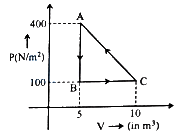 KCET 2019 Medium
 - The ratio of heats liberated at \( 298 \mathrm{~K} \) from the combustion of one \( \mathrm{kg} \) of coke and by burning
water gas obtained from \( 1 \mathrm{~kg} \) of coke is
(Assume coke to be \( 100 \% \) carbon.)
(Given enthalpies of combustion of \( \mathrm{CO}_{2}, \mathrm{CO} \) and \( \mathrm{H}_{2} \) as \( 393.5 \mathrm{~kJ}, 285 \mathrm{~kJ}, 285 \mathrm{~kJ} \) respectively
all at \( 298 \) K.)KCET 2014 Hard