


KCET · Maths · Matrices
If \(A=\left[\begin{array}{ccc}1 & -1 & 1 \\ 2 & 1 & -3 \\ 1 & 1 & 1\end{array}\right], 10 B=\left[\begin{array}{ccc}4 & 2 & 2 \\ -5 & 0 & \alpha \\ 1 & -2 & 3\end{array}\right]\) and \(B\) is the inverse of \(A\), then the value of \(\alpha\) is
- A 2
- B 0
- C 5
- D 4
Answer & Solution
Correct Answer
(C) 5
Step-by-step Solution
Detailed explanation
Given, \(A=\left[\begin{array}{ccc}1 & -1 & 1 \\ 2 & 1 & -3 \\ 1 & 1 & 1\end{array}\right]\)
and \(\quad 10 B=\left[\begin{array}{ccc}4 & 2 & 2 \\ -5 & 0 & \alpha \\ 1 & -2 & 3\end{array}\right]\)
Since, \(B\) is the inverse of \(A\),
i.e. \(\quad B=A^{-1}\)
So, \(\quad 10 A^{-1}=\left[\begin{array}{ccc}4 & 2 & 2 \\ -5 & 0 & \alpha \\ 1 & -2 & 3\end{array}\right]\)
\(\Rightarrow 10 A^{-1} A=\left[\begin{array}{ccc}4 & 2 & 2 \\ -5 & 0 & \alpha \\ 1 & -2 & 3\end{array}\right] A\)
\(\Rightarrow \quad 10 I=\left[\begin{array}{ccc}4 & 2 & 2 \\ -5 & 0 & \alpha \\ 1 & -2 & 3\end{array}\right]\left[\begin{array}{ccc}1 & -1 & 1 \\ 2 & 1 & -3 \\ 1 & 1 & 1\end{array}\right]\)
\(\Rightarrow\left[\begin{array}{ccc}10 & 0 & 0 \\ 0 & 10 & 0 \\ 0 & 0 & 10\end{array}\right]=\left[\begin{array}{ccc}10 & 0 & 0 \\ -5+\alpha & 5+\alpha & -5+\alpha \\ 0 & 0 & 10\end{array}\right]\)
\(\Rightarrow \quad-5+\alpha=0\)
\(\Rightarrow \quad \alpha=5\)
Alternative \(\quad A^{-1}=\frac{1}{|A|} \operatorname{adj}(A)\)
\(\operatorname{adj}(A)=\left[\begin{array}{ccc}4 & 2 & 2 \\ -5 & 0 & 5 \\ 1 & -2 & 3\end{array}\right]\)
\(|A|=1[1+3]+1[2+3]+1[2-1]=0\)
\(\therefore \quad A^{-1}=\frac{1}{10}\left[\begin{array}{ccc}4 & 2 & 2 \\ -5 & 0 & 5 \\ 1 & -2 & 3\end{array}\right]\)
\(10 B=\left[\begin{array}{ccc}4 & 2 & 2 \\ -5 & 0 & \alpha \\ 1 & -2 & 3\end{array}\right]\)
\[
\begin{aligned}
&=\left[\begin{array}{ccc}
4 & 2 & 2 \\
-5 & 0 & 5 \\
1 & -2 & 3
\end{array}\right] \\
\Rightarrow \quad \alpha &=5
\end{aligned}
\]
and \(\quad 10 B=\left[\begin{array}{ccc}4 & 2 & 2 \\ -5 & 0 & \alpha \\ 1 & -2 & 3\end{array}\right]\)
Since, \(B\) is the inverse of \(A\),
i.e. \(\quad B=A^{-1}\)
So, \(\quad 10 A^{-1}=\left[\begin{array}{ccc}4 & 2 & 2 \\ -5 & 0 & \alpha \\ 1 & -2 & 3\end{array}\right]\)
\(\Rightarrow 10 A^{-1} A=\left[\begin{array}{ccc}4 & 2 & 2 \\ -5 & 0 & \alpha \\ 1 & -2 & 3\end{array}\right] A\)
\(\Rightarrow \quad 10 I=\left[\begin{array}{ccc}4 & 2 & 2 \\ -5 & 0 & \alpha \\ 1 & -2 & 3\end{array}\right]\left[\begin{array}{ccc}1 & -1 & 1 \\ 2 & 1 & -3 \\ 1 & 1 & 1\end{array}\right]\)
\(\Rightarrow\left[\begin{array}{ccc}10 & 0 & 0 \\ 0 & 10 & 0 \\ 0 & 0 & 10\end{array}\right]=\left[\begin{array}{ccc}10 & 0 & 0 \\ -5+\alpha & 5+\alpha & -5+\alpha \\ 0 & 0 & 10\end{array}\right]\)
\(\Rightarrow \quad-5+\alpha=0\)
\(\Rightarrow \quad \alpha=5\)
Alternative \(\quad A^{-1}=\frac{1}{|A|} \operatorname{adj}(A)\)
\(\operatorname{adj}(A)=\left[\begin{array}{ccc}4 & 2 & 2 \\ -5 & 0 & 5 \\ 1 & -2 & 3\end{array}\right]\)
\(|A|=1[1+3]+1[2+3]+1[2-1]=0\)
\(\therefore \quad A^{-1}=\frac{1}{10}\left[\begin{array}{ccc}4 & 2 & 2 \\ -5 & 0 & 5 \\ 1 & -2 & 3\end{array}\right]\)
\(10 B=\left[\begin{array}{ccc}4 & 2 & 2 \\ -5 & 0 & \alpha \\ 1 & -2 & 3\end{array}\right]\)
\[
\begin{aligned}
&=\left[\begin{array}{ccc}
4 & 2 & 2 \\
-5 & 0 & 5 \\
1 & -2 & 3
\end{array}\right] \\
\Rightarrow \quad \alpha &=5
\end{aligned}
\]
See the Complete Solution
Get step-by-step explanations for this and 2.5 Lakh+ more JEE, NEET & CET questions.
- Unlock all solutions
- Practice the full chapter
- Track accuracy across PYQs
4.8 rated on Google Play · 14,000+ reviews
More questions from Maths
- If \(\mathrm{m}\) is the slope of one of the lines represented by \(a x^{2}+2 h x y+b^{2}=0\), then \((h+b m)^{2}\) is equal toKCET 2010 Hard
- The sum of the degree and order of the differential equation \(\left(1+y_1^2\right)^{2 / 3}=y_2\) isKCET 2022 Easy
- The function \(f(x)=[x]\), where \([x]\) denotes the greatest integer not greater than \(x\), isKCET 2010 Easy
- The last digit of number \(7^{886}\) isKCET 2012 Easy
- The value of \(\int \frac{1+x^{4}}{1+x^{6}} d x\) isKCET 2020 Medium
- If \(x+y=\tan ^{-1} y\) and \(\frac{d^{2} y}{d x^{2}}=f(y) \frac{d y}{d x}\), then \(f(y)\) is equal toKCET 2013 Hard
More PYQs from KCET
- Arrange benzene, \(n\)-hexane and ethyne in decreasing order of their acidic behaviour.KCET 2021 Medium
- Several mammary ducts join to form a wider structure called:KCET 2018 Hard
- Five capacitance each of value \(l \mu \mathrm{F}\) are connected as shown in the figure. The equivalent capacitance between \(A\) and \(B\) is
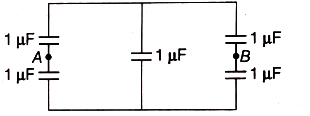 KCET 2023 Easy
 - The value of the expression \( \tan \left(\frac{1}{2} \cos ^{-1} \frac{2}{\sqrt{5}}\right) \) isKCET 2018 Hard
- The range of the function \(f(x)=\sin [x],-\frac{\pi}{4} < x < \frac{\pi}{4}\), where \([x]\) denotes the greatest integer \(\leq x\), isKCET 2013 Easy
- \( \int \frac{\sin 2 x}{\left(\sin ^{2} x+2 \cos ^{2} x\right.} d x= \)KCET 2014 Medium