


KCET · Chemistry · General Organic Chemistry
Arrange benzene, \(n\)-hexane and ethyne in decreasing order of their acidic behaviour.
- A Benzene \(>n\)-hexane \(>\) Ethyne
- B \(n\)-hexane \(>\) Benzene \(>\) Ethyne
- C Ethyne \(>n\)-hexane \(>\) Benzene
- D Ethyne \(>\) Benzene \(>n\)-hexane
Answer & Solution
Correct Answer
(D) Ethyne \(>\) Benzene \(>n\)-hexane
Step-by-step Solution
Detailed explanation
The decreasing order of acidic behaviour is ethyne \(>\) benzene \(>n\)-hexane
Because carbon in ethyne, benzene and \(n\)-hexane are \(s p, s p^{2}\) and \(s p^{3}\) hybridised respectively.
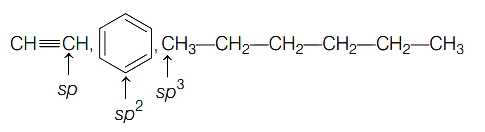
\(\therefore\) The carbocation formed after the removal of ' \(\mathrm{H}\) ' is more stable in \(s p\) hybridised carbon atom because of high electronegativity due to more \(s\)-character.
Because carbon in ethyne, benzene and \(n\)-hexane are \(s p, s p^{2}\) and \(s p^{3}\) hybridised respectively.
\(\therefore\) The carbocation formed after the removal of ' \(\mathrm{H}\) ' is more stable in \(s p\) hybridised carbon atom because of high electronegativity due to more \(s\)-character.
See the Complete Solution
Get step-by-step explanations for this and 2.5 Lakh+ more JEE, NEET & CET questions.
- Unlock all solutions
- Practice the full chapter
- Track accuracy across PYQs
4.8 rated on Google Play · 14,000+ reviews
More questions from Chemistry
- The shape of \( X e F_{6} \) is,KCET 2016 Easy
- Arrange the following compounds in their decreasing order of reactivity towards Nucleop addition reaction.
\(\mathrm{CH}_3 \mathrm{COCH}_3, \mathrm{CH}_3 \mathrm{COC}_2 \mathrm{H}_5, \mathrm{CH}_3 \mathrm{CHO}\)KCET 2025 Medium - The order of stability of metal oxides isKCET 2009 Easy
- The compound with molecular formula \(\text{C}_{20}\text{H}_{42}\) isKCET 2026 Easy
- Which of the following is not true?KCET 2016 Easy
- \(25 \mathrm{~g}\) of each of the following gasses are taken at \(27^{\circ} \mathrm{C}\) and \(600 \mathrm{~mm}\) pressure. Which of these will have the least volume?KCET 2011 Easy
More PYQs from KCET
- The \(X\) and \(Y\) components of a force \(F\) acting at \(30^{\circ}\) to \(x\)-axis are respectivelyKCET 2012 Easy
- Which of the following statements is incorrect w.r.t. Physisorption ?KCET 2016 Easy
- A hot body is allowed to cool. The surrounding temperature is constant at \(30^{\circ} \mathrm{C}\). The takes time \(t_{1}\) to cool from \(70^{\circ} \mathrm{C}\) to \(68^{\circ} \mathrm{C}\) and time \(t_{2}\) to cool from \(60^{\circ} \mathrm{C}\) to \(59.5^{\circ} \mathrm{C}\). ThenKCET 2012 Medium
- Two rectangular blocks \(A\) and \(B\) of masses \(2 \mathrm{~kg}\) and \(3 \mathrm{~kg}\) respectively are connected by a spring of spring constant \(10.8 \mathrm{Nm}^{-1}\) and are placed on a frictionless horizontal surface. The block A was given an initial velocity of \(0.15 \mathrm{~ms}^{-1}\) in the direction shown in the figure. The maximum compression of the spring during the motion is
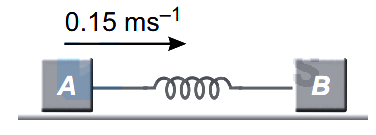 KCET 2009 Hard
 - A radioactive nucleus has specific binding energy \(\mathrm{E}_{1}\). It emits an \(\alpha\)-particle. The resulting nucleus has specific binding energy \(\mathrm{E}_{2}\). ThenKCET 2012 Medium
- In garden pea, round shape of seeds is dominant over wrinkled shape. A pea plant heterozygous for round shape of seed is selfed and 1600 seeds produced during the cross are subsequently germinated. How many seedlings would have the parental phenotype?KCET 2014 Hard