


KCET · Maths · Differentiation
If \(2^{x}+2^{y}=2^{x+y}\), then \(\frac{d y}{d x}\) is
- A \(2^{y-x}\)
- B \(-2^{y-x}\)
- C \(2^{x-y}\)
- D \(\frac{2^{y}-1}{2^{x}-1}\)
Answer & Solution
Correct Answer
(B) \(-2^{y-x}\)
Step-by-step Solution
Detailed explanation
We have,
\(2^{x}+2^{y}=2^{x+y}...(i)\)
On differentiating Eq. (i) w.r.t. \(x\), we get
\(2^{x} \log 2+2^{y} \log 2 \frac{d y}{d x}\)
\(=2^{x+y} \log 2\left(1+\frac{d y}{d x}\right)\)
\(\Rightarrow \quad 2^{x}+2^{y} \frac{d y}{d x}=2^{x+y}\left(1+\frac{d y}{d x}\right)\)
\(\Rightarrow \quad 2^{x}-2^{x+y}=\frac{d y}{d x}\left(2^{x+y}-2^{y}\right)\)
\(\Rightarrow \quad-2^{y}=\frac{d y}{d x}\left(2^{x}\right)\)
\(\Rightarrow \quad \frac{d y}{d x}=-2^{y} / 2^{x}=-2^{y-x}\)
\(2^{x}+2^{y}=2^{x+y}...(i)\)
On differentiating Eq. (i) w.r.t. \(x\), we get
\(2^{x} \log 2+2^{y} \log 2 \frac{d y}{d x}\)
\(=2^{x+y} \log 2\left(1+\frac{d y}{d x}\right)\)
\(\Rightarrow \quad 2^{x}+2^{y} \frac{d y}{d x}=2^{x+y}\left(1+\frac{d y}{d x}\right)\)
\(\Rightarrow \quad 2^{x}-2^{x+y}=\frac{d y}{d x}\left(2^{x+y}-2^{y}\right)\)
\(\Rightarrow \quad-2^{y}=\frac{d y}{d x}\left(2^{x}\right)\)
\(\Rightarrow \quad \frac{d y}{d x}=-2^{y} / 2^{x}=-2^{y-x}\)
See the Complete Solution
Get step-by-step explanations for this and 2.5 Lakh+ more JEE, NEET & CET questions.
- Unlock all solutions
- Practice the full chapter
- Track accuracy across PYQs
4.8 rated on Google Play · 14,000+ reviews
More questions from Maths
- If \(\mathbf{a}, \mathbf{b}\) and \(\mathbf{c}\) are three non-coplanar vectors and
\(\mathbf{p}, \mathbf{q}\) and \(\mathbf{r}\) are vectors defined by \(\mathbf{p}=\frac{\mathbf{b} \times \mathbf{c}}{[\mathbf{a} \mathbf{b} \mathbf{c}]}, \mathbf{q}=\frac{\mathbf{c} \times \mathbf{a}}{[\mathbf{a} \mathbf{b} \mathbf{c}]}\) and \(\mathbf{r}=\frac{\mathbf{a} \times \mathbf{b}}{[\mathbf{a} \mathbf{b} \mathbf{c}]}\), then the value of \((\mathbf{a}+\mathbf{b}) \cdot \mathbf{p}+(\mathbf{b}+\mathbf{c}) \cdot \mathbf{q}+(\mathbf{c}+\mathbf{a}) \cdot \mathbf{r}\) is equal toKCET 2012 Easy - If \(f(x)=\sin \left[\pi^{2}\right] x+\cos \left[-\pi^{2}\right] x\), then \(f^{\prime}(x)\) is, here \(\left[\pi^{2}\right]\) and \(\left[-\pi^{2}\right]\) greatest integer function not greater than its valueKCET 2012 Medium
- The probability distribution of \( x \) is
\(\begin{array}{|l|l|l|l|l|}
\hline \mathbf{x} & 0 & 1 & 2 & 3 \\
\hline \mathbf{P}(\mathbf{x}) & 0.2 & k & k & 2 k \\
\hline
\end{array}\)
find the value of \( k \)KCET 2015 Hard - The order of the differential equation obtained by eliminating arbitrary constants in the family of curves \(c_{1} y=\left(c_{2}+c_{3}\right) e^{x+c_{4}}\) isKCET 2020 Medium
- \( 3+5+7+\ldots \ldots \) to \( n \) terms isKCET 2017 Easy
- If \(4^{\text {th }}, 10^{\text {th }}\) and \(16^{\text {th }}\) terms of a G.P. are \(\mathrm{x}, \mathrm{y}\) and z respectively, thenKCET 2025 Easy
More PYQs from KCET
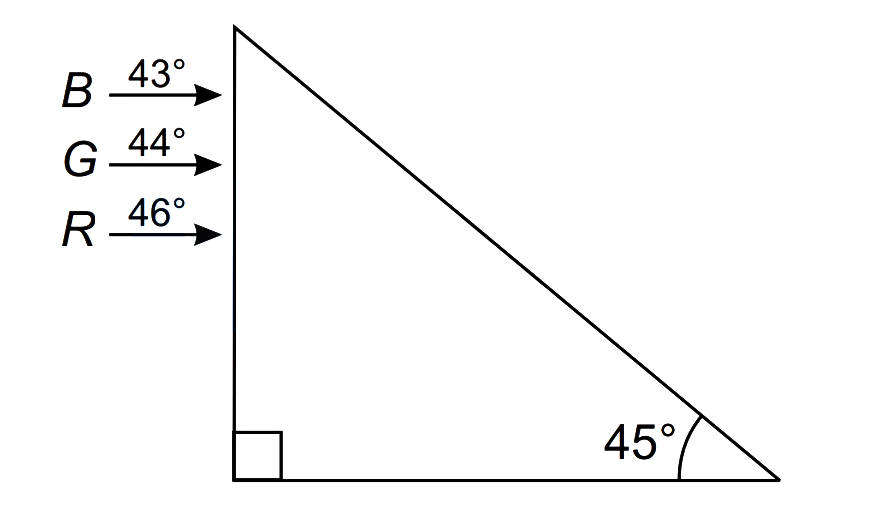
- Figure shows a mixture of blue, green and red coloured rays incident normally on a right angled prism. The critical angles of the material of the prism for red, green and blue are \(46^{\circ}, 44^{\circ}\) and \(43^{\circ}\) respectively. The arrangement will separate
 KCET 2008 Medium
 - A crystalline solid \( X Y_{3} \) has ccp arrangement for its element \( Y . X \) occupiesKCET 2014 Medium
- When the pure solvent diffuses out of the solution through the semi-permeable membrane then
the process is calledKCET 2017 Medium - The correct sequence of steps involved in the mechanism of Cannizaro's reaction isKCET 2010 Easy
- Consider the following statements in case of Young's double slit experiment.
(1) A slit \(S\) is necessary if we use an ordinary extended source of light.
(2) A slit \(S\) is not needed if we use an ordinary but well collimated beam of light.
(3) A slit \(S\) is not needed if we use a spatially coherent source of light.
Which of the above statements are correct?KCET 2011 Easy - Hydrogen atom from excited state comes to the ground stage by emitting a photon of wavelength \(\lambda\). If \(R\) is the Rydberg constant, the principal quantum number \(n\) of the excited state isKCET 2009 Medium