


KCET · Maths · Differentiation
If \(f(x)=\sin \left[\pi^{2}\right] x+\cos \left[-\pi^{2}\right] x\), then \(f^{\prime}(x)\) is, here \(\left[\pi^{2}\right]\) and \(\left[-\pi^{2}\right]\) greatest integer function not greater than its value
- A \(\sin 9 x+\cos 9 x\)
- B \(9 \cos 9 x-10 \sin 10 x\)
- C 0
- D \(-1\)
Answer & Solution
Correct Answer
(B) \(9 \cos 9 x-10 \sin 10 x\)
Step-by-step Solution
Detailed explanation
We have, \(\pi^{2}=9.86 \quad\) (nearly)
\[
\begin{aligned}
\therefore \cos \left[-\pi^{2}\right] x &=\cos [-9.86] x \\
&=\cos (-10) x=\cos 10 x \\
\therefore \quad \sin \left[\pi^{2}\right] x &=\sin [9.86] x=\sin 9 x \\
\therefore \quad f(x) &=\sin \left[\pi^{2}\right] x+\cos \left[-\pi^{2}\right] x \\
f(x) &=\sin 9 x+\cos 10 x
\end{aligned}
\]
On differentiating w.r.t. \(x\), we get
\[
\Rightarrow \quad f^{\prime}(x)=9 \cos 9 x-10 \sin 10 x
\]
\[
\begin{aligned}
\therefore \cos \left[-\pi^{2}\right] x &=\cos [-9.86] x \\
&=\cos (-10) x=\cos 10 x \\
\therefore \quad \sin \left[\pi^{2}\right] x &=\sin [9.86] x=\sin 9 x \\
\therefore \quad f(x) &=\sin \left[\pi^{2}\right] x+\cos \left[-\pi^{2}\right] x \\
f(x) &=\sin 9 x+\cos 10 x
\end{aligned}
\]
On differentiating w.r.t. \(x\), we get
\[
\Rightarrow \quad f^{\prime}(x)=9 \cos 9 x-10 \sin 10 x
\]
See the Complete Solution
Get step-by-step explanations for this and 2.5 Lakh+ more JEE, NEET & CET questions.
- Unlock all solutions
- Practice the full chapter
- Track accuracy across PYQs
4.8 rated on Google Play · 14,000+ reviews
More questions from Maths
- The contrapositive statement of the statement "If \( x \) is prime number, then \( x \) is odd" isKCET 2017 Easy
- The angles of a triangle are in A.P and the greatest angle is double the least angle, then sine of the third angle isKCET 2026 Easy
- If \((2,3,-1)\) is the foot of the perpendicular from \((4,2,1)\) to a plane, then the equation of the plane isKCET 2023 Easy
- A wire of length \(20 \mathrm{~cm}\) is bent in the form of a sector of a circle. The maximum area that can be enclosed by the wire isKCET 2010 Hard
- The digit in the unit place of the number \(2009 !+3^{7886}\) isKCET 2009 Medium
- \(\lim _{x \rightarrow 1} \frac{x^4-\sqrt{x}}{\sqrt{x}-1}\) isKCET 2025 Medium
More PYQs from KCET
- In a transition series, with increase in atomic-number, the paramagnetismKCET 2013 Easy
- Two simple harmonic motions are represented by
\(\begin{aligned} \mathrm{y}_{1} &=5[\sin 2 \pi \mathrm{t}+\sqrt{3} \cos 2 \pi \mathrm{t}] \\ \text {and}~ \mathrm{y}_{2} &=5 \sin \left(2 \pi \mathrm{t}+\frac{\pi}{4}\right) \end{aligned}\)
The ratio of their amplitudes isKCET 2010 Easy - Given below and the atomic masses of the elements:
\begin{array}{|l|l|l|l|l|l|l|l|l|l|}
\hline \text { Element: } & \mathrm{Li} & \mathrm{Na} & \mathrm{Cl} & \mathrm{~K} & \mathrm{Ca} & \mathrm{Br} & \mathrm{Sr} & \mathrm{I} & \mathrm{Ba} \\
\hline \text { Atomic Mas }\left(\mathrm{g} \mathrm{~mol}^{-1}\right): & 7 & 23 & 35.5 & 39 & 40 & 80 & 88 & 127 & 137 \\
\hline
\end{array}
Which of the following doesn't form triad?KCET 2025 Easy - The value of I in the figure shown below is
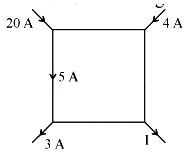 KCET 2017 Easy
 - A \( 10 \mathrm{~kg} \) metal block is attached to a spring of spring constant \( 1000 \mathrm{~N} \mathrm{~m}^{-1} \), A block is
displaced from equilibrium position by \( 10 \mathrm{~cm} \) and released. The maximum acceleration of the
block isKCET 2014 Easy - The resistance of a wire at \(300 \mathrm{~K}\) is found to be \(0.3 \Omega\). If the temperature coefficient of resistance of wire is \(1.5 \times 10^{-3} \mathrm{~K}^{-1}\), the temperature at which the resistance becomes \(0.6 \Omega\) isKCET 2009 Hard