


KCET · Maths · Linear Programming
Consider the following statements:
Statement (I): In a LPP, the objective function is always linear.
Statement (II): In a LPP, the linear inequalities on variables are called constraints.
Which of the following is correct?
- A Statement (I) is true, Statement (II) is true
- B Statement (I) is true, Statement (II) is false
- C Both Statements (I) and (II) are false
- D Statement (I) is false, Statement (II) is true
Answer & Solution
Correct Answer
(A) Statement (I) is true, Statement (II) is true
Step-by-step Solution
Detailed explanation
Both Statement (I) and Statement (II) are true in a Linear Programming Problem (LPP):
Statement (1):
The objective function in an LPP is always linear, meaning it can be expressed as a linear equation with the variables raised to the power of one.
Statement (II):
The linear inequalities that restrict the variables in an LPP are called constraints.
Explanation:
In a linear programming problem, you are trying to optimize (maximize or minimize) an objective function (a linear equation) while adhering to certain constraints (linear inequalities) that limit the possible values of the variables.
Statement (1):
The objective function in an LPP is always linear, meaning it can be expressed as a linear equation with the variables raised to the power of one.
Statement (II):
The linear inequalities that restrict the variables in an LPP are called constraints.
Explanation:
In a linear programming problem, you are trying to optimize (maximize or minimize) an objective function (a linear equation) while adhering to certain constraints (linear inequalities) that limit the possible values of the variables.
See the Complete Solution
Get step-by-step explanations for this and 2.5 Lakh+ more JEE, NEET & CET questions.
- Unlock all solutions
- Practice the full chapter
- Track accuracy across PYQs
4.8 rated on Google Play · 14,000+ reviews
More questions from Maths
- A YouTube short video is getting viral according to \(f(t) = -2t^3 + 3t^2 + 5\). At what time does the video get maximum number of shares? (\(t\) is in hours)KCET 2026 Medium
- If \( A=\left[\begin{array}{ll}1 & 3 \\ 4 & 2\end{array}\right], B=\left[\begin{array}{cc}2 & -1 \\ 1 & 2\end{array}\right] \) then \( \left|A B B^{\prime}\right|= \)KCET 2019 Medium
- If \(A=\left|\begin{array}{ll}x & 1 \\ 1 & x\end{array}\right|\) and \(B=\left|\begin{array}{lll}x & 1 & 1 \\ 1 & x & 1 \\ 1 & 1 & x\end{array}\right|\), then \(\frac{d B}{d x}\) isKCET 2024 Easy
- The shaded region in the figure given is the solution of which of the inequations?
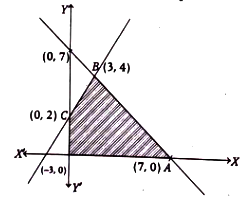 KCET 2023 Easy
 - The contrapositive statement of the statement "If \( x \) is prime number, then \( x \) is odd" isKCET 2017 Easy
- A function is \(f(x)=\left\{\begin{array}{cc}\frac{e^{\frac{1}{x}}-1}{e^{\frac{1}{x}}+1}, & \text { if } x \neq 0 \\ 0, & \text { if } x=0\end{array}\right.\)KCET 2025 Medium
More PYQs from KCET
- Which one of the following is not true regarding electromeric effect?KCET 2012 Easy
- The function \(f(x)=[x]\), where \([x]\) denotes the greatest integer not greater than \(x\), isKCET 2010 Easy
- If \(P(x, y)\) denotes \(z=x+i y\) in Argand's plane and \(\left|\frac{z-1}{z+2 i}\right|=1\), then the locus of \(P\) is a/anKCET 2011 Easy
- The derivative of \(\sin x\) with respect to \(\log x\) isKCET 2025 Easy
- A resistor of \(500 \Omega\), an inductance of \(0.5 \mathrm{H}\) are in series with an AC which is given by \(V=100 \sqrt{2} \sin (1000 t)\). The power factor of the combination isKCET 2012 Medium
- A dipole moment \(p\) and moment of inertia \(I\) is placed in a uniform electric field \(\mathbf{E}\). If it is displaced slightly from its stable equilibrium position, the period of oscillation of dipole isKCET 2020 Easy