


KCET · Physics · Electrostatics
The concentric spheres of radii \(R\) and \(r\) have positive charges \(q_{1}\) and \(q_{2}\) with equal surface charge densities. What is the electric potential at their common centre?
- A \(\frac{\sigma}{\varepsilon_{0}}(R+r)\)
- B \(\frac{\sigma}{\varepsilon_{0}}(R-r)\)
- C \(\frac{\sigma}{\varepsilon_{0}}\left(\frac{1}{R}+\frac{1}{r}\right)\)
- D \(\frac{\sigma}{\varepsilon_{0}}\left(\frac{1}{R}\right)\)
Answer & Solution
Correct Answer
(A) \(\frac{\sigma}{\varepsilon_{0}}(R+r)\)
Step-by-step Solution
Detailed explanation
Potential at the centre due to sphere with radius \(R\),
\(V_{1}=\frac{q_{1}}{4 \pi \varepsilon_{0} R}\)
Potential at the centre due to sphere with radius \(r\),
\(V_{2}=\frac{q_{2}}{4 \pi \varepsilon_{0} r}\)
Given, surface charge densities for both spheres
\(\sigma=\sigma_{R}=\sigma_{r}\)
i.e.,
\(\text {i.e., } \frac{q_{1}}{4 \pi \varepsilon_{0} R^{2}} =\frac{q_{2}}{4 \pi \varepsilon_{0} r^{2}} \)
\( \Rightarrow q_{1} =\frac{R^{2}}{r^{2}} q_{2}\)
Total potential at the centre due to both spheres
\(\begin{aligned}
V &=V_{1}+V_{2} \\
&=\frac{q_{1}}{4 \pi \varepsilon_{0} R}+\frac{q_{2}}{4 \pi \varepsilon_{0} r}=\frac{1}{4 \pi \varepsilon_{0}}\left(\frac{q_{1}}{R}+\frac{q_{2}}{r}\right) \\
&=\frac{1}{4 \pi \varepsilon_{0}}\left(\frac{R^{2}}{r^{2}} \frac{q_{2}}{R}\right)+\frac{q_{2}}{r}=\frac{q_{2}}{4 \pi \varepsilon_{0}}\left(\frac{R+r}{r^{2}}\right) \\
&=\frac{q_{2}}{4 \pi r^{2} \varepsilon_{0}}(R+r)=\frac{\sigma}{\varepsilon_{0}}(R+r)
\end{aligned}\)
\(V_{1}=\frac{q_{1}}{4 \pi \varepsilon_{0} R}\)
Potential at the centre due to sphere with radius \(r\),
\(V_{2}=\frac{q_{2}}{4 \pi \varepsilon_{0} r}\)
Given, surface charge densities for both spheres
\(\sigma=\sigma_{R}=\sigma_{r}\)
i.e.,
\(\text {i.e., } \frac{q_{1}}{4 \pi \varepsilon_{0} R^{2}} =\frac{q_{2}}{4 \pi \varepsilon_{0} r^{2}} \)
\( \Rightarrow q_{1} =\frac{R^{2}}{r^{2}} q_{2}\)
Total potential at the centre due to both spheres
\(\begin{aligned}
V &=V_{1}+V_{2} \\
&=\frac{q_{1}}{4 \pi \varepsilon_{0} R}+\frac{q_{2}}{4 \pi \varepsilon_{0} r}=\frac{1}{4 \pi \varepsilon_{0}}\left(\frac{q_{1}}{R}+\frac{q_{2}}{r}\right) \\
&=\frac{1}{4 \pi \varepsilon_{0}}\left(\frac{R^{2}}{r^{2}} \frac{q_{2}}{R}\right)+\frac{q_{2}}{r}=\frac{q_{2}}{4 \pi \varepsilon_{0}}\left(\frac{R+r}{r^{2}}\right) \\
&=\frac{q_{2}}{4 \pi r^{2} \varepsilon_{0}}(R+r)=\frac{\sigma}{\varepsilon_{0}}(R+r)
\end{aligned}\)
See the Complete Solution
Get step-by-step explanations for this and 2.5 Lakh+ more JEE, NEET & CET questions.
- Unlock all solutions
- Practice the full chapter
- Track accuracy across PYQs
4.8 rated on Google Play · 14,000+ reviews
More questions from Physics
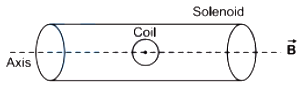
- The torque required to hold a small circular coil of 10 turns, area \(1 \mathrm{~mm}^{2}\) and carrying a current of \(\left(\frac{21}{44}\right)\) A in the middle of a long solenoid of \(10^{3}\) turns/m carrying a current of \(2.5 \mathrm{~A}\), with its axis perpendicular to the axis of the solenoid is
 KCET 2011 Hard
 - A solenoid of length \(50 \mathrm{~cm}\) having 100 turns carries a current of \(2.5 \mathrm{~A}\). The magnetic field at one end of the solenoid isKCET 2022 Easy
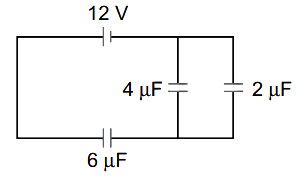
- The charge deposited on \(4 \mu \mathrm{F}\) capacitor in the circuit is
 KCET 2009 Hard
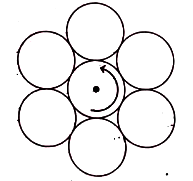
 - Seven identical discs are arranged in a planar pattern, so as to touch each other as shown in the figure. Each disc has mass \(m\) radius \(R\). What is the moment of inertia of system of six discs about an axis passing through the centre of central disc and normal to plane of all discs?
 KCET 2023 Easy
 - Two masses of \(5 \mathrm{~kg}\) and \(3 \mathrm{~kg}\) are suspended with the help of massless inextensible strings as shown in figure below.
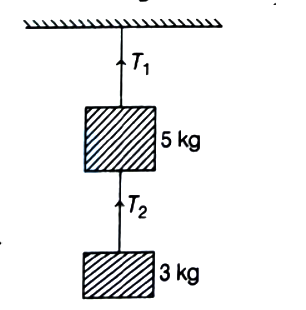
When whole system is going upwards with acceleration \(2 \mathrm{~m} / \mathrm{s}^2\), the value of \(T_1\) is (use, \(g=9.8 \mathrm{~m} / \mathrm{s}^2\) )KCET 2022 Medium - Two particles which are initially at rest move towards each other under the action of their
mutual attraction. If their speeds are \( v \) and \( 2 v \) at any instant, then the speed of center of mass
of the system is,KCET 2019 Easy
More PYQs from KCET
- The phenomenon of polarization shows that light has ......... nature.KCET 2012 Easy
- Volume occupied by single \( \mathrm{CsCl} \) ion pair in a crystal is \( 7.014 \times 10^{-23} \mathrm{~cm}^{3} \). The smallest \( \mathrm{Cs}- \)
Cs inter-nuclear distance is equal to length of the side of the cube corresponding to volume of
one \( \mathrm{CsCl} \) ion pair. The smallest \( \mathrm{Cs}-\mathrm{Cs} \) inter-nuclear distance is nearlyKCET 2014 Medium - Effective resistance between \( A \) and \( B \) in the following circuit
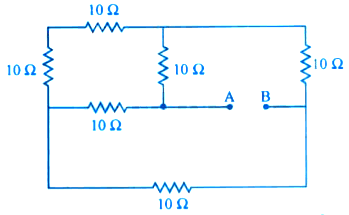 KCET 2016 Hard
 - \(\int_0^1 \frac{x e^x}{(2+x)^3} d x\) is equal toKCET 2022 Medium
- If \( |\bar{a} \times \bar{b}|^{2}+|\bar{a} \cdot \bar{b}|^{2}=144 \) and \( |\bar{a}|=4 \), then the value of \( |\bar{b}| \) isKCET 2018 Hard
- The pressure at the bottom of a liquid tank is not proportional to theKCET 2018 Medium