


KCET · Maths · Heights and Distances
Angles of elevation of the top of a tower from three points (collinear) \(A, B\) and \(C\) on a road leading to the foot of the tower are \(30^{\circ}, 45^{\circ}\) and \(60^{\circ}\) respectively. The ratio of \(A B\) to \(B C\) is
- A \(\sqrt{3}: 1\)
- B \(\sqrt{3}: 2\)
- C \(1: 2\)
- D \(2: \sqrt{3}\)
Answer & Solution
Correct Answer
(A) \(\sqrt{3}: 1\)
Step-by-step Solution
Detailed explanation
By sine law, in \(\triangle A B Q\)
\(\frac{\sin 15^{\circ}}{A B}=\frac{\sin 30^{\circ}}{B Q}\)
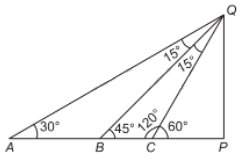
\(\Rightarrow B Q=\frac{\sin 30^{\circ} \cdot A B}{\sin 15^{\circ}}\)
By sine law, in \(\triangle B C Q\)
\(\frac{\sin 120^{\circ}}{B Q}=\frac{\sin 15^{\circ}}{B C} \)
\(\Rightarrow B Q=\frac{B C \sin 120^{\circ}}{\sin 15^{\circ}}\)
From Eqs. (i) and (ii), we get
\(\frac{\sin 30^{\circ} \cdot A B}{\sin 15^{\circ}} =\frac{B C \cdot \sin 120^{\circ}}{\sin 15^{\circ}} \)
\(\Rightarrow \frac{A B}{B C}-\frac{\sin 120^{\circ}}{\sin 30^{\circ}} =\frac{\cos 30^{\circ}}{\sin 30^{\circ}}-\frac{\sqrt{3} / 2}{1 / 2} \)
\(A B: B C =\sqrt{3}: 1\)
\(\frac{\sin 15^{\circ}}{A B}=\frac{\sin 30^{\circ}}{B Q}\)
\(\Rightarrow B Q=\frac{\sin 30^{\circ} \cdot A B}{\sin 15^{\circ}}\)
By sine law, in \(\triangle B C Q\)
\(\frac{\sin 120^{\circ}}{B Q}=\frac{\sin 15^{\circ}}{B C} \)
\(\Rightarrow B Q=\frac{B C \sin 120^{\circ}}{\sin 15^{\circ}}\)
From Eqs. (i) and (ii), we get
\(\frac{\sin 30^{\circ} \cdot A B}{\sin 15^{\circ}} =\frac{B C \cdot \sin 120^{\circ}}{\sin 15^{\circ}} \)
\(\Rightarrow \frac{A B}{B C}-\frac{\sin 120^{\circ}}{\sin 30^{\circ}} =\frac{\cos 30^{\circ}}{\sin 30^{\circ}}-\frac{\sqrt{3} / 2}{1 / 2} \)
\(A B: B C =\sqrt{3}: 1\)
See the Complete Solution
Get step-by-step explanations for this and 2.5 Lakh+ more JEE, NEET & CET questions.
- Unlock all solutions
- Practice the full chapter
- Track accuracy across PYQs
4.8 rated on Google Play · 14,000+ reviews
More questions from Maths
- Consider the following statements :
(a) If any two rows or columns of a determinant are identical, then the value of the determinant
is zero.
(b) If the corresponding rows and columns of a determinant are interchanged, then the value of
the determinant does not change.
(c) If any two rows (or columns) of a determinant are interchanged, then the value of the
determinant changes in sign.
Which of these are correct ?KCET 2014 Easy - \( X Y \) - plane divides the line joining the points \( A(2,3,-5) \) and \( B(-1,-2,-3) \) in the ratioKCET 2019 Easy
- The modulus of the complex number
\(\frac{(1+i)^2(1+3 i)}{(2-6 i)(2-2 i)}\) isKCET 2023 Easy - A particle starts form rest and its angular displacement (in radians) is given by \(\theta=\frac{t^{2}}{20}+\frac{t}{5}\). If the angular velocity at the end of \(t=4\) is \(k\), then the value of \(5 k\) isKCET 2021 Easy
- The angles of a triangle are in A.P and the greatest angle is double the least angle, then sine of the third angle isKCET 2026 Easy
- Events \(E_{1}\) and \(E_{2}\) from a partition of the sample space \(S . A\) is any event such that \(P\left(E_{1}\right)=P\left(E_{2}\right)=\frac{1}{2}, P\left(E_{2} / A\right)=\frac{1}{2}\) and \(P\left(A / E_{2}\right)=\frac{2}{3}\), then \(P\left(E_{1} / A\right)\) isKCET 2020 Easy
More PYQs from KCET
- The sodium fusion extract is boiled with concentrated nitric acid while testing for halogens. By doing so, itKCET 2025 Medium
- The edible part of the fruit of apple isKCET 2016 Medium
- For the decomposition of a compound \(A B\) at \(600 \mathrm{~K}\), the following data were obtained
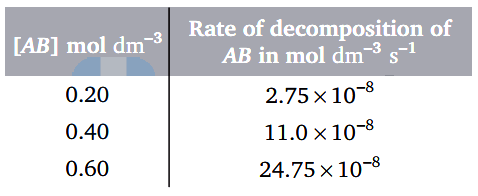
The order for the decomposition of \(A B\) isKCET 2009 Easy - If \(x=a \cos ^{3} \theta\) and \(y=a \sin ^{3} \theta\), then \(\frac{d y}{d x}\) isKCET 2010 Medium
- The direction of a ray of light incident on a concave mirror is shown by PQ, while direction in which the ray would travel after reflection is shown by four rays marked as A, B, C and D as shown in the figure. Which of the four rays correctly shows the direction of the reflected ray?
 KCET 2026 Easy
 - The figure gives the electric potential \( V \) as a function of distance through four regions on \( x- \) axis. Which of the following is true for the magnitude of the electric field \( E \) in these regions?
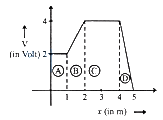 KCET 2019 Easy