


KCET · Chemistry · p Block Elements (Group 15, 16, 17 & 18)
Which one of the following oxoacids of phosphorus can reduce \(\mathrm{AgNO}_3\) to metallic silver?
- A \(\mathrm{H}_3 \mathrm{PO}_2\)
- B \(\mathrm{H}_4 \mathrm{P}_2 \mathrm{O}_7\)
- C \(\mathrm{H}_4 \mathrm{P}_2 \mathrm{O}_6\)
- D \(\mathrm{H}_3 \mathrm{PO}_4\)
Answer & Solution
Correct Answer
(A) \(\mathrm{H}_3 \mathrm{PO}_2\)
Step-by-step Solution
Detailed explanation
Hypophosphorus acid \(\left(\mathrm{H}_3 \mathrm{PO}_2\right)\) is a strong
reducing agent which can effectively reduce \(\mathrm{Ag}^{+}\) ions to \(\mathrm{Ag}\) and itself gets oxidise to phosphorus acid \(\left[\mathrm{H}_3 \mathrm{PO}_3\right]\) as follows
\(\begin{aligned} 3 \mathrm{AgNO}_3+4 \mathrm{H}_3 \mathrm{PO}_2+\mathrm{H}_2 \mathrm{O} \longrightarrow & 3 \mathrm{Ag}+4 \mathrm{H}_3 \mathrm{PO}_3 \\ & +3 \mathrm{HNO}_3\end{aligned}\)
reducing agent which can effectively reduce \(\mathrm{Ag}^{+}\) ions to \(\mathrm{Ag}\) and itself gets oxidise to phosphorus acid \(\left[\mathrm{H}_3 \mathrm{PO}_3\right]\) as follows
\(\begin{aligned} 3 \mathrm{AgNO}_3+4 \mathrm{H}_3 \mathrm{PO}_2+\mathrm{H}_2 \mathrm{O} \longrightarrow & 3 \mathrm{Ag}+4 \mathrm{H}_3 \mathrm{PO}_3 \\ & +3 \mathrm{HNO}_3\end{aligned}\)
See the Complete Solution
Get step-by-step explanations for this and 2.5 Lakh+ more JEE, NEET & CET questions.
- Unlock all solutions
- Practice the full chapter
- Track accuracy across PYQs
4.8 rated on Google Play · 14,000+ reviews
More questions from Chemistry
- 180 g of glucose, \(\mathrm{C}_6 \mathrm{H}_{12} \mathrm{O}_6\), is dissolved in 1 kg of water in a vessel. The temperature at which water boils at 1.013 bar is ______ (given, \(\mathrm{K}_{\mathrm{b}}\) for water is \(052 \mathrm{~K} \mathrm{~kg} \mathrm{~mol}^{-1}\). Boiling point for pure water is 373.15 K )KCET 2025 Medium
- The third ionisation enthalpy is highest inKCET 2021 Easy
- When carbon monoxide is passed over solid caustic soda heated to \(200^{\circ} \mathrm{C}\), it formsKCET 2008 Medium
-

\(a\) and \(y\) respectively areKCET 2023 Medium - Enthalpy of vaporization of benzene is \(+35.3 \mathrm{~kJ} \mathrm{~mol}^{-1}\) at its boiling point, \(80^{\circ} \mathrm{C}\). The entropy change in the transition of the vapour to liquid at its boiling point in \(\left[\mathrm{JK}^{-1} \mathrm{~mol}^{-1}\right]\) isKCET 2010 Medium
- The vapour pressures of two liquids \(A\) and \(B\) in their pure states are in the ratio of \(1: 2\). A binary solution of \(A\) and \(B\) contains \(A\) and \(B\) in the mole proportion of \(1: 2\). The mole fraction of \(A\) in the vapour phase of the solution will beKCET 2012 Easy
More PYQs from KCET
- Roquefort cheese' is ripened by using aKCET 2014 Easy
- \(\mathrm{B}_{1}, \mathrm{~B}_{2}\) and \(\mathrm{B}_{3}\) are the three identical bulbs connected to a battery of steady emf with key \(\mathrm{K}\) closed. What happens to the brightness of the bulbs \(B_{1}\) and \(B_{2}\) when the key is opened?
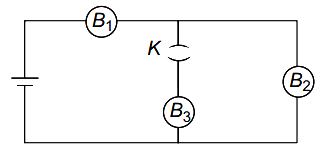 KCET 2010 Hard
 - During the adsorption of krypton on activated charcoal at low temperatureKCET 2010 Easy
- If the energies of the two photons in the ratio of \(3: 2\), their wavelength will be in the ratio ofKCET 2011 Medium
- The codon AUG has dual function. It is an initiation codon and also codes forKCET 2015 Easy
- For a chemical reaction \(\mathrm{A} \rightarrow \mathrm{B}\), the rate of the reaction is \(2 \times 10^{-3} \mathrm{~mol} \mathrm{} \mathrm{dm}^{-3} \mathrm{~s}^{-1}\), when the initial concentration is \(0.05 \mathrm{~mol} \mathrm{dm}^{-3}\). The rate of the same reaction is \(1.6 \times 10^{-2} \mathrm{~mol} \mathrm{dm}^{-3} \mathrm{~s}^{-1}\) when the initial concentration is \(0.1 \mathrm{~mol} \mathrm{} \mathrm{dm}^{-3}\). The order of the reaction isKCET 2009 Easy