


KCET · Chemistry · Carboxylic Acid Derivatives
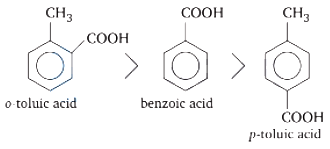
The relative acidic strengths of benzoic acid, \(o\)-toluic acid and \(p\)-toluic acid is of the decreasing order
- A \(o\)-toluic acid \(>p\)-toluic acid \(>\) benzoic acid
- B \(p\)-toluic acid \(>\) benzoic acid \(>0\)-toluic acid
- C 0 -toluic acid \(>\) benzoic acid \(>p\)-toluic acid
- D \(p\)-toluic acid \(>0\)-toluic acid \(>\) benzoic acid
Answer & Solution
Correct Answer
(C) 0 -toluic acid \(>\) benzoic acid \(>p\)-toluic acid
Step-by-step Solution
Detailed explanation
+ I effect showing groups like \(\mathrm{CH}_{3}\) when present decreases the acidic strength of carboxylic acids but ortho toluic acid is more acidic due to ortho effect.
See the Complete Solution
Get step-by-step explanations for this and 2.5 Lakh+ more JEE, NEET & CET questions.
- Unlock all solutions
- Practice the full chapter
- Track accuracy across PYQs
4.8 rated on Google Play · 14,000+ reviews
More questions from Chemistry
- Butylated hydroxy toluene as a food additive acts asKCET 2014 Medium
- The intermediates in heteropolar reactions areKCET 2026 Easy
- Which of the following is CORRECT with respect to the property mentioned against it?KCET 2026 Medium
- How many number of atoms are there in a cube based unit cell, having one atom on each corner and 2 atoms on each body diagonal of cube?KCET 2022 Easy
- Which of the following is not a green house gas?KCET 2020 Easy
- The statement that is NOT correct isKCET 2014 Easy
More PYQs from KCET
- Match the following.
(A) VNTR p. Largest gene (B) Inrons and exons q. DNA fingerprinting (C) Dystrophin r. Bulk DNA (D) Satellite S. Splicing KCET 2015 Easy - \(\int_1^5(|x-3|+|1-x|) d x=\)KCET 2024 Easy
- Ernst Chain and Howard Florey's contribution wasKCET 2015 Medium
- During chemiosmotic synthesis at ATP in photosynthesisKCET 2019 Medium
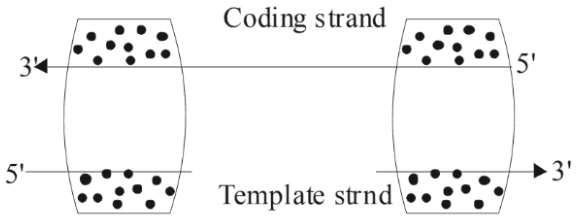
- In the given transcription unit, identify the regions the regions I and II respectively.
 KCET 2018 Hard
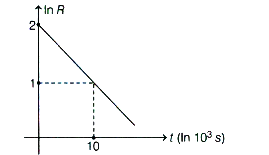
 - The natural logarithm of the activity \(R\) of a radioactive sample varies with time \(t\) as shown. At \(t=0\), there are \(N_0\) undecayed nuclei. Then, \(N_0\) is equal to [Take \(e^2=7.5\) ]
 KCET 2024 Easy