


KCET · Chemistry · Hydrocarbons
Peroxide effect is observed with the addition of HBr but not with the addition of HI to unsymmetrical alkene because
- A \(\mathrm{H}-\mathrm{I}\) bond is stronger than \(\mathrm{H}-\mathrm{Br}\) and is not cleaved by the free radical
- B \(\mathrm{H}-\mathrm{I}\) bond is weaker than \(\mathrm{H}-\mathrm{Br}\) bond so that iodine free radicals combine to form iodine molecules
- C Bond strength of HI and \(\mathrm{HBr}\) are same but free radicals are formed in \(\mathrm{HBr}\)
- D All of the above
Answer & Solution
Correct Answer
(B) \(\mathrm{H}-\mathrm{I}\) bond is weaker than \(\mathrm{H}-\mathrm{Br}\) bond so that iodine free radicals combine to form iodine molecules
Step-by-step Solution
Detailed explanation
Peroxide effect is observed with addition of \(\mathrm{HBr}\) but not with the addition of \(\mathrm{H}\) - I to unsymmetrical alkene because \(\mathrm{H}-\mathrm{I}\) bond is weaker than H-Br bond. So, unstable iodine free radicals combine to form stable iodine molecules as
i.e.,
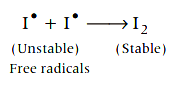
i.e.,
See the Complete Solution
Get step-by-step explanations for this and 2.5 Lakh+ more JEE, NEET & CET questions.
- Unlock all solutions
- Practice the full chapter
- Track accuracy across PYQs
4.8 rated on Google Play · 14,000+ reviews
More questions from Chemistry
-
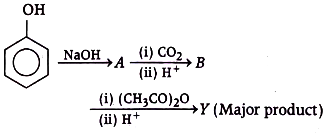
\(Y\) in the above reaction isKCET 2023 Medium - Which of the following pair contains \( 2 \) lone pair of electrons on the central atom?KCET 2019 Easy
- In nucleic acids, the nucleotides are joined together byKCET 2019 Easy
- During the electrolysis of brine, by using inert electrodes,KCET 2023 Medium
- A solution of two liquids boils at a temperature more than the boiling point of either of them. Hence, the binary solution showsKCET 2011 Easy
- Excess of carbon dioxide is passed through 50 \(\mathrm{mL}\) of \(0.5 \mathrm{M}\) calcium hydroxide solution. After the completion of the reaction, the solution was evaporated to dryness. The solid calcium carbonate was completely neutralised with \(0.1 \mathrm{~N}\) hydrochloric acid. The volume of hydrochloric acid required is (Atomic mass of calcium \(=40\) )KCET 2009 Hard
More PYQs from KCET
- The equation \(\frac{x^{2}}{2-\lambda}-\frac{y^{2}}{\lambda-5}-1=0\) represents an ellipse, ifKCET 2008 Easy
- If \( y=\tan ^{-1}\left(\frac{\sin x+\cos x}{\cos x-\sin x}\right) \), then \( \frac{d y}{d x} \) is equal toKCET 2017 Medium
- Which of the following is employed as Tranquilizer?KCET 2016 Easy
- The electric field and the potential of an electric dipole vary with distance \(r\) asKCET 2022 Easy
- In fog, photographs of the objects taken with infrared radiations are more clear than those obtained during visible light becauseKCET 2009 Medium
- The equation of the curve passing through the point \( (1,1) \) such that the slope of the tangent at
any point \( (x, y) \) is equal to the product of its co-ordinates isKCET 2019 Medium