


KCET · Chemistry · Some Basic Concepts of Chemistry
The empirical formula of a non-electrolyte is \(\mathrm{CH}_{2} \mathrm{O}\). A solution containing \(6 \mathrm{~g}\) of the compound exerts the same osmotic pressure as that of \(0.05 \mathrm{M}\) glucose solution at the same temperature. The molecular formula of the compound is
- A \(\mathrm{C}_{2} \mathrm{H}_{4} \mathrm{O}_{2}\)
- B \(\mathrm{C}_{3} \mathrm{H}_{6} \mathrm{O}_{3}\)
- C \(\mathrm{C}_{5} \mathrm{H}_{10} \mathrm{O}_{5}\)
- D \(\mathrm{C}_{4} \mathrm{H}_{8} \mathrm{O}_{4}\)
Answer & Solution
Correct Answer
(D) \(\mathrm{C}_{4} \mathrm{H}_{8} \mathrm{O}_{4}\)
Step-by-step Solution
Detailed explanation
Solutions having same osmotic pressure, at a given temperature, have same concentration. Concentration of compound \(=\) concentration of glucose
\[
\begin{aligned}
&\frac{6}{\mathrm{M} \times 1}=0.05 \\
&\mathrm{M}=\frac{6}{0.05}=120 \\
&\text { Empirical formula mass }\left(\mathrm{CH}_{2} \mathrm{O}\right)=12+2+16 \\
&\mathrm{n}=\frac{\text { molecular mass }}{\text { empirical formula mass }} \\
&=\frac{120}{30}=4
\end{aligned}
\]
Hence, molecular formula \(=\left(\mathrm{CH}_{2} \mathrm{O}\right)_{4}=\mathrm{C}_{4} \mathrm{H}_{8} \mathrm{O}_{4}\)
\[
\begin{aligned}
&\frac{6}{\mathrm{M} \times 1}=0.05 \\
&\mathrm{M}=\frac{6}{0.05}=120 \\
&\text { Empirical formula mass }\left(\mathrm{CH}_{2} \mathrm{O}\right)=12+2+16 \\
&\mathrm{n}=\frac{\text { molecular mass }}{\text { empirical formula mass }} \\
&=\frac{120}{30}=4
\end{aligned}
\]
Hence, molecular formula \(=\left(\mathrm{CH}_{2} \mathrm{O}\right)_{4}=\mathrm{C}_{4} \mathrm{H}_{8} \mathrm{O}_{4}\)
See the Complete Solution
Get step-by-step explanations for this and 2.5 Lakh+ more JEE, NEET & CET questions.
- Unlock all solutions
- Practice the full chapter
- Track accuracy across PYQs
4.8 rated on Google Play · 14,000+ reviews
More questions from Chemistry
- Which of the following statement is wrong regarding lanthanoids?KCET 2017 Easy
- \( \mathrm{CO} \) is a stronger ligand than \( \mathrm{Cl}^{-} \), becauseKCET 2016 Easy
- Dialysis can be used to separateKCET 2012 Medium
- For a chemical reaction,
\( \mathrm{mA} \rightarrow \mathrm{xB} \), the rate law is \( r=k[\mathrm{~A}]^{2} \).
If the concentration of \( A \) is doubled, the reaction rate will be,KCET 2016 Medium - Bond angle is \(\mathrm{PH}_{4}^{+}\)is more than that of \(\mathrm{PH}_{3}\). This is becauseKCET 2020 Easy
- The time required for \(100 \%\) completion of a zero order reaction isKCET 2011 Medium
More PYQs from KCET
- If a line makes angles \(90^{\circ}, 60^{\circ}\) and \(\theta\) with \(\mathrm{x}, \mathrm{y}\) and z axes respectively, where \(\theta\) is acute, then the value of \(\theta\) isKCET 2025 Easy
- Which one of these is not an accessory gland in male reproductive system?KCET 2016 Medium
- Which of the following statements is true in case of alkyl halides?KCET 2018 Easy
- The moment of inertia of a circular disc of radius \(2 \mathrm{~m}\) and mass \(1 \mathrm{~kg}\) about an axis passing through the centre of mass but perpendicular to the plane of the disc is \(2 \mathrm{~kg} \mathrm{~m}^{2}\). Its moment of inertia about an axis parallel to this axis but passing through the edge of the disc is (see the given figure).
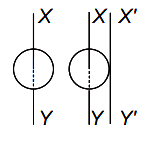 KCET 2010 Medium
 - Which of the following statement is wrong?KCET 2019 Medium
- The electronegativities of \( \mathrm{C}, \mathrm{N}, \mathrm{Si} \) and \( \mathrm{P} \) are in the order ofKCET 2017 Hard