


KCET · Chemistry · Aldehydes and Ketones
In the reaction,

Formation of \(X, Y\) and \(Z\) are known by
- A Rosenmund reduction, Cannizzaro reaction
- B Clemmensen reduction, Sandmeyer reaction
- C Wolff-Kishner reaction, Wurtz reaction
- D Stephen reaction, Canizzaro reaction
Answer & Solution
Correct Answer
(D) Stephen reaction, Canizzaro reaction
Step-by-step Solution
Detailed explanation
The given reaction can be completed as
follows.
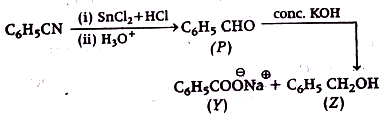
Formation of ' \(X\) ' involves Stephen reaction whereas the later part involves Cannizzaro reaction.
follows.
Formation of ' \(X\) ' involves Stephen reaction whereas the later part involves Cannizzaro reaction.
See the Complete Solution
Get step-by-step explanations for this and 2.5 Lakh+ more JEE, NEET & CET questions.
- Unlock all solutions
- Practice the full chapter
- Track accuracy across PYQs
4.8 rated on Google Play · 14,000+ reviews
More questions from Chemistry
- Which of the following statements are true about \(\left[\mathrm{NiCl}_4\right]^{2-}\) ?
(a) The complex has tetrahedral geometry
(b) Co-ordination number of Ni is 2 and oxidation state is +4
(c) The complex is \(\mathrm{sp}^3\) hybridised
(d) It is a high spin complex
(e) The complex is paramagneticKCET 2025 Medium - Match List-I with List-II
\begin{array}{|l|l|l|l|}\hline & \text{List-I (Types of redox reactions)} & & \text{List-II (Examples)} \\\hline \text{a}. & \text{Combination reaction} & \text{(i)} & \mathrm{Cl}_{2(\mathrm{~g})}+2 \mathrm{Br}_{(\mathrm{aq})}^{-} \rightarrow 2 \mathrm{Cl}_{(\mathrm{aq})}^{-}+\mathrm{Br}_{2(\mathrm{l})} \\\hline \text{b.} & \text{Decomposition reaction} & \text{(ii)} & 2 \mathrm{H}_2 \mathrm{O}_{2(\mathrm{aq})} \rightarrow 2 \mathrm{H}_2 \mathrm{O}_{(1)}+\mathrm{O}_{2(\mathrm{~g})} \\\hline \text{c.} & \text{Displacement reaction} & \text{(iii)} & \mathrm{CH}_{4(\mathrm{~g})}+2 \mathrm{O}_{2(\mathrm{~g})} \xrightarrow{\Delta} \mathrm{CO}_{2(\mathrm{~g})}+2 \mathrm{H}_2 \mathrm{O}_{(1)} \\\hline \text{d.} & \text{Disproportionation reaction} & \text{(iv)} & \mathrm{H}_2 \mathrm{O}_{(1)} \xrightarrow{\Delta} 2 \mathrm{H}_{2(\mathrm{~g})}+\mathrm{O}_{2(\mathrm{~g})} \\\hline\end{array}
Choose the correct answer from the options given below.KCET 2025 Medium - Consider the following gaseous equilibria with equilibrium constants \(\mathrm{K}_{1}\) and \(\mathrm{K}_{2}\) respectively.
\(\begin{aligned} \mathrm{SO}_{2}(\mathrm{~g})+& \frac{1}{2} \mathrm{O}_{2}(\mathrm{~g}) \rightleftharpoons \mathrm{SO}_{3}(\mathrm{~g}) \\ 2 \mathrm{SO}_{3}(g) & \rightleftharpoons 2 \mathrm{SO}_{2}(g)+\mathrm{O}_{2}(g) \end{aligned}\)
The equilibrium constants are related asKCET 2010 Medium - The correct order of ionisation energy of \(\mathrm{C}, \mathrm{N}, \mathrm{O}\) and \(\mathrm{F}\) isKCET 2012 Easy
- Which of the following electrolytic solutions has the least specific conductance?KCET 2008 Easy
- \(\mathrm{NO}_2\) gas isKCET 2024 Easy
More PYQs from KCET
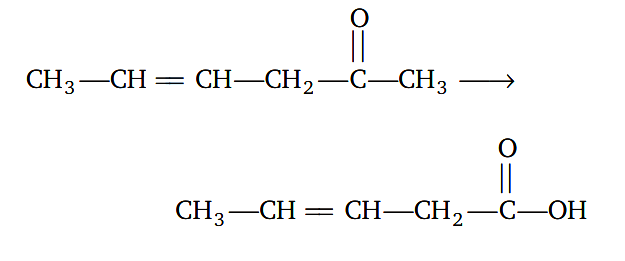
- Which is the most suitable reagent for the following conversion ?
 KCET 2021 Easy
 - A member of the Lanthanoid series which is well known to exhibit +4 oxidation state isKCET 2025 Easy
- The standard emf of a galvanic cell involving 2 moles of electrons in its redox reaction is \(0.59 \mathrm{~V}\). The equilibrium constant for the redox reaction of the cell isKCET 2011 Easy
- If \((\mathbf{a} \times \mathbf{b})^{2}+(\mathbf{a} \cdot \mathbf{b})^{2}=144\) and \(|\mathbf{a}|=4\), then \(|\mathbf{b}|\) is equal toKCET 2012 Easy
- A tangent is drawn to the circle \(2 x^{2}+2 y^{2}-3 x+4 y=0\) at point \(A\) and it meets the line \(x+y=3\) at \(B(2,1)\), then \(A B\) is equal toKCET 2013 Easy
- The reagent used to convert an alkyne to alkene isKCET 2008 Easy