


KCET · Chemistry · p Block Elements (Group 13 & 14)
In the electrolysis of aqueous sodium chloride solution, which of the half cell reaction will occur
at anode?
- A \( N a^{+}(a q)+e^{-} \rightarrow N a(s) ; E_{\text {cell }}^{\circ}=-2.71 \) volts
- B \( 2 \mathrm{H}_{2} \mathrm{O}(\mathrm{l}) \rightarrow \mathrm{O}_{2}+4 \mathrm{H}^{+}+4 e^{-} ; \mathrm{E}_{\text {cell }}^{\circ}=1.23 \) \$volts
- C \( H^{+}(a q)+e^{-} \rightarrow \frac{1}{2} H_{2} ; E_{\text {cell }}^{\circ}=0.00 \) volts
- D \( \mathrm{Cl}^{-}(a q) \rightarrow \frac{1}{2} \mathrm{Cl}_{2}+e^{-} ; E_{\text {cell }}^{\circ}=1.36 \) volts
Answer & Solution
Correct Answer
(D) \( \mathrm{Cl}^{-}(a q) \rightarrow \frac{1}{2} \mathrm{Cl}_{2}+e^{-} ; E_{\text {cell }}^{\circ}=1.36 \) volts
Step-by-step Solution
Detailed explanation
In water sodium chloride ionizes as
\( N a C l(a q) \rightleftharpoons N a^{+}(a q)+C l^{-}(a q) \)
water also dissociates into ions, though to very slight degree as,
\( \mathrm{H}_{2} \mathrm{O}(\mathrm{l}) \rightleftharpoons \mathrm{H}^{+}(a q)+\mathrm{OH}^{-}(a q) \)
Thus, the aqueous solution of sodium chloride contains \( \mathrm{N} a^{+}, \mathrm{H}^{+}, \mathrm{OH}^{-} \)and \( \mathrm{Cl}^{-} \)ions. When electric current is passed
through the solution, \( \mathrm{Cl}_{2} \) gas evolved at anode and hydrogen is evolved at the cathode. The resulting solution contains
\( \mathrm{Na}^{+} \)and \( \mathrm{OH}^{-} \)ions. Oxidation of \( \mathrm{Cl}^{-} \)ions and \( \mathrm{H}_{2} \mathrm{O} \) is possible at anode but, standard electrode potential of \( \mathrm{Cl}^{-} \)is
more, therefore, \( \mathrm{Cl}^{-} \)will oxidized at anode.
\( N a C l(a q) \rightleftharpoons N a^{+}(a q)+C l^{-}(a q) \)
water also dissociates into ions, though to very slight degree as,
\( \mathrm{H}_{2} \mathrm{O}(\mathrm{l}) \rightleftharpoons \mathrm{H}^{+}(a q)+\mathrm{OH}^{-}(a q) \)
Thus, the aqueous solution of sodium chloride contains \( \mathrm{N} a^{+}, \mathrm{H}^{+}, \mathrm{OH}^{-} \)and \( \mathrm{Cl}^{-} \)ions. When electric current is passed
through the solution, \( \mathrm{Cl}_{2} \) gas evolved at anode and hydrogen is evolved at the cathode. The resulting solution contains
\( \mathrm{Na}^{+} \)and \( \mathrm{OH}^{-} \)ions. Oxidation of \( \mathrm{Cl}^{-} \)ions and \( \mathrm{H}_{2} \mathrm{O} \) is possible at anode but, standard electrode potential of \( \mathrm{Cl}^{-} \)is
more, therefore, \( \mathrm{Cl}^{-} \)will oxidized at anode.
See the Complete Solution
Get step-by-step explanations for this and 2.5 Lakh+ more JEE, NEET & CET questions.
- Unlock all solutions
- Practice the full chapter
- Track accuracy across PYQs
4.8 rated on Google Play · 14,000+ reviews
More questions from Chemistry
- Which of the following species does not exert a resonance effect?KCET 2008 Easy
- Which one of the following oxoacids of phosphorus can reduce \(\mathrm{AgNO}_3\) to metallic silver?KCET 2023 Hard
- Which one of the following shows functional isomerism?KCET 2007 Easy
- \(30 \operatorname{cc}\) of \(\frac{\mathrm{M}}{3} \mathrm{HCl}, 20 \operatorname{cc}\) of \(\frac{\mathrm{M}}{2} \mathrm{HNO}_{3}\) and \(40 \mathrm{cc}\) of \(\frac{\mathrm{M}}{4} \mathrm{NaOH}\) solutions are mixed and the volume was made up to \(1 \mathrm{dm}^{3}\). The \(\mathrm{pH}\) of the resulting solution isKCET 2009 Easy
- Hofmann's bromamide reaction is to convertKCET 2007 Medium
- Addition of excess of \( \mathrm{AgNO}_{3} \) to an aqueous solution of \( 1 \) mole of \( \mathrm{PdCl}_{2} \cdot 4 \mathrm{NH}_{3} \) gives \( 2 \)
moles of \( \mathrm{AgCl} \). The conductivity of this solution corresponds toKCET 2019 Easy
More PYQs from KCET
- Typical mature embryo sac of angiosperm isKCET 2022 Hard
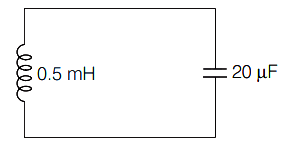
- In the given circuit, the resonant frequency is
 KCET 2020 Medium
 - An element \( X \) decays into element \( Z \) by two-step process.
\[
\begin{array}{l}
X \rightarrow Y+4 e \\
Y \rightarrow Z+2 e^{-} \text {then }:
\end{array}
\]KCET 2016 Medium - Acidified sodium fusion extract on addition of ferric chloride solution gives blood red colouration which confirms the presence ofKCET 2007 Medium
- During menstraul cycle, the cyclical changes take place inKCET 2015 Medium
- A gas deviates from ideal behaviour at a high pressure because its moleculesKCET 2008 Medium