


KCET · Chemistry · Solutions
If \(\mathrm{N}_2\) gas is bubbled through water at 293 K , how many moles of \(\mathrm{N}_2\) gas would dissolve in 1 litre of water? Assume that \(\mathrm{N}_2\) exerts a partial pressure of 0.987 bar.
[Given \(\mathrm{K}_{\mathrm{H}}\) for \(\mathrm{N}_2\) at 293 K is 76.48 K bar]
- A \(0.716 \times 10^{-3}\)
- B \(7.16 \times 10^{-5}\)
- C \(7.16 \times 10^{-4}\)
- D \(7.16 \times 10^{-3}\)
Answer & Solution
Correct Answer
(C) \(7.16 \times 10^{-4}\)
Step-by-step Solution
Detailed explanation
Henry law :- \(\quad \mathrm{P}=\mathrm{K}_{\mathrm{H}} \mathrm{X}\)
\(\mathrm{XN}_2=\frac{\mathrm{PN}_2}{\mathrm{~K}_4}=\frac{0.987}{76.48 \times 10^3}=1.29 \times 10^{-5}\)
\(\begin{aligned} & \mathrm{n}_{\mathrm{H}_2 \mathrm{O}}=\frac{1000}{18}=55.5 \\ & \mathrm{XN}_2=\frac{\mathrm{n}_{\mathrm{N}_2}}{\mathrm{n}_{\mathrm{N}_2}+\mathrm{n}_{\mathrm{H}_2 \mathrm{O}}} \\ & 1.29 \times 10^{-5}=\frac{\mathrm{n}}{\mathrm{n}+55.5}=\frac{\mathrm{n}}{55.5} \\ & \mathrm{n}=1.29 \times 10^{-5} \times 55.5 \\ & \mathrm{n}_{\mathrm{N}_2}=7.16 \times 10^{-4}\end{aligned}\)
\(\mathrm{XN}_2=\frac{\mathrm{PN}_2}{\mathrm{~K}_4}=\frac{0.987}{76.48 \times 10^3}=1.29 \times 10^{-5}\)
\(\begin{aligned} & \mathrm{n}_{\mathrm{H}_2 \mathrm{O}}=\frac{1000}{18}=55.5 \\ & \mathrm{XN}_2=\frac{\mathrm{n}_{\mathrm{N}_2}}{\mathrm{n}_{\mathrm{N}_2}+\mathrm{n}_{\mathrm{H}_2 \mathrm{O}}} \\ & 1.29 \times 10^{-5}=\frac{\mathrm{n}}{\mathrm{n}+55.5}=\frac{\mathrm{n}}{55.5} \\ & \mathrm{n}=1.29 \times 10^{-5} \times 55.5 \\ & \mathrm{n}_{\mathrm{N}_2}=7.16 \times 10^{-4}\end{aligned}\)
See the Complete Solution
Get step-by-step explanations for this and 2.5 Lakh+ more JEE, NEET & CET questions.
- Unlock all solutions
- Practice the full chapter
- Track accuracy across PYQs
4.8 rated on Google Play · 14,000+ reviews
More questions from Chemistry
- Dalda is prepared from oils byKCET 2008 Easy
- Hydrogenation of vegetable oils in presence of finely divided Nickel as catalyst. The reaction isKCET 2017 Easy
- Based on the first law of thermodynamics, which one of the following is correct?KCET 2010 Easy
- \(0.4 \mathrm{~g}\) of dihydrogen is made to react with \(7.4 \mathrm{~g}\) of dichlorine to form hydrogen chloride. The volume of hydrogen chloride formed at \(273 \mathrm{~K}\) and 1 bar pressure isKCET 2020 Hard
- The acid strength of active methylene group in
(a) \( \mathrm{CH}_{3} \mathrm{COCH}_{2} \mathrm{COOC}_{2} \mathrm{H}_{5} \)
(b) \( \mathrm{CH}_{3} \mathrm{COCH}_{2} \mathrm{COCH}_{3} \)
(c) \( \mathrm{C}_{2} \mathrm{H}_{5} \mathrm{OOCCH}_{2} \mathrm{COOC}_{2} \mathrm{H}_{5} \)
decreases asKCET 2014 Easy - For Freundlich adsorption isotherm, a graph of \(\log (x / m)\) vs \(\log (p)\) gives a straight line. The slope of line and its \(Y\)-axis intercept respectively areKCET 2023 Easy
More PYQs from KCET
- The family of curves whose \(x\) and \(y\) intercepts of a tangent at any point are respectively double the \(x\) and \(y\) coordinates of that point isKCET 2024 Hard
- The range of the function \( f(x)=\sqrt{9-x^{2}} \) isKCET 2017 Easy
- Which one of the following has maximum number of atoms of oxygen?KCET 2007 Easy
- In the sequence of following reactions :

the sarting compound ' \( P \) ' isKCET 2015 Hard - Which is the most suitable reagent for the following conversion ?
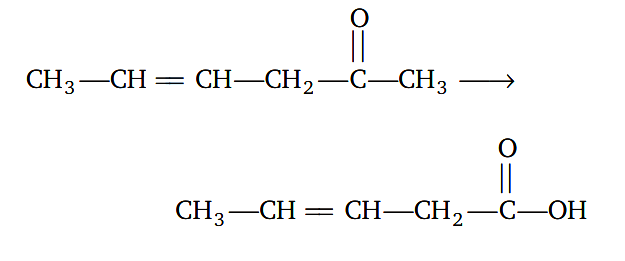 KCET 2021 Easy
 - If \(50 \%\) of the reactant is converted into a product in a first order reaction in \(25 \mathrm{~min}\), how much of it would react in \(100 \mathrm{~min}\) ?KCET 2013 Hard