


KCET · Chemistry · Solutions
If \(3 \mathrm{~g}\) of glucose (molar mass \(=180 \mathrm{~g})\) is dissolved in \(60 \mathrm{~g}\) of water at \(15^{\circ} \mathrm{C}\), the osmotic pressure of the solution will be
- A \(0.65 \mathrm{~atm}\)
- B \(6.57 \mathrm{~atm}\)
- C \(5.57 \mathrm{~atm}\)
- D \(0.34 \mathrm{~atm}\)
Answer & Solution
Correct Answer
(B) \(6.57 \mathrm{~atm}\)
Step-by-step Solution
Detailed explanation
Given, molar mass of glucose \(M_B=180 \mathrm{~g}\)
Mass of glucose, \(W_B=3 \mathrm{~g}\)
Mass of water, \(W_A=60 \mathrm{~g}\)
Temperature \(=15^{\circ} \mathrm{C} \Rightarrow 273+15=288 \mathrm{~K}\)
Osmotic pressure, \(\pi=\) ?
\[
C=\frac{W_B \times 1000}{W_A \times M_B}=\frac{3 \times 1000}{60 \times 180}=0.277 \mathrm{~mol} \mathrm{~L}^{-1}
\]
We know that,
\[
\begin{aligned}
\pi & =C R T=0.277 \times 0.0821 \times 288 \\
& =6.549 \simeq 6.57 \mathrm{~atm}
\end{aligned}
\]
Mass of glucose, \(W_B=3 \mathrm{~g}\)
Mass of water, \(W_A=60 \mathrm{~g}\)
Temperature \(=15^{\circ} \mathrm{C} \Rightarrow 273+15=288 \mathrm{~K}\)
Osmotic pressure, \(\pi=\) ?
\[
C=\frac{W_B \times 1000}{W_A \times M_B}=\frac{3 \times 1000}{60 \times 180}=0.277 \mathrm{~mol} \mathrm{~L}^{-1}
\]
We know that,
\[
\begin{aligned}
\pi & =C R T=0.277 \times 0.0821 \times 288 \\
& =6.549 \simeq 6.57 \mathrm{~atm}
\end{aligned}
\]
See the Complete Solution
Get step-by-step explanations for this and 2.5 Lakh+ more JEE, NEET & CET questions.
- Unlock all solutions
- Practice the full chapter
- Track accuracy across PYQs
4.8 rated on Google Play · 14,000+ reviews
More questions from Chemistry
- A compound of 'A' and 'B' crystallises in a cubic lattice in which 'A' atoms occupy the lattice points at the corners of the cube. The ' \(B\) ' atoms occupy the centre of each face of the cube. The probable empirical formula of the compound isKCET 2009 Medium
- Which of the following statements is/are true about equilibrium?
(a) Equilibrium is possible only in a closed system of at a given temperature
(b) All the measurable properties of the system remain constant at equilibrium
(c) Equilibrium constant for the reverse reaction is the inverse of the equilibrium constant for the reaction in the forward direction.KCET 2025 Medium - The types of hybrid orbitals of nitrogen in \(\text{NO}_2^+, \text{NO}_3^-\) and \(\text{NH}_4^+\) respectively areKCET 2026 Easy
- \(+I\) effect is shown byKCET 2007 Easy
- The approximate time duration in hours to electroplate 30 of calcium from molten calcium chloride using a current of \(5 \mathrm{~A}\) is [At. mass of \(\mathrm{Ca}=40\) ]KCET 2012 Medium
- The property which is not true about Fluorine is,KCET 2016 Easy
More PYQs from KCET
- The \(\mathrm{pH}\) of the solution obtained by mixing \(100 \mathrm{ml}\) of a solution of \(\mathrm{pH}=3\) with \(400 \mathrm{~mL}\) of a solution of \(\mathrm{pH}=4\) isKCET 2012 Hard
- The frequency of heart beat in our body maintained byKCET 2012 Hard
- The circuit shown in figure contains two ideal diodes \(D_1\) and \(D_2\). If a cell of emf 3 V and negligible internal resistance is connected as shown, then the current through \(70 \Omega\) resistance, (in ampere) is
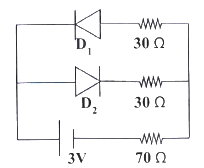 KCET 2025 Medium
 - Two identical conducting balls \(A\) and \(B\) have positive charges \(\mathrm{q}_{1}\) and \(\mathrm{q}_{2}\) respectively but \(\mathrm{q}_{1} \neq \mathrm{q}_{2}\). The balls are brought together so that they touch each other and then kept in their original positions. The force between them isKCET 2010 Hard
- Events \(E_{1}\) and \(E_{2}\) from a partition of the sample space \(S . A\) is any event such that \(P\left(E_{1}\right)=P\left(E_{2}\right)=\frac{1}{2}, P\left(E_{2} / A\right)=\frac{1}{2}\) and \(P\left(A / E_{2}\right)=\frac{2}{3}\), then \(P\left(E_{1} / A\right)\) isKCET 2020 Easy
- The integrating factor of the differential equation \( x \cdot \frac{d y}{d x}+2 y=x^{2} \) is \( (x \neq 0) \)KCET 2017 Medium