


KCET · Chemistry · s Block Elements
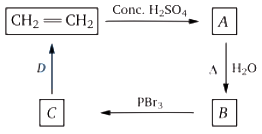
Identify \(B\) and \(D\) in the following sequence of reactions.
- A methanol and bromoethane
- B ethyl hydrogen sulphate and alcoholic \(\mathrm{KOH}\)
- C ethyl hydrogen sulphate and aqueous \(\mathrm{KOH}\)
- D ethanol and alcoholic \(\mathrm{KOH}\)
Answer & Solution
Correct Answer
(D) ethanol and alcoholic \(\mathrm{KOH}\)
Step-by-step Solution
Detailed explanation
\[
\mathrm{CH}_{2}=\mathrm{CH}_{2} \stackrel{\text { Conc. } \mathrm{H}_{2} \mathrm{SO}_{4}}{\longrightarrow} \mathrm{CH}_{3}-\underset{(A)}-\mathrm{CH}_{2}-\mathrm{HSO}_{4}
\]
(addition reaction)
\(\mathrm{CH}_{3}-\mathrm{CH}_{2}-\mathrm{HSO}_{4} \stackrel{\Delta, \mathrm{H}_{2} \mathrm{O}}{\longrightarrow} \mathrm{CH}_{3}-\underset{(B)}{\mathrm{CH}_{2}-\mathrm{OH}}\)
(hydrolysis)
\[
\mathrm{CH}_{3}-\mathrm{CH}_{2}-\mathrm{OH} \stackrel{\mathrm{PBr}_{3}}{\longrightarrow} \mathrm{CH}_{3}\underset{(c)}-\mathrm{CH}_{2}-\mathrm{Br}
\]
(bromination)
\(\mathrm{CH}_{3}-\mathrm{CH}_{2}-\mathrm{Br} \stackrel{\mathrm{Alc} . \mathrm{KOH}(\Delta)}{(\Delta)} \mathrm{CH}_{2}=\mathrm{CH}_{2}\)
(dehydrohalogenation)
Hence, \(B\) and \(D\) in the above given reactions are \(\mathrm{CH}_{3} \mathrm{CH}_{2} \mathrm{OH}\) (ethanol) and alc. \(\mathrm{KOH}\).
\mathrm{CH}_{2}=\mathrm{CH}_{2} \stackrel{\text { Conc. } \mathrm{H}_{2} \mathrm{SO}_{4}}{\longrightarrow} \mathrm{CH}_{3}-\underset{(A)}-\mathrm{CH}_{2}-\mathrm{HSO}_{4}
\]
(addition reaction)
\(\mathrm{CH}_{3}-\mathrm{CH}_{2}-\mathrm{HSO}_{4} \stackrel{\Delta, \mathrm{H}_{2} \mathrm{O}}{\longrightarrow} \mathrm{CH}_{3}-\underset{(B)}{\mathrm{CH}_{2}-\mathrm{OH}}\)
(hydrolysis)
\[
\mathrm{CH}_{3}-\mathrm{CH}_{2}-\mathrm{OH} \stackrel{\mathrm{PBr}_{3}}{\longrightarrow} \mathrm{CH}_{3}\underset{(c)}-\mathrm{CH}_{2}-\mathrm{Br}
\]
(bromination)
\(\mathrm{CH}_{3}-\mathrm{CH}_{2}-\mathrm{Br} \stackrel{\mathrm{Alc} . \mathrm{KOH}(\Delta)}{(\Delta)} \mathrm{CH}_{2}=\mathrm{CH}_{2}\)
(dehydrohalogenation)
Hence, \(B\) and \(D\) in the above given reactions are \(\mathrm{CH}_{3} \mathrm{CH}_{2} \mathrm{OH}\) (ethanol) and alc. \(\mathrm{KOH}\).
See the Complete Solution
Get step-by-step explanations for this and 2.5 Lakh+ more JEE, NEET & CET questions.
- Unlock all solutions
- Practice the full chapter
- Track accuracy across PYQs
4.8 rated on Google Play · 14,000+ reviews
More questions from Chemistry
- Dalton's law of partial pressure is applicable to which one of the following systems?KCET 2007 Easy
- The oxidation state of iron in \(\mathrm{K}_{4}\left[\mathrm{Fe}(\mathrm{CN})_{6}\right]\) isKCET 2007 Medium
- The rate of the reaction, \(\mathrm{CH}_3 \mathrm{COOC}_2 \mathrm{H}_5+\mathrm{NaOH} \longrightarrow \mathrm{CH}_3 \mathrm{COONa}+\mathrm{C}_2 \mathrm{H}_5 \mathrm{OH}\) is given by the equation, rate \(=k\left[\mathrm{CH}_3 \mathrm{COOC}_2 \mathrm{H}_5\right][\mathrm{NaOH}]\). If concentration is expressed in \(\mathrm{mol}^{-1}\), the unit of \(k\) isKCET 2022 Easy
- An aqueous solution containing \(6.5 \mathrm{~g}\) of \(\mathrm{NaCl}\) of \(90 \%\) purity was subjected to electrolysis. After the complete electrolysis, the solution was evaporated to get solid \(\mathrm{NaOH}\). The volume of \(1 \mathrm{M}\) acetic acid required to neutralise \(\mathrm{NaOH}\) obtained above isKCET 2009 Medium
- The major product of the following reaction is \(\mathrm{CH}_{2}=\mathrm{CH}-\mathrm{CH}_{2}-\mathrm{OH} \underset{\text { Excess }}{\stackrel{\mathrm{HBr}}{\longrightarrow}}\) ProductKCET 2021 Medium
- The compound with molecular formula \(\text{C}_{20}\text{H}_{42}\) isKCET 2026 Easy
More PYQs from KCET
- The codons UUU and UUC codes for phenylalanine only. This features of genetic code is calledKCET 2016 Medium
- If \( x \) is real, then the minimum value of \( x^{2}-8 x+17 \) isKCET 2015 Easy
- Which of the following parts of the vertebrate body arises form the mesoderm?KCET 2012 Medium
- The de-Broglie wavelength of a particle of kinetic energy \(K\) is \(\lambda\), the wavelength of the particle, if its kinetic energy \(\frac{K}{4}\) isKCET 2022 Easy
- A space vector makes the angles \(150^{\circ}\) and \(60^{\circ}\) with the positive direction of \(x\)-and \(y\)-axes. The angle made by the vector with the positive direction \(z\)-axis isKCET 2010 Easy
- If \(\overrightarrow{\mathbf{a}}, \overrightarrow{\mathbf{b}}\) and \(\overrightarrow{\mathbf{c}}\) are non-zero coplanar vectors, then \([2 \overrightarrow{\mathbf{a}}-\overrightarrow{\mathbf{b}} 3 \overrightarrow{\mathbf{b}}-\overrightarrow{\mathbf{c}} 4 \overrightarrow{\mathbf{c}}-\overrightarrow{\mathbf{a}}]\) isKCET 2010 Medium