


KCET · Chemistry · Chemical Kinetics
For the reaction, \( 2 \mathrm{SO}_{2}+\mathrm{O}_{2} \rightleftharpoons 2 \mathrm{SO}_{3} \), the rate of disappearance of \( \mathrm{O}_{2} \) is
\( 2 \times 10^{-4} \mathrm{~mol} \mathrm{~L}^{-1} \mathrm{~s}^{-1} \). The rate of apperance of \( \mathrm{SO}_{3} \) is
- A \( 2 \times 10^{-4} \mathrm{~mol} \mathrm{~L}^{-1} \mathrm{~s}^{-1} \)
- B \( 4 \times 10^{-4} \mathrm{~mol} \mathrm{~L}^{-1} \mathrm{~s}^{-1} \)
- C \( 1 \times 10^{-1} \mathrm{~mol} \mathrm{~L}^{-1} \mathrm{~s}^{-1} \)
- D \( 6 \times 10^{-4} \mathrm{~mol} \mathrm{~L}^{-1} \mathrm{~s}^{-1} \)
Answer & Solution
Correct Answer
(B) \( 4 \times 10^{-4} \mathrm{~mol} \mathrm{~L}^{-1} \mathrm{~s}^{-1} \)
Step-by-step Solution
Detailed explanation
For the reaction,
\(2 \mathrm{SO}_{2}+\mathrm{O}_{2} \rightleftharpoons 2 \mathrm{SO}_{3}\)
Rate
\(=-\frac{1}{2} \frac{d\left[\mathrm{SO}_{2}\right]}{d t}=-\frac{d\left[\mathrm{O}_{2}\right]}{d t}=+\frac{1}{2} \frac{d\left[\mathrm{SO}_{3}\right]}{d t}\)
Given \(-\frac{d\left[\mathrm{O}_{2}\right]}{d t}=2 \times 10^{-4} \mathrm{~mol} \mathrm{~L}^{-1} \mathrm{~S}^{-1}\)
To find \(+\frac{d\left[\mathrm{SO}_{3}\right]}{d t}=?\)
\(+\frac{1}{2} \frac{d\left[\mathrm{SO}_{3}\right]}{d t}=-\frac{d\left[\mathrm{O}_{2}\right]}{d t}\)
\(\frac{d\left[\mathrm{SO}_{3}\right]}{d t}=2 \times 2 \times 10^{-4} \mathrm{~mol} \mathrm{~L}^{-1} \mathrm{~S}^{-1}\)
\(=4 \times 10^{-4} \mathrm{~mol} \mathrm{~L}^{-1} \mathrm{~S}^{-1}\)
\(2 \mathrm{SO}_{2}+\mathrm{O}_{2} \rightleftharpoons 2 \mathrm{SO}_{3}\)
Rate
\(=-\frac{1}{2} \frac{d\left[\mathrm{SO}_{2}\right]}{d t}=-\frac{d\left[\mathrm{O}_{2}\right]}{d t}=+\frac{1}{2} \frac{d\left[\mathrm{SO}_{3}\right]}{d t}\)
Given \(-\frac{d\left[\mathrm{O}_{2}\right]}{d t}=2 \times 10^{-4} \mathrm{~mol} \mathrm{~L}^{-1} \mathrm{~S}^{-1}\)
To find \(+\frac{d\left[\mathrm{SO}_{3}\right]}{d t}=?\)
\(+\frac{1}{2} \frac{d\left[\mathrm{SO}_{3}\right]}{d t}=-\frac{d\left[\mathrm{O}_{2}\right]}{d t}\)
\(\frac{d\left[\mathrm{SO}_{3}\right]}{d t}=2 \times 2 \times 10^{-4} \mathrm{~mol} \mathrm{~L}^{-1} \mathrm{~S}^{-1}\)
\(=4 \times 10^{-4} \mathrm{~mol} \mathrm{~L}^{-1} \mathrm{~S}^{-1}\)
See the Complete Solution
Get step-by-step explanations for this and 2.5 Lakh+ more JEE, NEET & CET questions.
- Unlock all solutions
- Practice the full chapter
- Track accuracy across PYQs
4.8 rated on Google Play · 14,000+ reviews
More questions from Chemistry
- If one mole of ammonia and one mole of hydrogen chloride are mixed in a closed container to form ammonium chloride gas, thenKCET 2008 Easy
- The reducing agent in the given equations
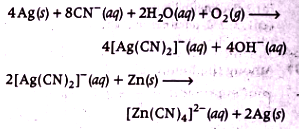 KCET 2023 Easy
 - Which one of the following vitamins is not stored in adipose tissue?KCET 2020 Easy
- For a reaction, the value of rate constant at \(300 \mathrm{~K}\) is \(6.0 \times 10^5 \mathrm{~s}^{-1}\). The value of Arrhenius factor \(A\) at infinitely high temperature isKCET 2023 Medium
- \(5 \mathrm{~mL}\) of \(0.4 \mathrm{~N} \mathrm{NaOH}\) is mixed with \(20 \mathrm{~mL}\) of \(0.1 \mathrm{~N} \mathrm{HCl}\). The \(\mathrm{pH}\) of the resulting solution will beKCET 2012 Hard
- For a cell reaction involving two electron changes, \( E_{\text {cell }}^{\circ}=0.3 \mathrm{~V} \) at \( 25^{\circ} \mathrm{C} \). The cell equilibrium
constant of the reaction isKCET 2018 Medium
More PYQs from KCET
- Which one of the following has a potential more than zero?KCET 2012 Easy
- The sum of two positive numbers is given. If the sum of their cubes is minimum, thenKCET 2012 Hard
- General solution of differential equation \( \frac{d y}{d x}+y=1(y \neq 1) \) isKCET 2017 Medium
- Energy of an electron in the second orbit of hydrogen atom is \(E_{2}\). The energy of electron in the third orbit of \(\mathrm{He}^{+}\)will beKCET 2021 Easy
- A nuclear reactor delivers a power of \(10^9 \mathrm{~W}\), the amount of fuel consumed by the reactor in one hour isKCET 2022 Easy
- When limestone is heated, \(\mathrm{CO}_{2}\) is given off. The metallurgical operation isKCET 2013 Easy