


KCET · BIOLOGY · STD 11 - 2. Biological Classification
Which of the following does not belong to Kingdom Monera?
- A Slime moulds
- B Mycoplasma
- C Eubacteria
- D Archaebacteria
Answer & Solution
Correct Answer
(A) Slime moulds
Step-by-step Solution
Detailed explanation
(A) Slime moulds
Monera includes prokaryotic organisms like Mycoplasma, Eubacteria, and archaebacteria, while slime moulds are eukaryotic, while slime moulds are eukaryotic, distinguishing them from Monera members.
Monera includes prokaryotic organisms like Mycoplasma, Eubacteria, and archaebacteria, while slime moulds are eukaryotic, while slime moulds are eukaryotic, distinguishing them from Monera members.
See the Complete Solution
Get step-by-step explanations for this and 2.5 Lakh+ more JEE, NEET & CET questions.
- Unlock all solutions
- Practice the full chapter
- Track accuracy across PYQs
4.8 rated on Google Play · 14,000+ reviews
More questions from BIOLOGY
- Some of the events occur during life cycle of Plasmodium are given below. Identify the correct statement.KCET 2016 Easy
- In Morgan's experiment with Drosophilia, when yellow bodied white eyed female was crossed with brown bodied red eyed male and their \(F_1\) progeny were intercrossed. What was the percentage of recombinants in \(F_2\) generation?KCET 2019 Hard
- The characteristic that is shared by urea, uric acid and ammonia is/are
(A) They are nitrogenous wastes.
(B) They all need very large amount of water is excretion.
(C) They all are equally toxic.
(D) They are produced in the kidneys.KCET 2009 Medium - Which of the following natural process is likely to hasten organic evolution?KCET 2005 Medium
- According to David Tilman's long term ecosystem experiments, the total biomass in plots with more species shows,KCET 2023 Medium
- The average length of hnRNA in humans isKCET 2017 Medium
More PYQs from KCET
- In an experiment to study photoelectric effect the observed variation of stopping potential with frequency of incident radiation is as shown in the figure. The slope and \(y\)-intercept are respectively
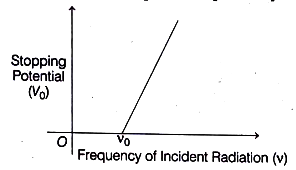 KCET 2023 Easy
 - If \( x, y, z \in R \), then the value of determinant
\[
\left|\begin{array}{lll}
\left(5^{x}+5^{-x}\right)^{2} & \left(5^{x}-5^{-x}\right)^{2} & 1 \\
\left(6^{x}+6^{-x}\right)^{2} & \left(6^{x}-6^{-x}\right)^{2} & 1 \\
\left(7^{x}+7^{-x}\right)^{2} & \left(7^{x}-7^{-x}\right)^{2} & 1
\end{array}\right| \text { is }
\]KCET 2018 Medium - Due to non-disjunction of chromosomes during spermatogenesis, sperms carry both sex chromosomes (22A + XY) and some sperms do not carry any sex chromosome (22A + O). If these sperms fertilize normal eggs (22A + X), what types of genetic disorders appear among the offsprings?KCET 2010 Medium
- If we consider an electron and a photon of same de-Broglie wavelength, then they will have sameKCET 2025 Easy
- The rate of reaction increases with rise in temperature because ofKCET 2013 Easy
- If \(\mathbf{a}, \mathbf{b}\) and \(\mathbf{c}\) are three non-coplanar vectors and \(p, q\) and \(r\) are vectors defined by
\(\mathbf{p}=\frac{\mathbf{a} \times \mathbf{c}}{[\mathbf{a} \mathbf{b} \mathbf{c}]}, \mathbf{q}=\frac{\mathbf{c} \times \mathbf{a}}{[\mathbf{a} \mathbf{b} \mathbf{c}]}, \mathbf{r}=\frac{\mathbf{a} \times \mathbf{b}}{[\mathbf{a} \mathbf{b} \mathbf{c}]}\), then
\((\mathbf{a}+\mathbf{b}) \cdot \mathbf{p}+(\mathbf{b}+\mathbf{c}) \cdot \mathbf{q}+(\mathbf{c}+\mathbf{a}) \cdot \mathbf{r}\) isKCET 2024 Medium