


KCET · BIOLOGY · STD 11 - 10. Cell Cycle and Cell Division
The enzyme Recombinase is required at which stage of Meiosis I?
- A Pachytene
- B Zygotene
- C Diplotene
- D Diakinesis
Answer & Solution
Correct Answer
(A) Pachytene
Step-by-step Solution
Detailed explanation
(A) Pachytene,
Crossing over between two homologous chromosomes takes place with the help of enzyme recombinase during pachytene.
Crossing over between two homologous chromosomes takes place with the help of enzyme recombinase during pachytene.
See the Complete Solution
Get step-by-step explanations for this and 2.5 Lakh+ more JEE, NEET & CET questions.
- Unlock all solutions
- Practice the full chapter
- Track accuracy across PYQs
4.8 rated on Google Play · 14,000+ reviews
More questions from BIOLOGY
- Which aspect forms the basis of DNA finger - printing?KCET 2022 Easy
- A population is correctly defined as having which of the following characteristics?
(A) Inhabiting the same geography area
(B) Individuals belonging to same species
(C) Possessing a constant and uniform density and dispersionKCET 2016 Hard - A student while extracting DNA from Aspergillus fungus __________ enzyme to break open the cell wall.KCET 2019 Medium
- A plant is provided with ideal conditions for photosynthesis and supplied with isotope \({ }^{14} CO _2\). When the products of the process are analysed carefully, what would be the nature of products?KCET 2016 Hard
- Due to non-disjunction of chromosomes during spermatogenesis, sperms carry both sex chromosomes (22A + XY) and some sperms do not carry any sex chromosome (22A + O). If these sperms fertilize normal eggs (22A + X), what types of genetic disorders appear among the offsprings?KCET 2010 Medium
- The gene disorder phenylketonuria is an example forKCET 2016 Hard
More PYQs from KCET
- The IUPAC name of the complex \(\left[\mathrm{Co}\left(\mathrm{NH}_{3}\right)_{4} \mathrm{Cl}_{2}\right] \mathrm{Cl}\) is
(III)KCET 2011 Easy - From the following pedigree chart of a family, one can make an analysis that
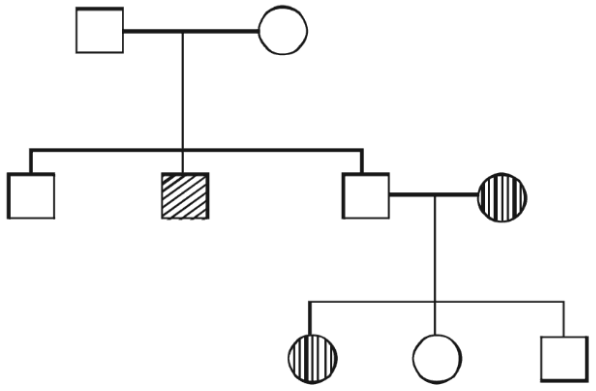 KCET 2016 Hard
 - An element \( X \) decays into element \( Z \) by two-step process.
\[
\begin{array}{l}
X \rightarrow Y+4 e \\
Y \rightarrow Z+2 e^{-} \text {then }:
\end{array}
\]KCET 2016 Medium - In \(P(X)\), the power set of a non-empty set \(X\), an binary operation * is defined by \(\mathrm{A}{ }^{*} \mathrm{~B}=\mathrm{A} \cup \mathrm{B}, \forall \mathrm{A}, \mathrm{B} \in \mathrm{P}(\mathrm{x})\) under \(*\), a true statement isKCET 2010 Easy
- A man takes a step forward with probability \( 0.4 \) and one step backward with probability \( 0.6 \),
then the probability that at the end of eleven steps he is one step away from the starting point
isKCET 2015 Hard - A particle executing a simple harmonic motion has a period of \(6 \mathrm{~s}\). The time taken by the particle to move from the mean position to half the amplitude, starting from the mean position isKCET 2011 Hard