


JEE Mains · Maths · STD 12 - 7.1 indefinite integral
If \(\int \sqrt{\sec 2 x-1} d x=\alpha \log _e\left|\cos 2 x+\beta+\sqrt{\cos 2 x\left(1+\cos \frac{1}{\beta} x\right)}\right|+\) constant, then \(\beta-\alpha\) is equal to
- A \(0.5\)
- B \(1\)
- C \(10\)
- D \(100\)
Answer & Solution
Correct Answer
(B) \(1\)
Step-by-step Solution
Detailed explanation
\(\int \sqrt{\sec 2 x-1} d x=\int \sqrt{\frac{1-\cos 2 x}{\cos 2 x}} d x\) \(=\sqrt{2} \int \frac{\sin x}{\sqrt{2 \cos ^2 x-1}} d x\) \(\text { put } \cos x=t \Rightarrow-\sin x d x=d t\) \(=-\sqrt{2} \int \frac{d t}{\sqrt{2 t^2-1}}\)…
See the Complete Solution
Get step-by-step explanations for this and 2.5 Lakh+ more JEE, NEET & CET questions.
- Unlock all solutions
- Practice the full chapter
- Track accuracy across PYQs
4.8 rated on Google Play · 14,000+ reviews
More questions from Maths
- If \(\frac{{ }^{11} C_1}{2}+\frac{{ }^{11} C_2}{3}+\ldots . .+\frac{{ }^{11} C_9}{10}=\frac{n}{m}\) with \(\operatorname{gcd}(n, m)=1\), then \(n+m\) is equal toJEE Mains 2024 Hard
- The line of shortest distance between the lines \(\frac{x-2}{0}=\frac{y-1}{1}=\frac{z}{1}\) and \(\frac{x-3}{2}=\frac{y-5}{2}=\frac{z-1}{1}\) makes an angle of \(\cos ^{-1}\left(\sqrt{\frac{2}{27}}\right)\) with the plane \(P: a x-y-\) \(z=0\), \((a>0)\). If the image of the point \((1,1,-5)\) in the plane \(P\) is \((\alpha, \beta, \gamma)\), then \(\alpha+\beta-\gamma\) is equal to \(........\)JEE Mains 2022 Hard
- Let \(x=2\) be a root of the equation \(x^2+p x+q=0\) and \(f(x)=\left\{\begin{array}{cc}\frac{1-\cos \left(x^2-4 p x+q^2+8 q+16\right)}{(x-2 p)^4}, & x \neq 2 p \\ 0, & x=2 p\end{array}\right.\) Then \(\lim _{x \rightarrow 22^{+}}[f(x)]\) where [. ] denotes greatest integer function, is \(........\)JEE Mains 2023 Hard
- Let the system of equations
\(\begin{aligned}
& x+5 y-z=1 \\
& 4 x+3 y-3 z=7 \\
& 24 x+y+\lambda z=\mu
\end{aligned}\)
\(\lambda, \mu \in \mathrm{R}\), have infinitely many solutions. Then the number of the solutions of this system, If \(x, y, z\) are integers and satisfy \(7 \leq x+y+z \leq 77\), isJEE Mains 2025 Medium - In the figure, \(\theta_1+\theta_2=\frac{\pi}{2}\) and \(\sqrt{3}(B E)=4(A B)\). If the area of \(\triangle CAB\) is \(2 \sqrt{3}-3\) unit \(^2\), when \(\frac{\theta_2}{\theta_1}\) is the largest, then the perimeter (in unit) of \(\triangle CED\) is equal to \(...........\).
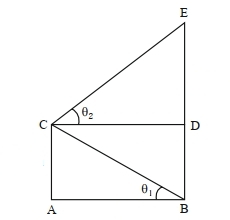 JEE Mains 2023 Hard
 - Let \(A=\left\{(x, y) \in R ^2: y \geq 0,2 x \leq y \leq \sqrt{4-(x-1)^2}\right\}\) and \(B=\left\{(x, y) \in R \times R : 0 \leq y \leq \min \left\{2 x, \sqrt{4-(x-1)^2}\right\}\right\}\) Then the ratio of the area of \(A\) to the area of \(B\) isJEE Mains 2023 Hard
More PYQs from JEE Mains
- Let \(\mathrm{L}_1: \frac{x-1}{1}=\frac{y-2}{-1}=\frac{z-1}{2}\) and \(\mathrm{L}_2: \frac{x+1}{-1}=\frac{y-2}{2}=\frac{z}{1}\) be two lines.
Let \(L_3\) be a line passing through the point \((\alpha, \beta, \gamma)\) and be perpendicular to both \(L_1\) and \(L_2\). If \(L_3\) intersects \(\mathrm{L}_1\), then \(|5 \alpha-11 \beta-8 \gamma|\) equals :JEE Mains 2025 Hard - For \(0 \le x \le \frac{\pi }{2}\), the value of \(\int\limits_0^{{{\sin }^2}\,x} {{{\sin }^{ - 1}}\,\left( {\sqrt t } \right)} dt + \int\limits_0^{{{\cos }^2}\,x} {{{\cos }^{ - 1}}\,\left( {\sqrt t } \right)}\, dt\) equalsJEE Mains 2013 Hard
- If \(f(x)=x^3-x^2 f^{\prime}(1)+x f^{\prime \prime}(2)-f^{\prime \prime \prime}(3), x \in R\), thenJEE Mains 2023 Hard
- If for the complex numbers \(z\) satisfying \(|z-2-2 i| \leq 1\), the maximum value of \(|3 i z+6|\) is attained at \(\mathrm{a}+i \mathrm{~b}\), then \(\mathrm{a}+\mathrm{b}\) is equal to .... .JEE Mains 2021 Hard
- Let \(x=x(y)\) be the solution of the differential equation \(y=\left(x-y \frac{\mathrm{~d} x}{\mathrm{~d} y}\right) \sin \left(\frac{x}{y}\right), y\gt0\) and \(x(1)=\frac{\pi}{2}\). Then \(\cos (x(2))\) is equal to :JEE Mains 2025 Hard
- Let \(g:(0, \infty) \rightarrow R\) be a differentiable function such that \(\int\left(\frac{x(\cos x-\sin x)}{e^{x}+1}+\frac{g(x)\left(e^{x}+1-x e^{x}\right)}{\left(e^{x}+1\right)^{2}}\right) d x=\frac{x g(x)}{e^{x}+1}+c\) for all \(x >0\), where \(c\) is an arbitrary constant. Then.JEE Mains 2022 Hard