


JEE Mains · Maths · STD 11 - 10.2 parabola,ellipse,hyperbola
A hyperbola having the transverse axis of length \(\sqrt{2}\) has the same foci as that of the ellipse \(3 x^{2}+4 y^{2}=12,\) then this hyperbola does not pass through which of the following points?
- A \(\left(1,-\frac{1}{\sqrt{2}}\right)\)
- B \(\left(\sqrt{\frac{3}{2}}, \frac{1}{\sqrt{2}}\right)\)
- C \(\left(\frac{1}{\sqrt{2}}, 0\right)\)
- D \(\left(-\sqrt{\frac{3}{2}}, 1\right)\)
Answer & Solution
Correct Answer
(B) \(\left(\sqrt{\frac{3}{2}}, \frac{1}{\sqrt{2}}\right)\)
Step-by-step Solution
Detailed explanation
Ellipse \(: \frac{x^{2}}{4}+\frac{y^{2}}{3}=1\) eccentricity \(=\sqrt{1-\frac{3}{4}}=\frac{1}{2}\) \(\therefore\) foci \(=(\pm 1,0)\) for hyperbola, given \(2 a =\sqrt{2} \Rightarrow a =\frac{1}{\sqrt{2}}\) \(\therefore \quad\) hyperbola will be…
See the Complete Solution
Get step-by-step explanations for this and 2.5 Lakh+ more JEE, NEET & CET questions.
- Unlock all solutions
- Practice the full chapter
- Track accuracy across PYQs
4.8 rated on Google Play · 14,000+ reviews
More questions from Maths
- Let \(f(x)=\int \frac{d x}{\left(3+4 x^2\right) \sqrt{4-3 x^2}},|x| < \frac{2}{\sqrt{3}}\). If \(f(0)=0\) and \(f(1)=\frac{1}{\alpha \beta} \tan ^{-1}\left(\frac{\alpha}{\beta}\right), \alpha, \beta > 0\), then \(\alpha^2+\beta^2\) is equal to \(.........\).JEE Mains 2023 Hard
- A factory is operating in two shifts, day and night, with \(70\) and \(30\) workers respectively . If per day mean wage of the day shift workers is \(Rs. 54\) and per day mean wage of all the workers is \(Rs. 60,\) then per day mean wage of the night shift workers(in \(Rs. \) )isJEE Mains 2015 Hard
- The sum \(1 + \dfrac{1}{2}(1^2 + 2^2) + \dfrac{1}{3}(1^2 + 2^2 + 3^2) + \ldots\) upto 10 terms is equal to :JEE Mains 2026 Medium
- A line is a common tangent to the circle \((x-3)^{2}+y^{2}=9\) and the parabola \(y^{2}=4 x.\) If the two points of contact \(( a , b )\) and \(( c , d )\) are distinct and lie in the first quadrant, then \(2(a+c)\) is equal to ........ .JEE Mains 2021 Hard
- Let \(\left(\begin{array}{l}n \\ k\end{array}\right)\) denotes \({ }^{n} C_{k}\) and \(\left[\begin{array}{l} n \\ k \end{array}\right]=\left\{\begin{array}{cc}\left(\begin{array}{c} n \\ k \end{array}\right), & \text { if } 0 \leq k \leq n \\ 0, & \text { otherwise }\end{array}\right.\) If \(A_{k}=\sum_{i=0}^{9}\left(\begin{array}{l}9 \\ i\end{array}\right)\left[\begin{array}{c}12 \\ 12-k+i\end{array}\right]+\sum_{i=0}^{8}\left(\begin{array}{c}8 \\ i\end{array}\right)\left[\begin{array}{c}13 \\ 13-k+i\end{array}\right]\) and \(A_{4}-A_{3}=190 \mathrm{p}\), then \(p\) is equal to :JEE Mains 2021 Hard
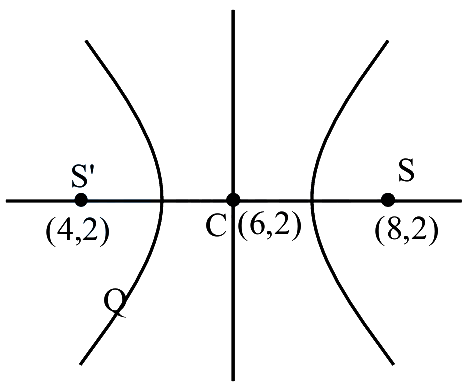
- If the equation of the hyperbola with foci \((4,2)\) and \((8,2)\) is \(3 x^2-y^2-\alpha x+\beta y+\gamma=0\), then \(\alpha+\beta+\gamma\) is equal to _____.
 JEE Mains 2025 Easy
More PYQs from JEE Mains
- If \(\sin ^{-1} \frac{\alpha}{17}+\cos ^{-1} \frac{4}{5}-\tan ^{-1} \frac{77}{36}=0,0 < \alpha < 13\), then \(\sin ^{-1}(\sin \alpha)+\cos ^{-1}(\cos \alpha)\) is equal to \(.........\).JEE Mains 2023 Hard
- Let \(\mathrm{P}\) be a parabola with vertex \((2,3)\) and directrix \(2 x+y=6\). Let an ellipse \(E: \frac{x^2}{a^2}+\frac{y^2}{b^2}=1, a>b\) of eccentricity \(\frac{1}{\sqrt{2}}\) pass through the focus of the parabola \(\mathrm{P}\). Then the square of the length of the latus rectum of \(\mathrm{E}\), isJEE Mains 2024 Hard
- Number of \(4-\)digit numbers (the repetition of digits is allowed) which are made using the digits \(1, 2, 3\) and \(5\) , and are divisible by \(15\) , is equal to \(............\).JEE Mains 2023 Hard
- Let \(R = \{(x, y) \in \mathbb{N} \times \mathbb{N} : \log_e(x + y) \leq 2\}\). Then the minimum number of elements, required to be added in \(R\) to make it a transitive relation, is __________.JEE Mains 2026 Hard
- If the area of the region \(\left\{(x, y): 0 \leq y \leq \min \left\{2 x, 6 x-x^2\right\}\right\}\) is \(A\), then \(12 A\) is equal toJEE Mains 2024 Medium
- Let \(\theta=\frac{\pi}{5}\) and \(A=\left[\begin{array}{cc}\cos \theta & \sin \theta \\ -\sin \theta & \cos \theta\end{array}\right] \cdot\) If \(B=A + A ^{4},\) then \(\operatorname{det}( B )\)JEE Mains 2020 Hard