


JEE Advanced · Physics · 15. Oscillations
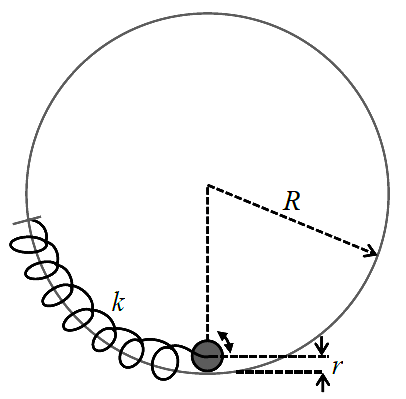
The center of a disk of radius \(r\) and mass \(m\) is attached to a spring of spring constant \(k\), inside a ring of radius \(R>r\) as shown in the figure. The other end of the spring is attached on the periphery of the ring. Both the ring and the disk are in the same vertical plane. The disk can only roll along the inside periphery of the ring, without slipping. The spring can only be stretched or compressed along the periphery of the ring, following the Hooke's law. In equilibrium, the disk is at the bottom of the ring. Assuming small displacement of the disc, the time period of oscillation of center of mass of the disk is written as \(T=\frac{2 \pi}{\omega}\). The correct expression for \(\omega\) is ( \(g\) is the acceleration due to gravity):
- A \(\sqrt{\frac{2}{3}\left(\frac{g}{R-r}+\frac{k}{m}\right)}\)
- B \(\sqrt{\frac{2 g}{3(R-r)}+\frac{k}{m}}\)
- C \(\sqrt{\frac{1}{6}\left(\frac{g}{R-r}+\frac{k}{m}\right)}\)
- D \(\sqrt{\frac{1}{4}\left(\frac{g}{R-r}+\frac{k}{m}\right)}\)
Answer & Solution
Correct Answer
(A) \(\sqrt{\frac{2}{3}\left(\frac{g}{R-r}+\frac{k}{m}\right)}\)
Step-by-step Solution
Detailed explanation
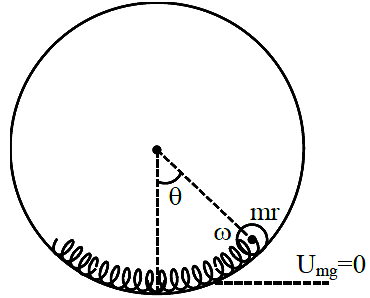
\(E=\frac{1}{2} k(R-r)^2 \theta^2+m g(R-r)(1-\cos \theta)+\) \(\frac{1}{2} m v^2+\frac{1}{2} \frac{m r^2}{2} \omega^2\)
Differentiating wrt t ,
\(0 =\frac{1}{2} \mathrm{k}(\mathrm{R}-\mathrm{r})^2 \cdot 2 \theta \frac{\mathrm{~d} \theta}{\mathrm{dt}}+\mathrm{mg}(\mathrm{R}-\mathrm{r}) ~\cdot\) \(\frac{\mathrm{d}}{\mathrm{dt}}\left(2 \frac{\theta^2}{4}\right)+\frac{1}{2} \mathrm{~m} \cdot 2 \mathrm{v} \frac{\mathrm{dv}}{\mathrm{dt}}+\frac{\mathrm{mr}^2}{4} \cdot 2 \omega \frac{\mathrm{~d} \omega}{\mathrm{dt}} \)
\( \Rightarrow 0=\mathrm{k}(\mathrm{R}-\mathrm{r})^2 \theta \frac{\mathrm{~d} \theta}{\mathrm{dt}}+\mathrm{mg}(\mathrm{R}-\mathrm{r}) \theta\) \(\frac{\mathrm{d} \theta}{\mathrm{dt}}+\mathrm{mv} \frac{\mathrm{dv}}{\mathrm{dt}}+\frac{\mathrm{mr}^2}{2} \omega \frac{\mathrm{~d} \omega}{\mathrm{dt}}\)
Also, \(\frac{d \theta}{d t}=\frac{V}{(R-r)} \Rightarrow \frac{d^2 \theta}{d t^2}=\frac{1}{(R-r)} \frac{d v}{d t}=\frac{1}{R-r} a\)
\(\therefore \mathrm{k}(\mathrm{R}-\mathrm{r})^2 \cdot \theta \frac{\mathrm{~V}}{\mathrm{R}-\mathrm{r}}+\mathrm{mg}(\mathrm{R}-\mathrm{r}) \theta \frac{\mathrm{V}}{\mathrm{R}-\mathrm{r}}=\) \(-\mathrm{mv} \alpha \mathrm{r}-\frac{\mathrm{mr}^2}{2} \frac{\mathrm{~V}}{\mathrm{r}} \alpha \)
\( \Rightarrow \mathrm{k}(\mathrm{R}-\mathrm{r})+\mathrm{mg} \theta=-\frac{3}{2} \mathrm{mr} \alpha \)
\( \Rightarrow-[\mathrm{k}(\mathrm{R}-\mathrm{r})+\mathrm{mg}] \theta=\frac{3}{2} \mathrm{~m}(\mathrm{R}-\mathrm{r}) \frac{\mathrm{d}^2 \theta}{\mathrm{dt}^2} \)
\( \Rightarrow-\frac{2}{3}\left[\frac{\mathrm{k}}{\mathrm{m}}+\frac{\mathrm{g}}{\mathrm{R}-\mathrm{r}}\right]=\frac{\mathrm{d}^2 \theta}{\mathrm{dt}^2}\)
Compering with standard equation of SHM
\(\omega=\sqrt{\frac{2}{3}\left[\frac{\mathrm{k}}{\mathrm{m}}+\frac{\mathrm{g}}{\mathrm{R}-\mathrm{r}}\right]}\)
Hence answer is option(A)
\(\mathrm{OR}\)
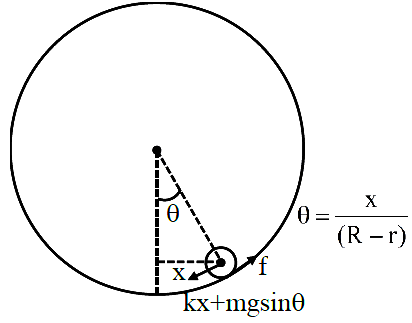
\(\mathrm{kx}+\mathrm{mg} \sin \theta-\mathrm{f}=\mathrm{ma}\)
\(\begin{aligned} & \Rightarrow \mathrm{kx}+\mathrm{mg} \frac{\mathrm{x}}{(\mathrm{R}-\mathrm{r})}-\mathrm{f}=\mathrm{ma} \\ & \mathrm{fr}=\frac{\mathrm{mr}^2}{2} \cdot \alpha \Rightarrow \mathrm{f}=\frac{\mathrm{ma}}{2} \\ & \therefore\left(\alpha+\frac{\mathrm{mg}}{\mathrm{R}-\mathrm{r}}\right) \mathrm{x}=\frac{3 \mathrm{ma}}{2} \\ & \therefore \omega=\sqrt{\frac{2}{3}\left[\frac{\mathrm{k}}{\mathrm{m}}+\frac{\mathrm{g}}{\mathrm{R}-\mathrm{r}}\right]}\end{aligned}\)
See the Complete Solution
Get step-by-step explanations for this and 2.5 Lakh+ more JEE, NEET & CET questions.
- Unlock all solutions
- Practice the full chapter
- Track accuracy across PYQs
4.8 rated on Google Play · 14,000+ reviews
More questions from Physics
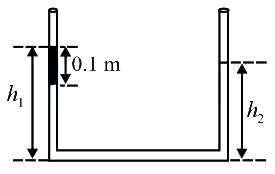
- An open-ended U-tube of uniform cross-sectional area contains water (density ). Initially the water level stands at from the bottom in each arm. Kerosene oil (a water-immiscible liquid) of density is added to the left arm until its length is , as shown in the schematic figure below. The ratio of the heights of the liquid in the two arms is
 JEE Advanced 2020 Easy
 - Paragraph:
A small block of mass \(M\) moves on a frictionless surface of an inclined plane, as shown in figure. The angle of the incline suddenly changes from \(60^{\circ}\) to \(30^{\circ}\) at point \(B\). The block is initially at rest at \(A\). Assume that collisions between the block and the incline are totally inelastic \(\left(g=10 \mathrm{~m} / \mathrm{s}^2\right)\)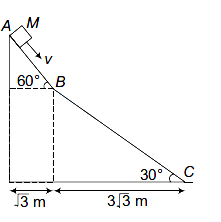
Question:
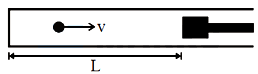
The speed of the block at point \(C\), immediately before it leaves the second incline isJEE Advanced 2008 Hard - A small particle of mass moving inside a heavy, hollow and straight tube along the tube axis, undergoes elastic collision at two ends. The tube has no friction and it is closed at one end by a flat surface while the other end is fitted with a heavy movable flat piston as shown in figure. When the distance of the piston from closed end is the particle speed is The piston is moved inward at a very low speed such that where is the infinitesimal displacement of the piston. Which of the following statement(s) is/are correct?
 JEE Advanced 2019 Hard
 - Statement \(1 \mathrm{In}\) a Meter Bridge experiment, null point for an unknown resistance is measured. Now, the unknown resistance is put inside an enclosure maintained at a higher temperature. The null point can be obtained at the same point as before by decreasing the value of the standard resistance.
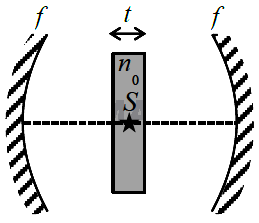
and Statement 2 Resistance of a metal increase with increase in temperature.JEE Advanced 2008 Medium - Two identical concave mirrors each of focal length \(f\) are facing each other as shown in the schematic diagram. The focal length \(f\) is much larger than the size of the mirrors. A glass slab of thickness \(t\) and refractive index \(n_0\) is kept equidistant from the mirrors and perpendicular to their common principal axis. A monochromatic point light source \(S\) is embedded at the center of the slab on the principal axis, as shown in the schematic diagram. For the image to be formed on \(S\) itself, which of the following distances between the two mirrors is/are correct:
 JEE Advanced 2025 Hard
 - A train is moving along a straight line with a constant acceleration a. A boy standing in the train throws a ball forward with a speed of \(10 \mathrm{~m} / \mathrm{s}\), at an angle of \(60^{\circ}\) to the horizontal. The boy has to move forward by \(1.15 \mathrm{~m}\) inside the train to catch the ball back at the initial height. The acceleration of the train in \(\mathrm{m} / \mathrm{s}^2\), isJEE Advanced 2011 Medium
More PYQs from JEE Advanced
- When light of a given wavelength is incident on a metallic surface, the minimum potential needed to stop the emitted photoelectrons is . This potential drops to if another source with wavelength four times that of the first one and intensity half of the first one is used. What are the wavelength of the first source and the work function of the metal, respectively? [Take .]JEE Advanced 2022 Easy
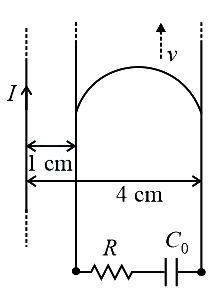
- A long straight wire carries a current, ampere. A semi-circular conducting rod is placed beside it on two conducting parallel rails of negligible resistance. Both the rails are parallel to the wire. The wire, the rod and the rails lie in the same horizontal plane, as shown in the figure. Two ends of the semi-circular rod are at distances and from the wire. At time , the rod starts moving on the rails with a speed (see the figure). A resistor and a capacitor are connected in series between the rails. At time , is uncharged. Which of the following statement(s) is (are) correct? [ SI units. Take ]
 JEE Advanced 2021 Medium
 - Consider the hyperbola with foci at and , where lies on the positive -axis. Let be a point on the hyperbola, in the first quadrant. Let , with . The straight line passing through the point and having the same slope as that of the tangent at to the hyperbola, intersects the straight line at . Let be the distance of from the straight line , and . Then the greatest integer less than or equal to is _____ .JEE Advanced 2022 Medium
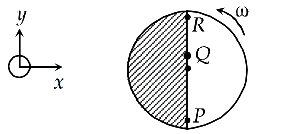
- Consider a disc rotating in the horizontal plane with a constant angular speed \(\omega\) about its centre \(\mathrm{O}\). The disc has a shaded region on one side of the diameter and an unshaded region on the other side as shown in the figure. When the disc is in the orientation as shown, two pebbles \(P\) and \(Q\) are simultaneously projected at an angle towards \(R\). The velocity of projection is in the \(y\) - \(z\) plane and is same for both pebbles with respect to the disc. Assume that (i) they land back on the disc before the disc has completed \(1 / 8\) rotation, (ii) their range is less than half the disc radius, and (iii) \(\omega\) remains constant throughout. Then
 JEE Advanced 2012 Medium
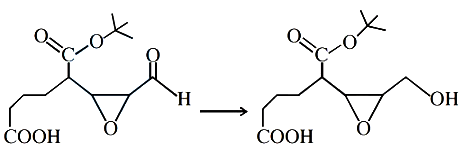
 - Reagent(s) which can be used to bring about the following transformation is(are)
 JEE Advanced 2016 Medium
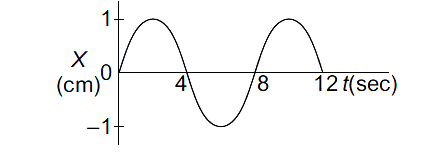
 - The \(x-t\) graph of a particle undergoing simple harmonic motion is shown below. The acceleration of the particle at \(t=\frac{4}{3} \mathrm{~s}\) is
 JEE Advanced 2009 Easy