


JEE Advanced · Physics · 28. Nuclear Physics
An accident in a nuclear laboratory resulted in deposition of a certain amount of radioactive material of half-life 18 days inside the laboratory. Tests revealed that the radiation was 64 times more than the permissible level required for safe operation of the laboratory. What is the minimum number of days after which the laboratory can be considered safe for use?
- A 64
- B 90
- C 108
- D 120
Answer & Solution
Correct Answer
(C) 108
Step-by-step Solution
Detailed explanation
Given half-life of radioactive material days. Let the permissible level have activity of
Thus, initially
[Given]
Let number of days required be t.
Thus, initially
[Given]
Let number of days required be t.
See the Complete Solution
Get step-by-step explanations for this and 2.5 Lakh+ more JEE, NEET & CET questions.
- Unlock all solutions
- Practice the full chapter
- Track accuracy across PYQs
4.8 rated on Google Play · 14,000+ reviews
More questions from Physics
- Two satellites and are moving in different circular orbits around the Earth(radius ). The heights of and from the Earth surface are and , respectively, where . The accelerations of and due to Earth’s gravity are and , respectively. If , what is the value of ?JEE Advanced 2023 Easy
- A double slit setup is shown in the figure. One of the slits is in medium of refractive index . The other slit is at the interface of this medium with another medium of refractive index . The line joining the slits is perpendicular to the interface and the distance between the slits is . The slit widths are much smaller than . A monochromatic parallel beam of light is incident on the slits from medium . A detector is placed in medium at a large distance from the slits, and at an angle from the line joining them, so that equals the angle of refraction of the beam. Consider two approximately parallel rays from the slits received by the detector.
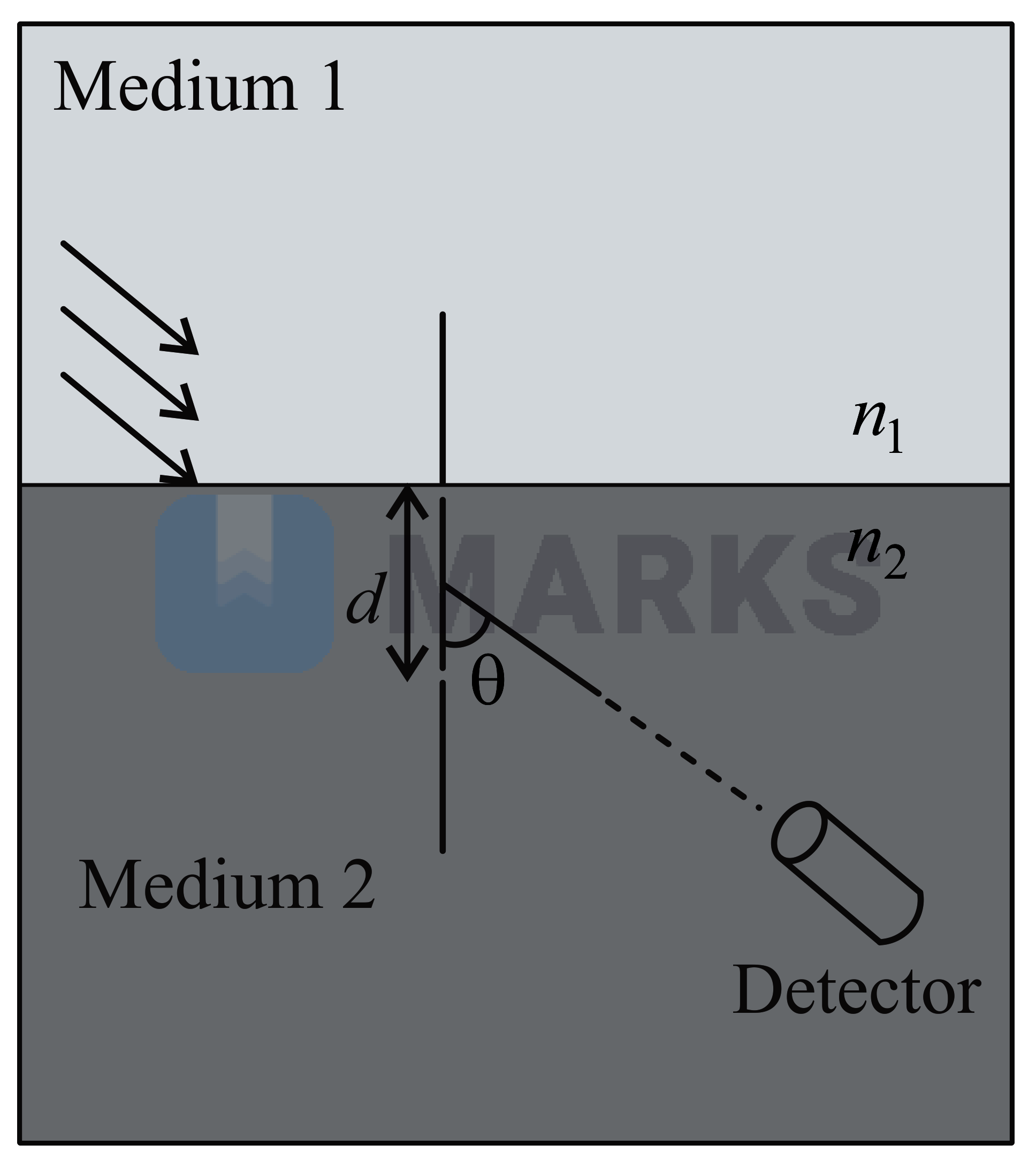
Which of the following statement(s) is(are) correct?JEE Advanced 2022 Easy - The figure below shows the variation of specific heat capacity () of a solid as a function of temperature (). The temperature is increased continuously from to at a constant rate. Ignoring any volume change, the following statement (s) is (are) correct to a reasonable approximation.
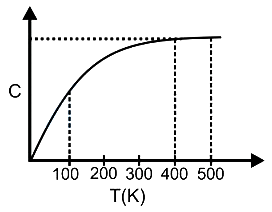 JEE Advanced 2013 Medium
 - Statement I The total translational kinetic energy of all the molecules of a given mass of an ideal gas is \(1.5\) times the product of its pressure and its volume.
Statement II The molecules of a gas collide with each other and the velocities of the molecules change due to the collision.JEE Advanced 2007 Easy - Paragraph:
Consider a simple \(R C\) circuit as shown in Figure \(1\).
Process 1: In the circuit the switch \(S\) is closed at \(t=0\) and the capacitor is fully charged to voltage \(V_{0}\) (i.e., charging continues for time \(T>>R C\) ). In the process some dissipation \(\left(E_{D}\right)\) occurs across the resistance \(R\). The amount of energy finally stored in the fully charged capacitor is \(E_{C}\).
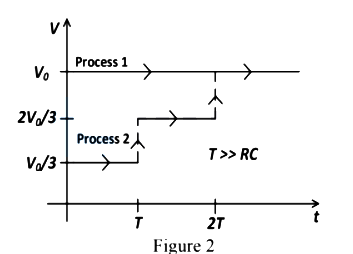
Process 2: In a different process the voltage is first set to \(\frac{V_{0}}{3}\) and maintained for a charging time \(T>>R C\). Then the voltage is raised to \(\frac{2 V_{0}}{3}\) without discharging the capacitor and again maintained for a time \(T>>R C\). The process is repeated one more time by raising the voltage to \(V_{0}\) and the capacitor is charged to the same final voltage \(V_{0}\) as in Process 1.
These two processes are depicted in Figure \(2 .\)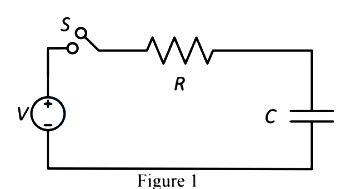
Question:
In Process 2, total energy dissipated across the resistance \(E_{D}\) is:JEE Advanced 2017 Medium - A metal rod \(A B\) of length \(10 x\) has its one end \(A\) in ice at \(0^{\circ} \mathrm{C}\) and the other end \(B\) in water at \(100^{\circ} \mathrm{C}\). If a point \(P\) on the rod is maintained at \(400^{\circ} \mathrm{C}\), then it is found that equal amounts of water and ice evaporate and melt per unit time. The latent heat of evaporation of water is \(540 \mathrm{calg}^{-1}\) and latent heat of melting of ice is \(80 \mathrm{calg}^{-1}\). If the point \(P\) is at a distance of \(\lambda x\) from the ice end \(A\), find the value of \(\lambda\). [Neglect any heat loss to the surrounding.]JEE Advanced 2009 Medium
More PYQs from JEE Advanced
- An organic compound undergoes first-order decomposition. The time taken for its decomposition to \(1 /\) 8 and \(1 / 10\) of its initial concentration are \(t_{1 / 8}\) and \(t_{1 / 10}\) respectively. What is the value of \(\left[\frac{t_{1 / 8}}{t_{1 / 10}}\right] \times 10\) ? \(\left(\log _{10} 2=0.3\right)\)JEE Advanced 2012 Medium
- Paragraph:
The amount of energy required to break a bond is same as the amount of energy released when the same bond is formed. In gaseous state, the energy required for homolytic cleavage of a bond is called Bond Dissociation Energy (BDE) or Bond Strength. BDE is affected by \(s\)-character of the bond and the stability of the radicals formed. Shorter bonds are typically stronger bonds. BDEs for some bonds are given below:



Question:
\(\mathrm{CH}_{4}(\mathrm{~g})+\mathrm{Cl}_{2}(\mathrm{~g}) \stackrel{\text { light }}{\longrightarrow} \mathrm{CH}_{3} \mathrm{Cl}(\mathrm{g})+\mathrm{HCl}(\mathrm{g})\) the correct statement isJEE Advanced 2021 Medium - For the reaction:
The correct statement(s) in the balanced equation is/are:JEE Advanced 2014 Medium - Based on VSEPR model, match the xenon compounds given in List-I with the corresponding geometries and the number of lone pairs on xenon given in List-II and choose the correct option.
List - I List - II (P) \(XeF _2\) (1) Trigonal bipyramidal and two lone pair of electrons (Q) \(XeF _4\) (2) Tetrahedral and one lone pair of electrons (R) \(XeO _3\) (3) Octahedral and two lone pair of electrons (S) \(XeO _3 F_2\) (4) Trigonal bipyramidal and no lone pair of electrons (5) Trigonal bipyramidal and three lone pair of electrons JEE Advanced 2024 Medium - Paragraph:
A small spherical monoatomic ideal gas bubble \(\left(\gamma=\frac{5}{3}\right)\) is trapped inside a liquid of density \(\rho_1\) (see figure). Assume that the bubble does not exchange any heat with the liquid. The bubble contains \(n\) moles of gas. The temperature of the gas when the bubble is at the bottom is \(T_0\), the height of the liquid is \(H\) and the atmospheric pressure is \(p_0\) (Neglect surface tension).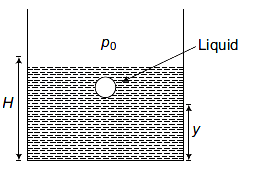
Question:
As the bubble moves upwards, besides the buoyancy force the following forces are acting on it.JEE Advanced 2008 Medium - For the resistance network shown in the figure, choose the correct option(s)
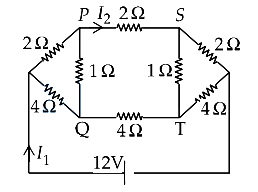 JEE Advanced 2012 Medium