


JEE Advanced · Mathematics · 12. Circle
The circle passing through the point \((-1,0)\) and touching the \(Y\)-axis at \((0,2)\), also passes through the point
- A
\(\left(-\frac{3}{2}, 0\right)\)
- B
\(\left(-\frac{5}{2}, 2\right)\)
- C
\(\left(-\frac{3}{2}, \frac{5}{2}\right)\)
- D
\((-1,-4)\)
Answer & Solution
Correct Answer
(D)
\((-1,-4)\)
Step-by-step Solution
Detailed explanation
Equation of circle passing through a point \(\left(x_1, y_1\right)\) and touching the straight line \(L\), is given by
\[
\left(x-x_1\right)^2+\left(y-y_1\right)^2=\lambda L=0
\]
\(\therefore\) Equation of circle passing through \((0,2)\) and touching \(x=0\).
Now, \((x-0)^2+(y-2)^2+\lambda x=0 \ldots\) (i)
Also, it passes through \((-1,0)\).
So, \(1+4-\lambda=0 \Rightarrow \lambda=5\)
Eq. (i) becomes,
\[
\begin{aligned}
& x^2+y^2-4 y+4+5 x=0 \\
\Rightarrow \quad x^2+y^2+5 x-4 y+4 & =0
\end{aligned}
\]
For \(x\)-intercept, put \(y=0\),
\[
\begin{array}{rlrl}
& x^2+5 x+4 & =0 \\
\Rightarrow & & (x+1)(x+4) & =0 \\
\therefore & & x & =-1,-4
\end{array}
\]
\[
\left(x-x_1\right)^2+\left(y-y_1\right)^2=\lambda L=0
\]
\(\therefore\) Equation of circle passing through \((0,2)\) and touching \(x=0\).
Now, \((x-0)^2+(y-2)^2+\lambda x=0 \ldots\) (i)
Also, it passes through \((-1,0)\).
So, \(1+4-\lambda=0 \Rightarrow \lambda=5\)
Eq. (i) becomes,
\[
\begin{aligned}
& x^2+y^2-4 y+4+5 x=0 \\
\Rightarrow \quad x^2+y^2+5 x-4 y+4 & =0
\end{aligned}
\]
For \(x\)-intercept, put \(y=0\),
\[
\begin{array}{rlrl}
& x^2+5 x+4 & =0 \\
\Rightarrow & & (x+1)(x+4) & =0 \\
\therefore & & x & =-1,-4
\end{array}
\]
See the Complete Solution
Get step-by-step explanations for this and 2.5 Lakh+ more JEE, NEET & CET questions.
- Unlock all solutions
- Practice the full chapter
- Track accuracy across PYQs
4.8 rated on Google Play · 14,000+ reviews
More questions from Mathematics
- Let \(a_{n}\) denote the number of all \(n\)-digit positive integers formed by the digits 0,1 or both such that no consecutive digits in them are 0 . Let \(b_{n}=\) the number of such \(n\)-digit integers ending with digit 1 and \(c_{n}=\) the number of such \(n\)-digit integers ending with digit 0 .
Question:
The value of \(b_{6}\) isJEE Advanced 2012 Medium - For let Then the possible value(s) of is/are:JEE Advanced 2019 Medium
- The maximum value of the function \(f(x)=2 x^3-15 x^2+36 x-48\) on the set \(A=\left\{x \mid x^2+20 \leq 9 x\right\}\) isJEE Advanced 2009 Hard
- Columns 1, 2 and 3 contain conics, equations of tangents to the conics and points of contact, respectively.
For , if a tangent is drawn to a suitable conic (Column 1) at the point of contact , then which of the following options is the only Correct combination for obtaining its equation?Column 1 Column 2 Column 3 (I) (i) (P) (II) (ii) (Q) (III) (iii) (R) (IV) (iv) (S) JEE Advanced 2017 Hard - Paragraph:
A fair die is tossed repeatedly until a six is obtained. Let \(X\) denotes the number of tosses required.Question:
The probability that \(X=3\) equalsJEE Advanced 2009 Easy - Let and be defined by . Then is -JEE Advanced 2016 Easy
More PYQs from JEE Advanced
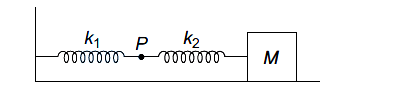
- The mass \(M\) shown in the figure oscillates in simple harmonic motion with amplitude \(A\). The amplitude of the point \(P\) is
 JEE Advanced 2009 Easy
 - In a study about a pandemic, data of persons was collected. It was found that persons had symptom of fever, persons had symptom of cough, persons had symptom of breathing problem, persons had symptom of fever or cough or both, persons had symptom of cough or breathing problem or both, persons had symptom of fever or breathing problem or both, persons had all three symptoms (fever, cough and breathing problem). If a person is chosen randomly from these persons, then the probability that the person has at most one symptom is ______.JEE Advanced 2022 Easy
- Using the data provided, calculate the multiple bond energy \(\left(\mathrm{kJ} \mathrm{mol}^{-1}\right)\) of a \(\mathrm{C} \equiv \mathrm{C}\) bond in \(\mathrm{C}_{2} \mathrm{H}_{2}\). That energy is (take the bond energy of a \(\mathrm{C}-\mathrm{H}\) bond as \(350 \mathrm{~kJ} \mathrm{~mol}^{-1}\) ) \(2 \mathrm{C}(\mathrm{s})+\mathrm{H}_{2}(\mathrm{~g}) \longrightarrow \mathrm{HC}=\mathrm{CH}(\mathrm{g}) ; \Delta \mathrm{H}=\) \(225 \mathrm{~kJ} \mathrm{~mol}^{-1}\) \(2 \mathrm{C}(\mathrm{s}) \longrightarrow 2 \mathrm{C}(\mathrm{g}) ; \Delta \mathrm{H}=1410 \mathrm{~kJ} \mathrm{~mol}^{-1}\) \(\mathrm{H}_{2}(\mathrm{~g}) \longrightarrow 2 \mathrm{H}(\mathrm{g}) ; \Delta \mathrm{H}=330 \mathrm{~kJ} \mathrm{~mol}^{-1}\)JEE Advanced 2012 Hard
- Four point charges, each of \(+q\), are rigidly fixed at the four corners of a square planar soap film of side \(a\). The surface tension of the soap film is \(\gamma\). The system of charges and planar film are in equilibrium, and \(a=k\left[\frac{q^2}{\gamma}\right]^{1 / N}\), where \(k\) is a constant. Then, \(N\) isJEE Advanced 2011 Hard
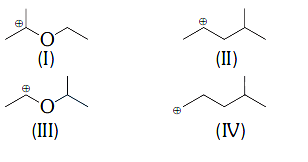
- The correct stability order for the following species is
 JEE Advanced 2008 Medium
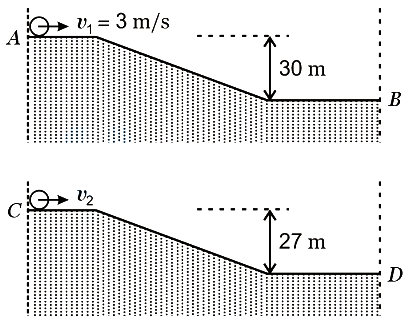
 - Two identical uniform discs roll without slipping on two different surfaces AB and CD (see figure) starting at A and C with linear speeds \(v_1\) and \(v_2\), respectively, and always remain in contact with the surfaces. If they reach B and D with the same linear speed and \(v_1=3 m / s\), then \(v_2\) in \(m / s\) is \(\left( g =10 \frac{m}{ s ^2}\right)\)
 JEE Advanced 2015 Medium