


JEE Advanced · Mathematics · 19. Determinants
Paragraph:
Let \(A\) be the set of all \(3 \times 3\) symmetric matrices all of whose entries are either 0 or 1 . Five of these entries are 1 and four of them are 0 .Question:
The number of matrices \(A\) in \(A\) for which the system of linear equations \(A\left[\begin{array}{l}x \\ y \\ z\end{array}\right]=\left[\begin{array}{l}1 \\ 0 \\ 0\end{array}\right]\) has a unique solution, is
- A
less than 4
- B
atleast 4 but less than 7
- C
atleast 7 but less than 10
- D
at least 10
Answer & Solution
Correct Answer
(B)
atleast 4 but less than 7
Step-by-step Solution
Detailed explanation
Given, \(A\left[\begin{array}{l}x \\ y \\ z\end{array}\right]=\left[\begin{array}{l}1 \\ 0 \\ 0\end{array}\right]\)
For unique solution, \(\operatorname{det}(A) \neq 0\)
\[
\begin{gathered}
\text { Case I } \operatorname{det}(A)=\left|\begin{array}{lll}
1 & a & b \\
a & 1 & c \\
b & c & 1
\end{array}\right| \\
=1-a^2-b^2-c^2+2 a b c \neq 0
\end{gathered}
\]
Here \(a, b, c\) is selected from \(1,0,0\). (No case is possible)
Case II
(i) \(\operatorname{det}(A)=\left|\begin{array}{lll}1 & a & b \\ a & 0 & c \\ b & c & 0\end{array}\right|=2 a b c-c^2 \neq 0\)
Here \(a, b, c\) are selected from \(1,1,0\). (2 cases are possible)
(ii) \(\operatorname{det}(A)=\left|\begin{array}{lll}0 & a & b \\ a & 1 & c \\ b & c & 0\end{array}\right|=2 a b c-b^2 \neq 0\)
Here \(a, b, c\) are selected from \(1,1,0\). (2 cases are possible)
(iii) \(\operatorname{det}(A)=\left|\begin{array}{lll}0 & a & b \\ a & 0 & c \\ b & c & 1\end{array}\right|=2 a b c-a^2 \neq 0\)
Here \(a, b, c\) are selected from \(1,1,0\). (2 cases are possible)
Hence, there are exactly 6 matrices for unique solution. Hence, option (b) is correct.
For unique solution, \(\operatorname{det}(A) \neq 0\)
\[
\begin{gathered}
\text { Case I } \operatorname{det}(A)=\left|\begin{array}{lll}
1 & a & b \\
a & 1 & c \\
b & c & 1
\end{array}\right| \\
=1-a^2-b^2-c^2+2 a b c \neq 0
\end{gathered}
\]
Here \(a, b, c\) is selected from \(1,0,0\). (No case is possible)
Case II
(i) \(\operatorname{det}(A)=\left|\begin{array}{lll}1 & a & b \\ a & 0 & c \\ b & c & 0\end{array}\right|=2 a b c-c^2 \neq 0\)
Here \(a, b, c\) are selected from \(1,1,0\). (2 cases are possible)
(ii) \(\operatorname{det}(A)=\left|\begin{array}{lll}0 & a & b \\ a & 1 & c \\ b & c & 0\end{array}\right|=2 a b c-b^2 \neq 0\)
Here \(a, b, c\) are selected from \(1,1,0\). (2 cases are possible)
(iii) \(\operatorname{det}(A)=\left|\begin{array}{lll}0 & a & b \\ a & 0 & c \\ b & c & 1\end{array}\right|=2 a b c-a^2 \neq 0\)
Here \(a, b, c\) are selected from \(1,1,0\). (2 cases are possible)
Hence, there are exactly 6 matrices for unique solution. Hence, option (b) is correct.
See the Complete Solution
Get step-by-step explanations for this and 2.5 Lakh+ more JEE, NEET & CET questions.
- Unlock all solutions
- Practice the full chapter
- Track accuracy across PYQs
4.8 rated on Google Play · 14,000+ reviews
More questions from Mathematics
- Paragraph:
Let \(a\), b and \(c\) be three real numbers satisfying \(\left[\begin{array}{lll}a & b & c\end{array}\right]\left[\begin{array}{lll}1 & 9 & 7 \\ 8 & 2 & 7 \\ 7 & 3 & 7\end{array}\right]=\left[\begin{array}{lll}0 & 0 & 0\end{array}\right]\)Question:
If the point \(P(a, b, c)\), with reference to Eq. (E), lies on the plane \(2 x+y+z=1\), then the value of \(7 a+b+c\) isJEE Advanced 2011 Easy - If the sum of first \(n\) terms of an \(\mathrm{AP}\) is \(\mathrm{cn}^2\), then the sum of squares of these \(n\) terms isJEE Advanced 2009 Easy
- Paragraph:
If a continuous \(f\) defined on the real line \(R\), assume positive and negative values in \(R\), then the equation \(f(x)=0\) has a root in \(R\). For example, if it is known that a continuous function \(f\) on \(R\) is positive at some point and its minimum values is negative, then the equation \(f(x)=0\) has a root in \(R\).
Consider \(f(x)=k e^x-x\) for all real \(x\), where \(k\) is real constant.Question:
The positive value of \(k\) for which \(k e^x-x=0\) has only one root isJEE Advanced 2007 Hard - Let complex numbers α and lie on circles and respectively. If satisfies the equationJEE Advanced 2013 Hard
- If , then which of the following matrices is equal to ?JEE Advanced 2022 Easy
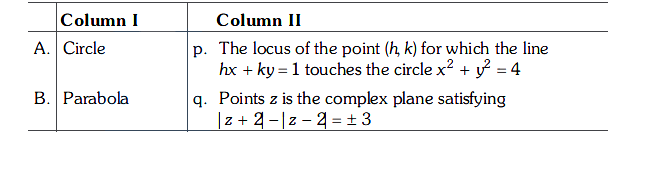
- \[
\text { Match the conics in Column I with the statements/expressions in Column II. }
\]
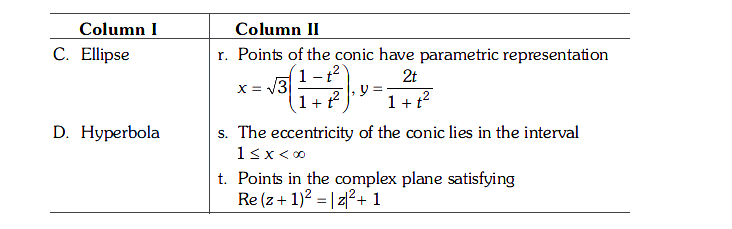 JEE Advanced 2009 Easy
More PYQs from JEE Advanced
- A horizontal circular platform of radius 0.5 m and mass 0.45 kg is free to rotate about its axis. Two massless spring toy-guns, each carrying a steel ball of mass 0.05 kg are attached to the platform at a distance 0.25 m from the centre on its either sides along its diameter (see figure). Each gun simultaneously fires the balls horizontally and perpendicular to the diameter in opposite directions. After leaving the platform, the balls have horizontal speed of 9 with respect to the ground. The rotational speed of the platform in rad after the balls leave the platform is
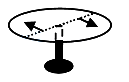 JEE Advanced 2014 Medium
 - A point source \(\mathrm{S}\) emits unpolarized light uniformly in all directions. At two points \(\mathrm{A}\) and \(\mathrm{B}\), the ratio \(r=I_A / I_B\) of the intensities of light is 2. If a set of two polaroids having \(45^{\circ}\) angle between their pass-axes is placed just before point \(\mathrm{B}\), then the new value of \(r\) will be ______JEE Advanced 2024 Easy
- Three randomly chosen non negative integers are found to satisfy the equation . Then the probability that is even, is
JEE Advanced 2017 Medium - Paragraph :
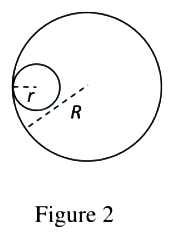
One twirls a circular ring (of mass \(M\) and radius \(R\) ) near the tip of one's finger as shown in Figure 1 . In the process the finger never loses contact with the inner rim of the ring. The finger traces out the surface of a cone, shown by the dotted line. The radius of the path traced out by the point where the ring and the finger is in contact is \(r\). The finger rotates with an angular velocity \(\omega_{0}\). The rotating ring rolls without slipping on the outside of a smaller circle described by the point where the ring and the finger is in contact (Figure 2). The coefficient of friction between the ring and the finger is \(\mu\) and the acceleration due to gravity is \(g\).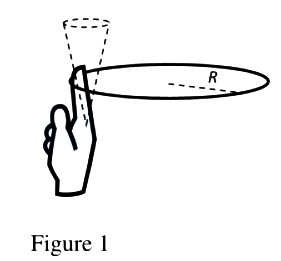
Question :
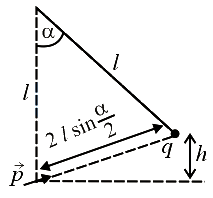
The total kinetic energy of the ring isJEE Advanced 2017 Medium - A point charge of mass is suspended vertically by a string of length A point dipole of dipole moment is now brought towards from infinity so that the charge moves away. The final equilibrium position of the system including the direction of the dipole, the angles and distances is shown in the figure below. If the work done in bringing the dipole to this position is , where is the acceleration due to gravity, then the value of is ____________ (Note that for three coplanar forces keeping a point mass in equilibrium, is the same for all forces, where is any one of the forces and is the angle between the other two forces)
 JEE Advanced 2020 Hard
 - A vernier calipers has \(1 \mathrm{~mm}\) marks on the main scale. It has 20 equal divisions on the vernier scale which match with 16 main scale divisions. For this vernier calipers, the least count isJEE Advanced 2010 Medium