


JEE Advanced · Mathematics · 6. Binomial Theorem
Let \(m\) be the smallest positive integer such that the coefficient of \(x^2\) in the expansion of \((1+x)^2 +(1+x)^3+\ldots+(1+x)^{49}\) \(+~(1+m x)^{50}\) is \((3 n+1){ }^{51} C_3\) for some positive integer n . Then the value of \(n\) is
- A 5
- B 10
- C 15
- D 20
Answer & Solution
Correct Answer
(A) 5
Step-by-step Solution
Detailed explanation
Coefficient of \(x^2\) in the expansion of
\((1+x)^2+(1+x)^3+\ldots(1+x)^{49}+(1~+\) \(m x)^{50}\) is
\( { }^2 C_2+{ }^3 C_2+\ldots{ }^{49} C_2+{ }^{50} C_2 m^2=(3 n+1)^{51} C_3 \)
\( \Rightarrow{ }^3 C_3+{ }^3 C_2+\ldots{ }^{49} C_2+{ }^{50} C_2 m^2=(3 n\) \(+~1)^{51} C_3 \quad\) \(\left({\text{Use} }^n C_r+{ }^n C_{r+1}={ }^{n+1} C_{r+1}\right) \)
\( \Rightarrow{ }^{50} C_3+{ }^{50} C_2 m^2=(3 n+1){ }^{51} C_3 \)
\( \frac{50.49 .48}{6}+\frac{50.49}{2} m^2=(3 n+1) \frac{51.50 .49}{6} \)
\( m^2=51 n+1\) must be a perfect square
By trial \(\Rightarrow n=5\) and \(m=16 \quad( M , n \in N )\)
\(\Rightarrow n=5\)
\((1+x)^2+(1+x)^3+\ldots(1+x)^{49}+(1~+\) \(m x)^{50}\) is
\( { }^2 C_2+{ }^3 C_2+\ldots{ }^{49} C_2+{ }^{50} C_2 m^2=(3 n+1)^{51} C_3 \)
\( \Rightarrow{ }^3 C_3+{ }^3 C_2+\ldots{ }^{49} C_2+{ }^{50} C_2 m^2=(3 n\) \(+~1)^{51} C_3 \quad\) \(\left({\text{Use} }^n C_r+{ }^n C_{r+1}={ }^{n+1} C_{r+1}\right) \)
\( \Rightarrow{ }^{50} C_3+{ }^{50} C_2 m^2=(3 n+1){ }^{51} C_3 \)
\( \frac{50.49 .48}{6}+\frac{50.49}{2} m^2=(3 n+1) \frac{51.50 .49}{6} \)
\( m^2=51 n+1\) must be a perfect square
By trial \(\Rightarrow n=5\) and \(m=16 \quad( M , n \in N )\)
\(\Rightarrow n=5\)
See the Complete Solution
Get step-by-step explanations for this and 2.5 Lakh+ more JEE, NEET & CET questions.
- Unlock all solutions
- Practice the full chapter
- Track accuracy across PYQs
4.8 rated on Google Play · 14,000+ reviews
More questions from Mathematics
- The value of is equal toJEE Advanced 2016 Medium
- Let and be real numbers. Consider the following system of linear equations Match each entry in List-I to the correct entries in List-II.
The correct option is:List-I List-II If and then the system has a unique solution If and , then the system has no solution If where and , then the system has infinitely many solutions If where and , then the system has and as a solution and as a solution JEE Advanced 2023 Medium - Paragraph:
Let \(p\) be an odd prime number and \(T_p\) be the following set of \(2 \times 2\) matrices
\[
T_p=\left\{A=\left[\begin{array}{ll}
a & b \\
c & a
\end{array}\right] ; a, b, c \in\{0,1,2, \ldots, p-1\}\right\}
\]Question:
The number of \(A\) in \(T_p\) such that the trace of \(A\) is not divisible by \(p\) but det \((A)\) is divisible by \(p\) is
[Note : The trace of a matrix is the sum of its diagonal entries.]JEE Advanced 2010 Medium - If \(e_1\) is the eccentricity of the ellipse \(\frac{x^2}{16}+\frac{y^2}{25}=1\) and \(e_2\) is the eccentricity of the hyperbola passing through the focii of the ellipse and \(e_1 e_2=1\), then equation of the hyperbola isJEE Advanced 2006 Easy
- Paragraph:
Consider the functions defined implicitly by the equation \(y^3-3 y+x=0\) on various intervals in the real line. If \(x \in(-\infty,-2) \cup(2, \infty)\), the equation implicitly defines a unique real valued differentiable function \(y=f(x)\). If \(x \in(-2,2)\), the equation implicitly defines a unique real valued differentiable function \(y=g(x)\), satisfying \(g(0)=0\).Question:
If \(f(-10 \sqrt{2})=2 \sqrt{2}\), then \(f^{\prime \prime}(-10 \sqrt{2})\) is equal toJEE Advanced 2008 Medium - Let be given by
Then which of the following options is/are correct?JEE Advanced 2019 Medium
More PYQs from JEE Advanced
- The correct option(s) about entropy (S) is(are)
[ gas constant, Faraday constant, Temperature]JEE Advanced 2022 Hard - Benzene and naphthalene form an ideal solution at room temperature. For this process, the true statement(s) is (are)JEE Advanced 2013 Medium
- Let and be the respective electric fields at a distance r from a point charge Q, an infinitely long wire with constant linear charge density , and an infinite plane with uniform surface charge density . If at a given distance , thenJEE Advanced 2014 Medium
- The entropy versus temperature plot for phases and at bar pressure is given. and are entropies of the phases at temperatures and , respectively.
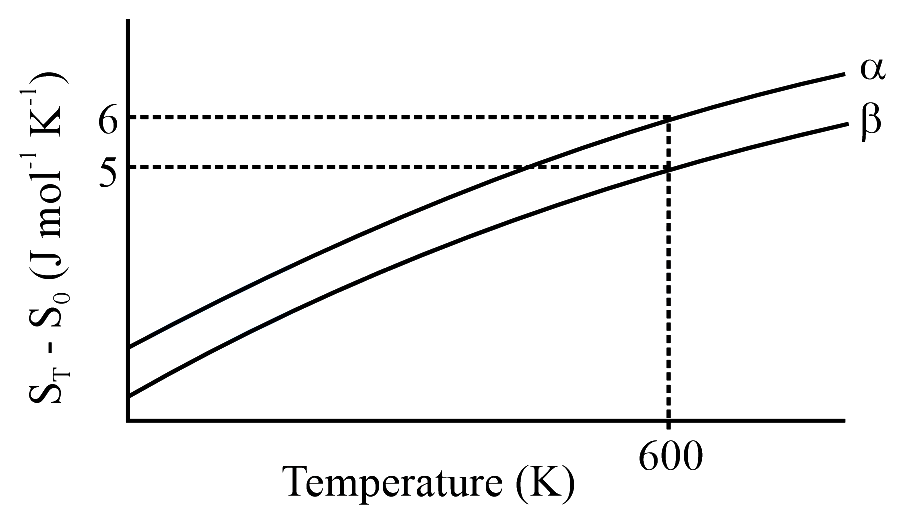 The transition temperature for to phase change is and . Assume is independent of temperature in the range of to and are heat capacities of and phases, respectively. The value of enthalpy change, (in ), at isJEE Advanced 2023 Medium
 - The area enclosed by the curves and over the interval isJEE Advanced 2013 Hard
- Paragraph :
A uniform thin cylindrical disk of mass \(M\) and radius \(R\) is attached to two identical massless springs of spring constant \(k\) which are fixed to the wall as shown in the figure. The springs are attached to the axle of the disk symmetrically on either side at a distance \(d\) from its centre. The axle is massless and both the springs and the axle are in a horizontal plane. The unstretched length of each spring is \(L\). The disk is initially at its equilibrium position with its centre of mass \((C M)\) at a distance Lfrom the wall. The disk rolls without slipping with velocity \(\mathbf{v}_0=v_0 \hat{\mathbf{i}}\) The coefficient of friction is \(\mu\).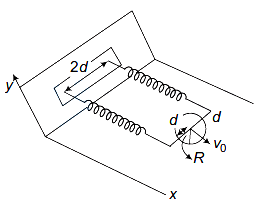
Question :
The net external force acting on the disk when its centre of mass is at displacement \(x\) with respect to its equilibrium position isJEE Advanced 2008 Medium