


JEE Advanced · Mathematics · 2. Quadratic Equations
Let \(f(x)=x^4+a x^3+b x^2+c\) be a polynomial with real coefficients such that \(f(1)=-9\). Suppose that \(i \sqrt{3}\) is a root of the equation \(4 x^3+3 a x^2+2 b x=0\), where \(i=\sqrt{-1}\). If \(\alpha_1, \alpha_2, \alpha_3\), and \(\alpha_4\) are all the roots of the equation \(f(x)=0\), then \(\left|\alpha_1\right|^2+\left|\alpha_2\right|^2+\left|\alpha_3\right|^2+\left|\alpha_4\right|^2\) is equal to ________.
- A 10
- B 20
- C 30
- D 40
Answer & Solution
Correct Answer
(B) 20
Step-by-step Solution
Detailed explanation
\(f(1)=1+a+b+c=-9 \quad \Rightarrow \quad a~+\) \(b+c=-10.....(1)\)
\(4 x^3+3 a x^2+2 b x=0\) roots are \(\sqrt{3} i,-\sqrt{3} i, 0\)
\(\Rightarrow4 x^2+3 a x+2 b=0 < ^{\sqrt{3i}}_{-{\sqrt{3i}}}\)
\(\Rightarrow \mathrm{a}=0 ~\&~ \frac{2 \mathrm{~b}}{4}=(\sqrt{3} \mathrm{i})(-\sqrt{3} \mathrm{i})\)
\(\mathrm{b}=6\) use \(\mathrm{a}, \mathrm{b}\) in (1) \(\Rightarrow \mathrm{c}=-16\)
\(\Rightarrow \mathrm{f}(\mathrm{x})=\mathrm{x}^4+6 \mathrm{x}^2-16=0 \)
\( \left(\mathrm{x}^2+8\right)\left(\mathrm{x}^2-2\right)=0 \)
\( \Rightarrow \mathrm{x}= \pm \sqrt{8} \mathrm{i}, \pm \sqrt{2}\)
\(\Rightarrow \left|\alpha_1\right|^2+\left|\alpha_2\right|^2+\left|\alpha_3\right|^2+\left|\alpha_4\right|^2=20\)
\(4 x^3+3 a x^2+2 b x=0\) roots are \(\sqrt{3} i,-\sqrt{3} i, 0\)
\(\Rightarrow4 x^2+3 a x+2 b=0 < ^{\sqrt{3i}}_{-{\sqrt{3i}}}\)
\(\Rightarrow \mathrm{a}=0 ~\&~ \frac{2 \mathrm{~b}}{4}=(\sqrt{3} \mathrm{i})(-\sqrt{3} \mathrm{i})\)
\(\mathrm{b}=6\) use \(\mathrm{a}, \mathrm{b}\) in (1) \(\Rightarrow \mathrm{c}=-16\)
\(\Rightarrow \mathrm{f}(\mathrm{x})=\mathrm{x}^4+6 \mathrm{x}^2-16=0 \)
\( \left(\mathrm{x}^2+8\right)\left(\mathrm{x}^2-2\right)=0 \)
\( \Rightarrow \mathrm{x}= \pm \sqrt{8} \mathrm{i}, \pm \sqrt{2}\)
\(\Rightarrow \left|\alpha_1\right|^2+\left|\alpha_2\right|^2+\left|\alpha_3\right|^2+\left|\alpha_4\right|^2=20\)
See the Complete Solution
Get step-by-step explanations for this and 2.5 Lakh+ more JEE, NEET & CET questions.
- Unlock all solutions
- Practice the full chapter
- Track accuracy across PYQs
4.8 rated on Google Play · 14,000+ reviews
More questions from Mathematics
- A line L : meets at E(0,3) and the arc of the parabola at the point .The tangent to the parabola at intersects the y-axis at .The slope m of the line L is chosen such that the area of the triangle EFG has a local maximum.
Match List I with List II and select the correct answer using the code given below the lists :
List I List II A. m = P. B. Maximum area of ΔEFG is Q. 4 C. y0 = R. 2 D. y1 = S. 1 JEE Advanced 2013 Medium - If \(\frac{\sin ^4 x}{2}+\frac{\cos ^4 x}{3}=\frac{1}{5}\), thenJEE Advanced 2009 Easy
- The value of \(\int_{\sqrt{\log 2}}^{\sqrt{\log 3}} \frac{x \sin x^2}{\sin x^2+\sin \left(\log 6-x^2\right)} d x\) isJEE Advanced 2011 Medium
- Let \(S\) be the set of all seven-digit numbers that can be formed using the digits 0,1 and 2 . For example, 2210222 is in \(S\), but 0210222 is NOT in \(S\).
Then the number of elements \(x\) in \(S\) such that at least one the digits 0 and 1 appears exactly twice in \(x\), is equal to ______.JEE Advanced 2025 Hard - A solution curve of differential equation passes through the point (1, 3). Then the solution curve -JEE Advanced 2016 Hard
- The value of \(b\) for which the equations \(x^2+b x-1=0, x^2+x+b=0\) have one root in common isJEE Advanced 2011 Hard
More PYQs from JEE Advanced
- An ellipse intersects the hyperbola \(2 x^2-2 y^2=1\) orthogonally. The eccentricity of the ellipse is reciprocal to that of the hyperbola. If the axes of the ellipse are along the coordinate axes, thenJEE Advanced 2009 Hard
- Paragraph :
A uniform thin cylindrical disk of mass \(M\) and radius \(R\) is attached to two identical massless springs of spring constant \(k\) which are fixed to the wall as shown in the figure. The springs are attached to the axle of the disk symmetrically on either side at a distance \(d\) from its centre. The axle is massless and both the springs and the axle are in a horizontal plane. The unstretched length of each spring is \(L\). The disk is initially at its equilibrium position with its centre of mass \((C M)\) at a distance Lfrom the wall. The disk rolls without slipping with velocity \(\mathbf{v}_0=v_0 \hat{\mathbf{i}}\) The coefficient of friction is \(\mu\).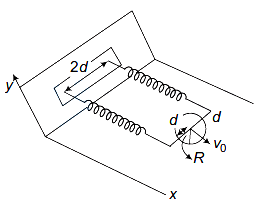
Question :
The maximum value of \(v_0\) for which the disk will roll without slipping isJEE Advanced 2008 Easy - Let S be the set of all twice differentiable functions f from to such that for all . For , let be the number of points for which . Then which of the following statements is(are) true?JEE Advanced 2023 Medium
- A bar of mass and length is lying on a horizontal frictionless surface. One end of the bar is pivoted at a point about which it is free to rotate. A small mass is moving on the same horizontal surface with speed on a path perpendicular to the bar. It hits the bar at a distance from the pivoted end and returns back on the same path with speed . After this elastic collision, the bar rotates with an angular velocity . Which of the following statement is correct?JEE Advanced 2023 Hard
- If the value of Avogadro number is and the value of Boltzmann constant is , then the number of significant digits in the calculated value of the universal gas constant isJEE Advanced 2014 Easy
- Paragraph:
An aqueous solution of metal ion \(\mathbf{M} 1\) reacts separately with reagents \(\mathbf{Q}\) and \(\mathbf{R}\) in excess to give tetrahedral and square planar complexes, respectively. An aqueous solution of another metal ion M2 always forms tetrahedral complexes with these reagents. Aqueous solution of \(\mathbf{M} 2\) on reaction with reagent \(\mathbf{S}\) gives white precipitate which dissolves in excess of \(\mathbf{S}\). The reactions are summarized in the scheme given below: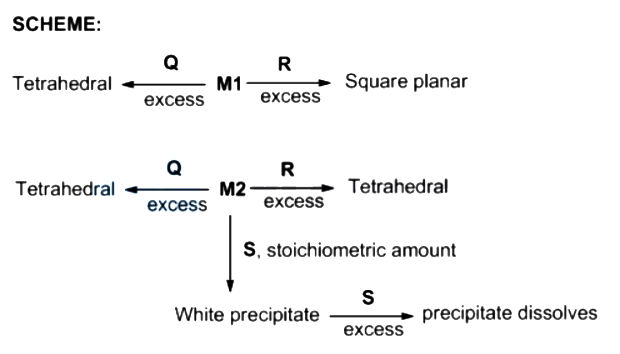
Question:
\(\mathbf{M} 1, \mathbf{Q}\) and \(\mathbf{R}\), respectively areJEE Advanced 2014 Easy