


JEE Advanced · Mathematics · 22. Functions
Let \(f: \mathbb{R} \rightarrow \mathbb{R}\) be a function such that \(f(x+y)=f(x)+f(y)\) for all \(x, y \in \mathbb{R}\), and \(g: \mathbb{R} \rightarrow(0, \infty)\) be a function such that \(g(x+y)=g(x) g(y)\) for all \(x, y \in \mathbb{R}\). If \(f\left(\frac{-3}{5}\right)=12\) and \(g\left(\frac{-1}{3}\right)=2\), then the value of \(\left(f\left(\frac{1}{4}\right)+g(-2)-8\right) g(0)\) is . ________.
- A 45
- B 99
- C 51
- D 20
Answer & Solution
Correct Answer
(C) 51
Step-by-step Solution
Detailed explanation
\(f(x+y)=f(x)+f(y)\) ...(1)
\(\Rightarrow \quad \mathrm{f}(\mathrm{nx})=\operatorname{nf}(\mathrm{x}) \forall \mathrm{n} \in \mathrm{N}\) ...(2)
Now put \(y=-x\) in eq.(1)
\(\begin{aligned} & \mathrm{f}(\mathrm{x})+\mathrm{f}(-\mathrm{x})=\mathrm{f}(0) \quad\{\mathrm{f}(0)=0\} \\ \Rightarrow \quad & \mathrm{f}(-\mathrm{x})=-\mathrm{f}(\mathrm{x})\end{aligned}\)
\(\Rightarrow \quad \mathrm{f}\) is odd function from eq. (2)
from eq. (2)
\(\begin{aligned} & f(-n x)=\operatorname{nf}(-x) \\ & \Rightarrow \quad \mathrm{f}(-\mathrm{nx})=-n f(\mathrm{x}) \\ & \end{aligned}\)
\(\Rightarrow \quad \mathrm{f}(\mathrm{mx})=\operatorname{mf}(\mathrm{x}) \forall \mathrm{m} \in \mathrm{Z}\) ...(3)
from eq. (2) and eq. (3)
\(\mathrm{f}(\mathrm{nx})=\mathrm{nf}(\mathrm{x}) \forall \mathrm{n} \in \mathrm{Z}\) ...(4)
Now put \(x=\frac{p}{q}\) where \(\mathrm{p}, \mathrm{q} \in \mathrm{Z}, \mathrm{q} \neq 0\)
\(\mathrm{f}\left(\frac{\mathrm{np}}{\mathrm{q}}\right)=\operatorname{nf}\left(\frac{\mathrm{p}}{\mathrm{q}}\right) \forall \mathrm{n} \in \mathrm{Z}\)
put \(\mathrm{n}=\mathrm{q}\)
\(f(p)=q f\left(\frac{p}{q}\right)\)
\(\Rightarrow \quad \mathrm{pf}(1)=\mathrm{qf}\left(\frac{\mathrm{p}}{\mathrm{q}}\right) \quad\) {from eq.(4)}
Let \(\mathrm{f}(1)=\mathrm{a}\)
then \(\quad \mathrm{pa}=\mathrm{qf}\left(\frac{\mathrm{p}}{\mathrm{q}}\right)\)
\(\mathrm{f}\left(\frac{\mathrm{p}}{\mathrm{q}}\right)=\frac{\mathrm{ap}}{q}\)
\(\Rightarrow \quad \mathrm{f}(\mathrm{x})=\mathrm{ax} \forall \mathrm{x} \in \mathbb{Q}\)
Now, \(\mathrm{f}\left(\frac{-3}{5}\right)=\mathrm{a}\left(\frac{-3}{5}\right)=12 \Rightarrow \mathrm{a}=-20\)
\(\Rightarrow \quad \mathrm{f}(\mathrm{x})=-20 \mathrm{x} \forall \mathrm{x} \in \mathbb{Q}\) ...(5)
From the given functional equation it is not possible to find a unique function for irrational values of ' \(x\) ', there are infinitely many such functions satisfying given functional equation for irrational values of \(x\), but in this problem we finally need the function at rational values of ' \(x\) ' only. So, for rational values of \(x\) we are getting a unique function mentioned in (5).
Now, \(g(x+y)=g(x) \cdot g(y)\)
\(\Rightarrow \quad \ell \mathrm{n}(\mathrm{g}(\mathrm{x}+\mathrm{y})=\ell \mathrm{n}(\mathrm{g}(\mathrm{x}))+\ell \ln (\mathrm{g}(\mathrm{y}))\)
Let \(\quad \ln (\mathrm{g}(\mathrm{x}))=\mathrm{h}(\mathrm{x})\)
\(\begin{array}{ll}\Rightarrow & \mathrm{h}(\mathrm{x}+\mathrm{y})=\mathrm{h}(\mathrm{x})+\mathrm{h}(\mathrm{y}) \\ \Rightarrow & \mathrm{h}(\mathrm{x})=\mathrm{kx} \forall \mathrm{x} \in \mathbb{Q}\end{array}\)
\(\Rightarrow \quad \mathrm{g}(\mathrm{x})=\mathrm{e}^{\mathrm{kx}} \forall \mathrm{x} \in \mathbb{Q}\) ...(6)
and \(\mathrm{g}\left(\frac{-1}{3}\right)=\mathrm{e}^{-\frac{\mathrm{K}}{3}}=2 \quad \Rightarrow \quad \mathrm{K}=-3 \ell \ln 2\)
\(\Rightarrow \quad \mathrm{K}=\ln \left(\frac{1}{8}\right)\)
\(\Rightarrow \quad \mathrm{g}(\mathrm{x})=\mathrm{e}^{\ln \left(\frac{1}{8}\right) \cdot \mathrm{x}}=\left(\frac{1}{8}\right)^{\mathrm{x}}=2^{-3 \mathrm{x}} \forall \mathrm{x} \in \mathbb{Q}\)
\(\begin{aligned} & \text { Now, } f\left(\frac{1}{4}\right)=-5, g(-2)=2^6=64 \\ & g(0)=1\end{aligned}\)
\(\begin{aligned} & \text { So } \quad\left(\mathrm{f}\left(\frac{1}{4}\right)+\mathrm{g}(-2)-(8) \cdot g(0)\right) \\ & =(-5+64-8)(1)=51 \\ & \end{aligned}\)
\(\Rightarrow \quad \mathrm{f}(\mathrm{nx})=\operatorname{nf}(\mathrm{x}) \forall \mathrm{n} \in \mathrm{N}\) ...(2)
Now put \(y=-x\) in eq.(1)
\(\begin{aligned} & \mathrm{f}(\mathrm{x})+\mathrm{f}(-\mathrm{x})=\mathrm{f}(0) \quad\{\mathrm{f}(0)=0\} \\ \Rightarrow \quad & \mathrm{f}(-\mathrm{x})=-\mathrm{f}(\mathrm{x})\end{aligned}\)
\(\Rightarrow \quad \mathrm{f}\) is odd function from eq. (2)
from eq. (2)
\(\begin{aligned} & f(-n x)=\operatorname{nf}(-x) \\ & \Rightarrow \quad \mathrm{f}(-\mathrm{nx})=-n f(\mathrm{x}) \\ & \end{aligned}\)
\(\Rightarrow \quad \mathrm{f}(\mathrm{mx})=\operatorname{mf}(\mathrm{x}) \forall \mathrm{m} \in \mathrm{Z}\) ...(3)
from eq. (2) and eq. (3)
\(\mathrm{f}(\mathrm{nx})=\mathrm{nf}(\mathrm{x}) \forall \mathrm{n} \in \mathrm{Z}\) ...(4)
Now put \(x=\frac{p}{q}\) where \(\mathrm{p}, \mathrm{q} \in \mathrm{Z}, \mathrm{q} \neq 0\)
\(\mathrm{f}\left(\frac{\mathrm{np}}{\mathrm{q}}\right)=\operatorname{nf}\left(\frac{\mathrm{p}}{\mathrm{q}}\right) \forall \mathrm{n} \in \mathrm{Z}\)
put \(\mathrm{n}=\mathrm{q}\)
\(f(p)=q f\left(\frac{p}{q}\right)\)
\(\Rightarrow \quad \mathrm{pf}(1)=\mathrm{qf}\left(\frac{\mathrm{p}}{\mathrm{q}}\right) \quad\) {from eq.(4)}
Let \(\mathrm{f}(1)=\mathrm{a}\)
then \(\quad \mathrm{pa}=\mathrm{qf}\left(\frac{\mathrm{p}}{\mathrm{q}}\right)\)
\(\mathrm{f}\left(\frac{\mathrm{p}}{\mathrm{q}}\right)=\frac{\mathrm{ap}}{q}\)
\(\Rightarrow \quad \mathrm{f}(\mathrm{x})=\mathrm{ax} \forall \mathrm{x} \in \mathbb{Q}\)
Now, \(\mathrm{f}\left(\frac{-3}{5}\right)=\mathrm{a}\left(\frac{-3}{5}\right)=12 \Rightarrow \mathrm{a}=-20\)
\(\Rightarrow \quad \mathrm{f}(\mathrm{x})=-20 \mathrm{x} \forall \mathrm{x} \in \mathbb{Q}\) ...(5)
From the given functional equation it is not possible to find a unique function for irrational values of ' \(x\) ', there are infinitely many such functions satisfying given functional equation for irrational values of \(x\), but in this problem we finally need the function at rational values of ' \(x\) ' only. So, for rational values of \(x\) we are getting a unique function mentioned in (5).
Now, \(g(x+y)=g(x) \cdot g(y)\)
\(\Rightarrow \quad \ell \mathrm{n}(\mathrm{g}(\mathrm{x}+\mathrm{y})=\ell \mathrm{n}(\mathrm{g}(\mathrm{x}))+\ell \ln (\mathrm{g}(\mathrm{y}))\)
Let \(\quad \ln (\mathrm{g}(\mathrm{x}))=\mathrm{h}(\mathrm{x})\)
\(\begin{array}{ll}\Rightarrow & \mathrm{h}(\mathrm{x}+\mathrm{y})=\mathrm{h}(\mathrm{x})+\mathrm{h}(\mathrm{y}) \\ \Rightarrow & \mathrm{h}(\mathrm{x})=\mathrm{kx} \forall \mathrm{x} \in \mathbb{Q}\end{array}\)
\(\Rightarrow \quad \mathrm{g}(\mathrm{x})=\mathrm{e}^{\mathrm{kx}} \forall \mathrm{x} \in \mathbb{Q}\) ...(6)
and \(\mathrm{g}\left(\frac{-1}{3}\right)=\mathrm{e}^{-\frac{\mathrm{K}}{3}}=2 \quad \Rightarrow \quad \mathrm{K}=-3 \ell \ln 2\)
\(\Rightarrow \quad \mathrm{K}=\ln \left(\frac{1}{8}\right)\)
\(\Rightarrow \quad \mathrm{g}(\mathrm{x})=\mathrm{e}^{\ln \left(\frac{1}{8}\right) \cdot \mathrm{x}}=\left(\frac{1}{8}\right)^{\mathrm{x}}=2^{-3 \mathrm{x}} \forall \mathrm{x} \in \mathbb{Q}\)
\(\begin{aligned} & \text { Now, } f\left(\frac{1}{4}\right)=-5, g(-2)=2^6=64 \\ & g(0)=1\end{aligned}\)
\(\begin{aligned} & \text { So } \quad\left(\mathrm{f}\left(\frac{1}{4}\right)+\mathrm{g}(-2)-(8) \cdot g(0)\right) \\ & =(-5+64-8)(1)=51 \\ & \end{aligned}\)
See the Complete Solution
Get step-by-step explanations for this and 2.5 Lakh+ more JEE, NEET & CET questions.
- Unlock all solutions
- Practice the full chapter
- Track accuracy across PYQs
4.8 rated on Google Play · 14,000+ reviews
More questions from Mathematics
- Paragraph:
Consider the functions defined implicitly by the equation \(y^3-3 y+x=0\) on various intervals in the real line. If \(x \in(-\infty,-2) \cup(2, \infty)\), the equation implicitly defines a unique real valued differentiable function \(y=f(x)\). If \(x \in(-2,2)\), the equation implicitly defines a unique real valued differentiable function \(y=g(x)\), satisfying \(g(0)=0\).Question:
If \(f(-10 \sqrt{2})=2 \sqrt{2}\), then \(f^{\prime \prime}(-10 \sqrt{2})\) is equal toJEE Advanced 2008 Medium - Let and be real numbers. Consider the following system of linear equations Match each entry in List-I to the correct entries in List-II.
The correct option is:List-I List-II If and then the system has a unique solution If and , then the system has no solution If where and , then the system has infinitely many solutions If where and , then the system has and as a solution and as a solution JEE Advanced 2023 Medium - Let the vectors \(\mathbf{P Q}, \mathbf{Q R}, \mathbf{R S}, \mathbf{S T}, \mathbf{T U}\) and UP represent the sides of a regular hexagon.
Statement I PQ \(\times(\mathbf{R S}+\mathbf{S T}) \neq \mathbf{0}\)
Statement II \(\mathbf{P Q} \times \mathbf{R S}=\mathbf{0}\) and \(\mathbf{P Q} \times \mathbf{S Q} \neq \mathbf{0}\)JEE Advanced 2007 Medium - For a polynomial with real coefficients, let denote the number of distinct real roots of . Suppose is the set of polynomials with real coefficients defined by . For a polynomial , let and denote its first and second order derivatives respectively. Then the minimum possible value of , where , is ____JEE Advanced 2020 Medium
- Let and where and are real numbers. Which of the following options is/are correct?JEE Advanced 2019 Medium
- Let the eccentricity of the hyperbola \(\frac{x^2}{a^2}-\frac{y^2}{b^2}=1\) be reciprocal to that of the ellipse \(x^2+4 y^2=4\). If the hyperbola passes through a focus of the ellipse, thenJEE Advanced 2011 Medium
More PYQs from JEE Advanced
- Two large vertical and parallel metal plates having a separation of \(1 \mathrm{~cm}\) are connected to a DC voltage source of potential difference \(X\). A proton is released at rest midway between the two plates. It is found to move at \(45^{\circ}\) to the vertical JUST after release. Then \(X\) is nearlyJEE Advanced 2012 Medium
- Among the following complexes \((K-P), \mathrm{K}_3\left[\mathrm{Fe}(\mathrm{CN})_6\right](K)\),
\(\left[\right.\) Co \(\left.\left(\mathrm{NH}_3\right)_6\right] \mathrm{Cl}_3(L), \mathrm{Na}_3\left[\mathrm{Co}(\mathrm{ox})_3\right](M)\),
\(\left[\mathrm{Ni}\left(\mathrm{H}_2 \mathrm{O}\right)_6\right] \mathrm{Cl}_2(\mathrm{~N}) ; \mathrm{K}_2\left[\mathrm{Pt}(\mathrm{CN})_4\right](\mathrm{O})\) and \(\left[\mathrm{Zn}\left(\mathrm{H}_2 \mathrm{O}\right)_6\right]\left(\mathrm{NO}_3\right)_2(P)\)
the diamagnetic complexes areJEE Advanced 2011 Medium - Sometimes it is convenient to construct a system of units so that all quantities can be expressed in terms of only one physical quantity. In one such system, dimensions of different quantities are given in terms of a quantity as follows: ; ;; . ThenJEE Advanced 2020 Medium
- List I describes four systems, each with two particles and in relative motion as shown in figure. List II gives possible magnitudes of their relative velocities (in ) at time .
Which one of the following options is correct?List-I List-II (I) and are moving on a horizontal circle of radius with uniform angular speed . The initial angular positions of and at time are and respectively. 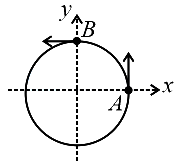
(P) (II) Projectiles and are fired (in the same vertical plane) at and respectively, with the same speed and at from the horizontal plane. The initial separation between and is large enough so that they do not collide, . 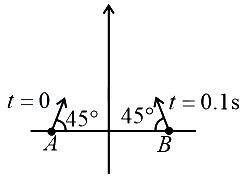
(Q) (III) Two harmonic oscillators and moving in the direction according to and respectively, starting from . Take . 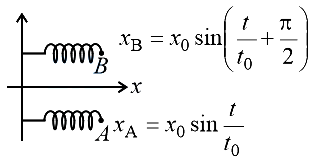
(R) (IV) Particle is rotating in a horizontal circular path of radius on the plane, with constant angular speed . Particle is moving up at a constant speed in the vertical direction as shown in the figure. (Ignore gravity.) 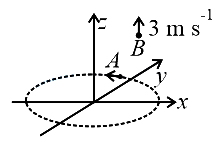
(S) (T) JEE Advanced 2022 Medium - Let and be two unit vectors such that For some let If and the vector is inclined at the same angle to both and then the value of isJEE Advanced 2018 Medium
- Tangents drawn from the point \(P(1,8)\) to the circle \(x^2+y^2-6 x-4 y-11=0\) touch the circle at the points \(A\) and \(B\). The equation of the circumcircle of \(\triangle P A B\) isJEE Advanced 2009 Medium