


JEE Advanced · Mathematics · 23. C&D
Let be a continuous function and let be defined as
. Then
- A is continuous but not differentiable at a
- B is differentiable on R
- C is continuous but not differentiable at b
- D is continuous and differentiable at either a or b but not both
Answer & Solution
Correct Answer
(C) is continuous but not differentiable at b
Step-by-step Solution
Detailed explanation
Since for
LHD at is zero
And RHD at
Hence is not differentiable at
Similarly LHD at is greater than 1
is not differentiable at
LHD at is zero
And RHD at
Hence is not differentiable at
Similarly LHD at is greater than 1
is not differentiable at
See the Complete Solution
Get step-by-step explanations for this and 2.5 Lakh+ more JEE, NEET & CET questions.
- Unlock all solutions
- Practice the full chapter
- Track accuracy across PYQs
4.8 rated on Google Play · 14,000+ reviews
More questions from Mathematics
- The tangent \(P T\) and the normal \(P N\) to the parabola \(y^2=4 a x\) at a point \(P\) onJEE Advanced 2009 Medium
- Let \(z=x+i y\) be a complex number, where \(x\) and \(y\) are integers. Then, the area of the rectangle whose vertices are the roots of the equation \(z \bar{z}^3+\bar{z} z^3=350\) isJEE Advanced 2009 Medium
- A debate club consists of 6 girls and 4 boys. A team of 4 members is to be selected from this club including the selection of a captain (from among these 4 members) for the team. If the team has to include at most one boy, then the number of ways of selecting the team isJEE Advanced 2016 Easy
- Paragraph:
Let \(f:[0,1] \rightarrow \mathbb{R}\) (the set of all real numbers) be a function. Suppose the function \(f\) is twice differentiable, \(f(0)=f(1)=0\) and satisfies \(f^{\prime \prime}(x)-2 f^{\prime}(x)+f(x) \geq e^{x}, x \in[0,1] .\)
Question:
If the function \(\mathrm{e}^{-x} f(x)\) assumes its minimum in the interval \([0,1]\) at \(x=\frac{1}{4}\), which of the following is true?JEE Advanced 2013 Hard - Let \(S\) denote the locus of the point of intersection of the pair of lines
\(4 x-3 y=12 \alpha\)
\(4 \alpha x+3 \alpha y=12\)
where \(\alpha\) varies over the set of non-zero real numbers. Let \(T\) be the tangent to \(S\) passing through the points \((p, 0)\) and \((0, q), q>0\), and parallel to the line \(4 x-\frac{3}{\sqrt{2}} y=0\).
Then the value of \(p q\) isJEE Advanced 2025 Hard - Let be a continuous function such that for all Then, which of the following statement(s) is (are) TRUE?JEE Advanced 2018 Hard
More PYQs from JEE Advanced
- If \(f(x)=\int_{0}^{x} e^{t^{2}}(t-2)(t-3) d t\) for all \(x \in(0, \infty)\), thenJEE Advanced 2012 Hard
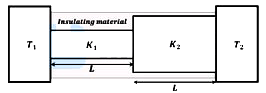
- Two conducting cylinders of equal length but different radii are connected in series between two heat baths kept at temperatures as shown in the figure. The radius of the bigger cylinder is twice that of the smaller one and the thermal conductivities of the materials of the smaller and the larger cylinders are , respectively. If the temperature at the junction of the two cylinders in the steady state is , then is
 JEE Advanced 2018 Easy
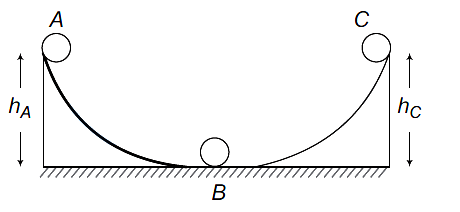
 - A ball moves over a fixed track as shown in the figure. From \(A\) to \(B\) the ball rolls without slipping. If surface \(B C\) is frictionless and \(K_A, K_B\) and \(K_C\) are kinetic energies of the ball at \(A, B\) and \(C\) respectively, then
 JEE Advanced 2006 Medium
 - Among PbS, CuS, HgS, MnS, , NiS, CoS, and , the total number of black coloured sulphides isJEE Advanced 2014 Easy
- Paragraph:
When a particle is restricted to move along \(x\)-axis between \(x=0\) and \(x=a\), where \(a\) is of nanometer dimension, its energy can take only certain specific values. The allowed energies of the particle moving in such a restricted region, correspond to the formation of standing waves with nodes at its ends \(x=0\) and \(x=a\). The wavelength of this standing wave is related to the liner momentum \(p\) of the particle according to the de Broglie relation. The energy of the particle of mass \(m\) is related to its linear momentum as \(E=\frac{p^2}{2 m}\). Thus, the energy of the particle can be denoted by a quantum number \(n\) taking values \(1,2,3, \ldots(n=1\), called the ground state) corresponding to the number of loops in the standing wave.
Use the model described above to answer the following three questions for a particle moving in the line \(x=0\) to \(x=a\) [Take \(h=6.6 \times 10^{-34} \mathrm{Js}\) and \(e=1.6 \times 10^{-19} \mathrm{C}\) ]
Question:
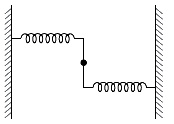
The speed of the particle that can take discrete values is proportional toJEE Advanced 2009 Easy - A uniform rod of length \(L\) and mass \(M\) is pivoted at the centre. Its two ends are attached to two springs of equal spring constants \(k\). The springs are fixed to rigid supports as shown in the figure, and rod is free to oscillate in the horizontal plane. The rod is gently pushed through a small angle \(\theta\) in one direction and released. The frequency of oscillation is
 JEE Advanced 2009 Medium